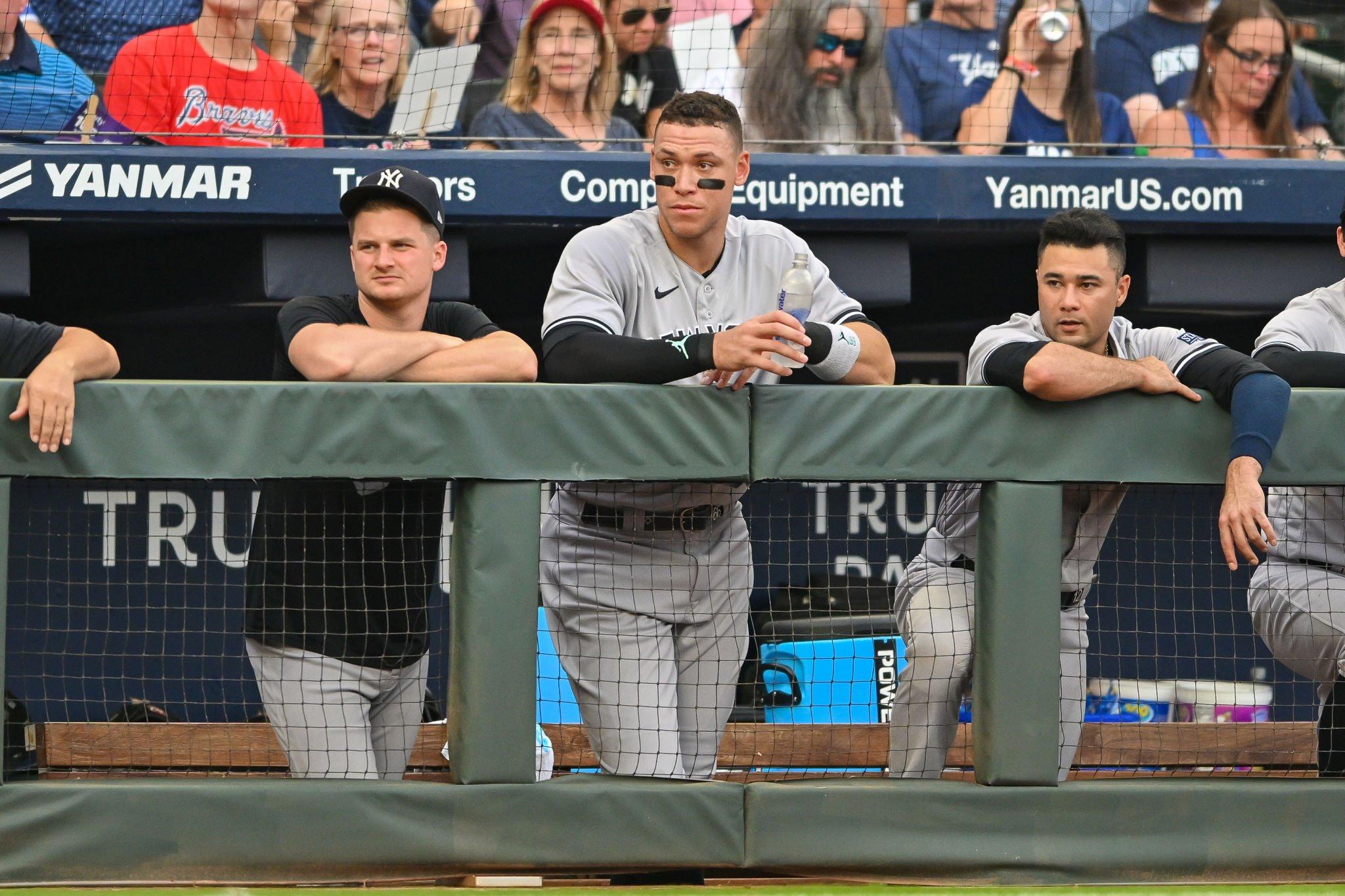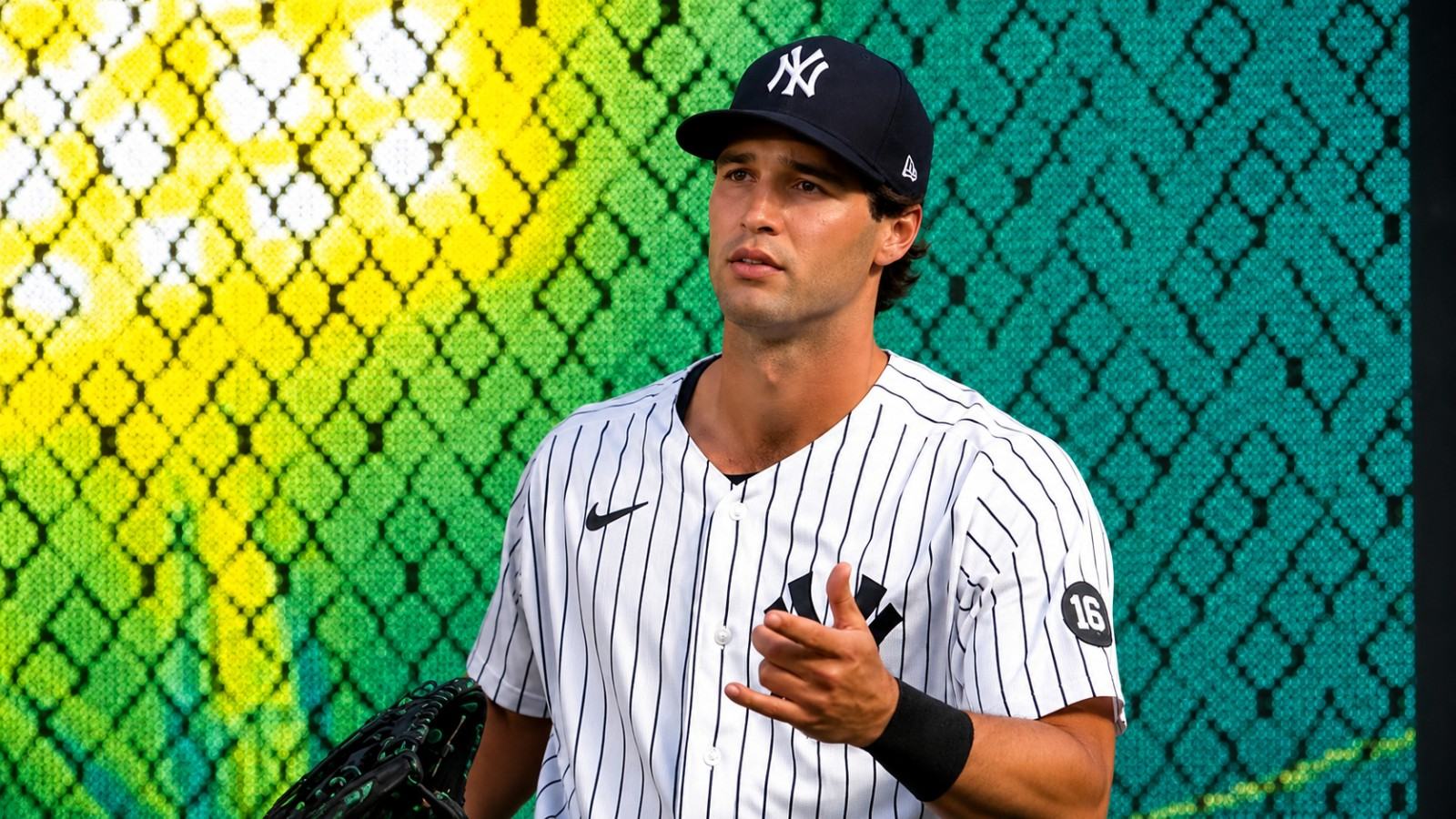
NEW YORK — A few hours before first pitch Friday, Paul O’Neill sat in the YES Network booth and tried to explain what makes Spencer Jones dangerous. He landed on the one trait scouts keep circling.
The Yankees legend pointed out that Jones was not the one-dimensional slugger his size suggests. Roughly half of the rookie’s home runs had gone the other way. O’Neill called him anything but a dead pull hitter, a hitter whose power sprays to all fields rather than depending on Yankee Stadium’s short right-field porch.
The timing turned the observation into a setup. A night earlier in Baltimore, the Yankees rookie had gone the opposite way to left-center, exactly the skill O’Neill was praising.
Then Spencer Jones went out and supplied the other half of the argument, the half O’Neill had not even needed to mention.
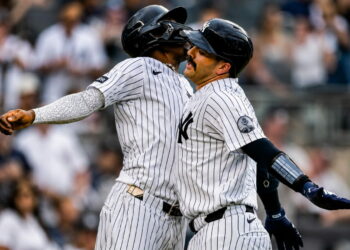
In the second inning, Jones turned on an 89-mph cutter from Toronto starter Spencer Arrighetti and drove a towering two-run homer down the right-field line. The pull-side blast gave the Yankees a 2-0 lead they never surrendered in a 3-1 win over the Blue Jays. One night after showing O’Neill’s point going one way, Jones proved the rest of it going the other.
The sequence mattered beyond the highlight. A hitter who can go the other way one night and pull a ball out the next cannot be defended with a single game plan. That is the developmental leap the Yankees have waited on.
Two nights, two directions, one point proven
The back-to-back homers were mirror images for the Yankees rookie. On Thursday in Baltimore, Jones went down and away and lifted a pitch to left-center, the opposite-field power that has followed him through the minors. On Friday, he got a pitch he could turn on and yanked it down the line to right.
The 385-foot drive to right nearly hooked foul. Jones watched, unsure, before first base umpire Dan Iassogna signaled fair. Toronto challenged, but the replay angles could not overturn the call, and it stood as his seventh home run of the season and second in as many games, and the Yankees had their lead.
The spray is the story. O’Neill had noted that pitchers were already attacking Jones up in the strike zone, the level where his long swing is toughest to keep short. Down in the zone, the analyst warned, Jones can punish anything. Both homers this week came on pitches he could extend on, and they left the yard in opposite directions.
What O’Neill said and what Jones answered with
The exchange began when YES reporter Meredith Marakovits asked O’Neill about Jones’ quick in-game adjustments, referencing the rookie’s three-hit, opposite-field night in Baltimore. O’Neill’s answer doubled as a scouting report on where Jones is, and where pitchers will try to live.
“Well, he’s getting some time now and half of his home runs have been the other way. So he’s not a dead pull hitter. He’s got so much power,” O’Neill said. “If you watch what happened, guys are throwing him up in the strike zone. That is the ball that he’s going to have to work to stay away from. I mean, when he gets the ball down, he can do a lot of things with his power.”
Aaron Boone had made a similar point a night earlier in Baltimore, after Jones’ opposite-field shot. The manager framed Jones’ power as the kind that does not need one specific part of the field.
The lefty swinger, Boone said, has the ability to “leave any part of the ballpark.”
Jones turns a quiet Yankees night into a loud statement
The homer carried extra weight because the Yankees did little else. New York managed just three runs and went 1-for-8 with runners in scoring position. Jones’ two-run swing accounted for two-thirds of the scoring and the only margin the Yankees would need.
It also extended a personal surge. Thursday’s homer snapped a 15-game stretch without one, and Jones answered immediately Friday. Since his July 26 recall, he has five home runs, all in his last 21 games, and Friday was his first back-to-back homer game. In 55 games overall, he is slashing .229/.306/.425 with seven homers, 21 RBIs and a 104 wRC+.
His natural power plays to left and left-center, the deepest, most punishing part of Yankee Stadium, the stretch fans call Death Valley. Most lefties chase the short right-field porch. Jones does not need it.
A pull-happy lefty can be neutralized on the road, where the right-field fence sits farther back. A hitter who already drives balls to left-center carries that power into every park. For the Yankees, Thursday’s opposite-field homer and Friday’s pull-side shot were, together, a two-night demonstration that Jones can hurt a pitcher anywhere on the field.
It also reframes the only real question about his profile. The concern was never the raw power. It was whether Jones could make enough contact to get to it against major league pitching. The all-fields damage is the proof the contact is catching up.
The broader backdrop sharpens the stakes. The Yankees have won five straight, their longest streak since Aaron Judge went down, and Jones has been at the center of the last two wins. He came up because Cody Bellinger got hurt. He is now making it hard for the Yankees to send him down when Bellinger returns.
Where Jones stands as Bellinger’s return nears
The roster math is closing in. Bellinger could be activated as soon as Sunday after a month out, forcing a corresponding move. Jones’ two-night power display has changed that decision from whether he can fill in to how the Yankees can justify removing him.
For now, Jones keeps hitting the ball to every field. O’Neill spent Friday afternoon explaining why that skill makes him so hard to defend. A few hours later, in the same ballpark, the Yankees rookie offered the live demonstration.
What do you think? Leave your comment below.