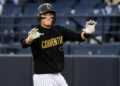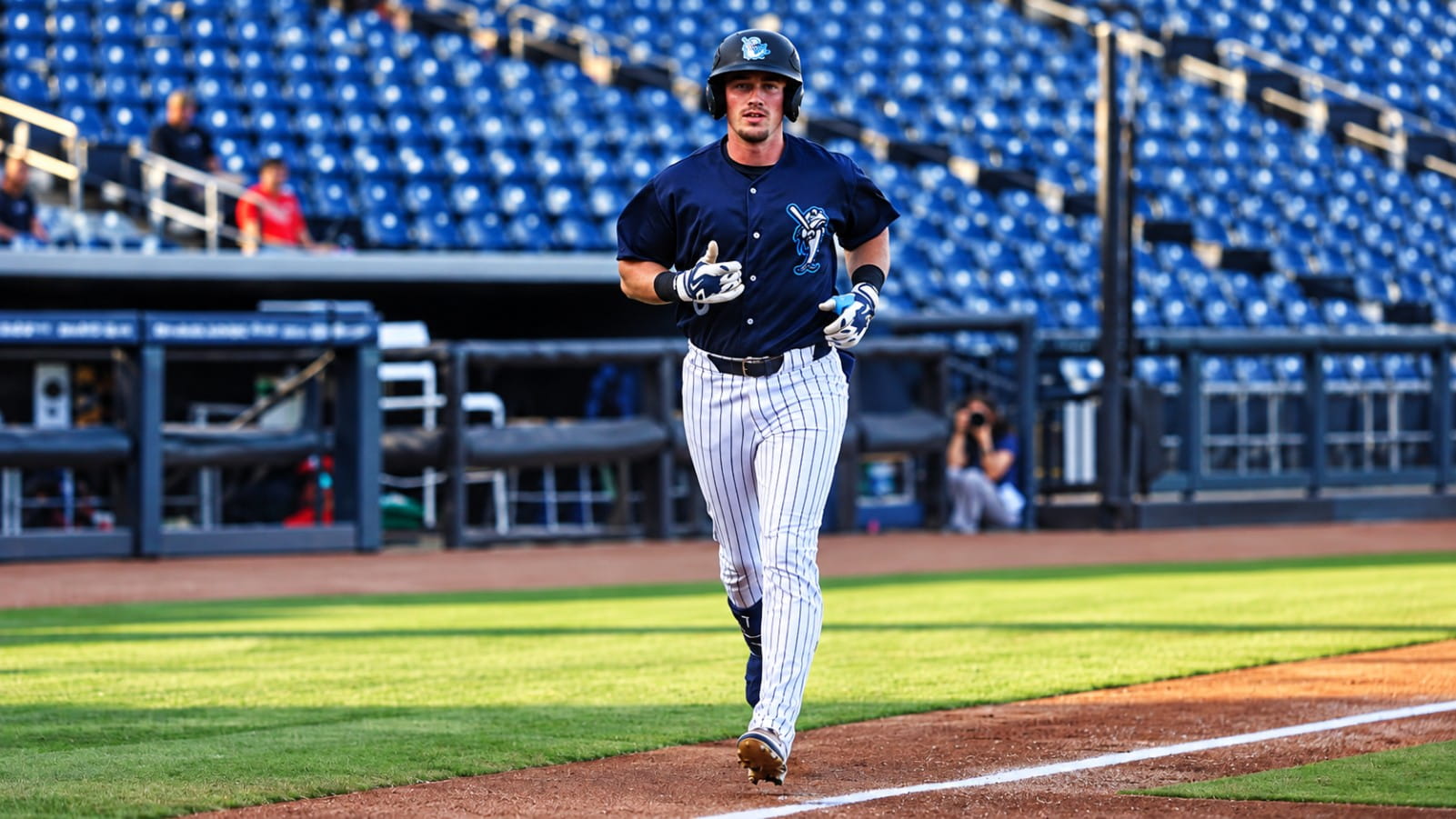
NEW YORK — The Yankees spent last summer adding a wave of young players after the draft, and Logan Maxwell looked like one of the more intriguing bets in that group.
Maxwell went undrafted after a breakout senior season at Arkansas, but the left-handed-hitting outfielder gave New York an obvious reason to take a chance. He batted .356 with a .454 on-base percentage and a .605 slugging percentage in 51 games for the Razorbacks in 2025. He hit 13 home runs, drove in 38 runs and scored 46 times. He also committed no errors in 54 defensive chances.
The Yankees signed Maxwell to a minor league contract on July 19, 2025. By the following spring, the 23-year-old was with Single-A Tampa and producing enough to make the undrafted route look promising. Across his first professional season, Maxwell hit .282 with a .386 on-base percentage and a .466 slugging percentage. He finished with five home runs, 24 RBIs, 26 runs and 10 stolen bases.
The production came in a season that rarely stayed uninterrupted. Maxwell went on Tampa’s 7-day injured list on May 11. He returned in early June after a brief Florida Complex League rehab assignment, then went back on the 7-day injured list July 7. On July 28, the Yankees transferred him to the 60-day injured list.
That left Maxwell’s debut frozen at only 30 games across two levels. Twenty-nine came with Tampa, where he hit .270 with an .839 OPS. His lone Florida Complex League game came during the rehab process. It was a tiny professional sample, but his combination of power, patience and speed gave the Yankees a developmental profile worth following into another season.
Maxwell had not yet reached the point where a conventional full-season evaluation could settle what he might become. The Yankees were still working from first-year evidence rather than a finished prospect profile.
A four-word transaction ends Maxwell’s Yankees run
The next entry in Maxwell’s record was far more final than another injured-list move.
On Sept. 3, MLB’s official Yankees transaction log listed the outfielder as retired. Maxwell was 23 and had been under contract with the organization for less than 14 months.
The transaction itself contained no explanation.
“OF Logan Maxwell retired.”
As of Saturday, there had been no public explanation from Maxwell or the Yankees detailing why he chose to step away. The timing draws attention because his only professional season included two injured-list stints, but there is no public evidence establishing that a particular injury caused the decision.
Maxwell’s retirement is abrupt. The available record does not support assigning a motive to it.
The 30-game line hides an unusual statistical detail
The Yankees did not get enough time to learn what Maxwell might become, but his final stat line explains why the exit stands out.
In 128 plate appearances, Maxwell collected 29 hits, including four doubles and five home runs. He walked 19 times, struck out 24 times and stole 10 bases in 11 attempts.
One detail gives his short debut an unusual symmetry. Maxwell finished with exactly 24 RBIs and 24 strikeouts. He paired that with a .386 on-base percentage and an .852 OPS across the Yankees’ rookie and Single-A levels.
At Tampa, Maxwell played 29 games and went 27-for-100 with five homers, 24 RBIs and nine steals. His additional rehab game in the Florida Complex League lifted the overall average to .282 and became his 30th professional appearance.
For an undrafted player, that was a credible first impression. It also makes the transaction more notable than a routine minor league roster move.
Arkansas breakout put Maxwell on Yankees’ radar
Maxwell’s path to the Yankees had been built on steady improvement.
The Lima, Ohio, product spent his first three college seasons at TCU. He hit .300 with an .878 OPS as a sophomore in 2023, then earned honorable mention All-Big 12 recognition in 2024 after batting .335 with a .447 on-base percentage.
He transferred to Arkansas for his senior season and took another step. Maxwell led the Razorbacks with a .356/.454/.605 slash line. His 13 home runs were a career high, and his grand slam against Tennessee in the NCAA Fayetteville Super Regional helped Arkansas advance to the College World Series.
Across four college seasons, Maxwell batted .316 with a .433 on-base percentage and a .487 slugging percentage in 161 games. He totaled 18 home runs, 93 RBIs and 20 stolen bases.
That body of work made him a logical post-draft target for the Yankees, who signed him less than a month after his final college season ended.
Yankees lose a low-cost development bet before Year 2
For the Yankees, the impact is not about losing a top-ranked prospect or a player close to the MLB roster. Maxwell had not advanced beyond Single-A, and his professional experience covered only 128 plate appearances.
The loss is about a development bet ending before the Yankees could properly evaluate it.
Undrafted free agents rarely arrive with the security attached to early-round picks. Their value comes from creating depth and giving player-development staffs another chance to uncover a useful major leaguer. Maxwell’s college track record and early pro production gave the Yankees something to work with.
His season also showed how quickly that path can narrow. Maxwell moved from an SEC breakout to a Yankees contract, then from a promising Single-A debut to two injured-list stints and retirement in little more than a year.
The Yankees transaction log now closes his professional record at 30 games, five home runs, 24 RBIs, 10 steals and an .852 OPS. Unless Maxwell later elects to return, that brief 2026 run will stand as the entirety of his minor league career.
What do you think? Leave your comment below.