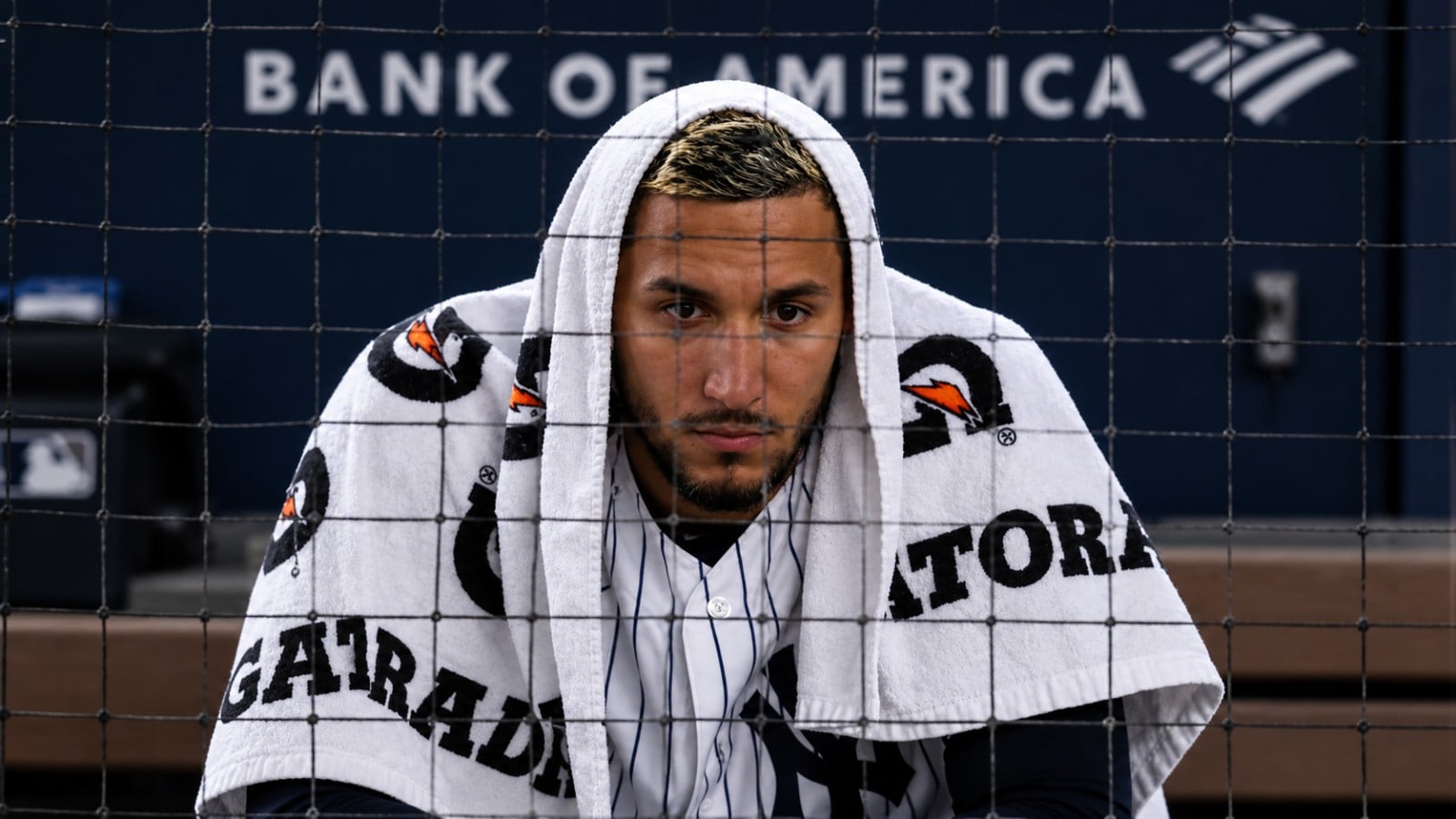
NEW YORK — The Yankees have spent two seasons turning a former division rival’s pitching prospect into one of their most valuable young arms. Now their next step is less straightforward than his rapid climb through the minors once suggested.
At 23, Elmer Rodriguez has already reached the majors. He has handled upper-level competition and given New York another homegrown option for a pitching staff that will face decisions this winter.
The club has a crowded collection of established starters. Gerrit Cole, Max Fried, Carlos Rodon and Cam Schlittler have made the route into the rotation narrow. Will Warren and Ryan Weathers add competition for innings.
That depth presents an opportunity and a complication. The Yankees can develop Rodriguez without asking him to carry a major-league workload immediately. But his first extended taste of the majors showed why a promising prospect does not automatically fit a postseason contender’s immediate plans.
The Yankees have already seen how quickly a pitching hierarchy can change. Spring projections rarely survive a full schedule without adjustments, and rotation depth matters even when the first five names appear settled. That reality makes a capable young starter valuable in his own right.
It also raises the stakes for anyone entering the organization’s next wave. A roster opportunity must be earned against major-league hitters, not just projected from prospect rankings.
Rodriguez remains at the intersection of those demands. The club must separate long-term upside from immediate utility before assigning precious pitching innings to another young arm during its next campaign.
Rodriguez’s rise began well before his debut. The Yankees acquired the Puerto Rico native from the Boston Red Sox in the December 2024 deal that sent catcher Carlos Narvaez to Boston. He responded with a standout 2025 campaign and quickly moved from promising acquisition to a significant part of the organization’s pitching pipeline.
Command trouble complicates Yankees’ plans
The concern became sharper during Rodriguez’s 2026 season. Despite posting a 2.45 ERA in 21 starts for Triple-A Scranton/Wilkes-Barre, his control deteriorated. He walked approximately 4.6 batters per nine innings and finished with a 1.31 WHIP across 106 1/3 innings.
The Yankees saw the same weakness during his six major-league starts. Rodriguez went 0-3 with a 5.40 ERA and a 1.58 WHIP over 26 2/3 innings. He walked 16 hitters and struck out 21. His 5.4 walks per nine innings exceeded his Triple-A rate.
The split between his minor-league run prevention and his major-league outings complicates three possible paths: retain him as starting depth, test him in relief or explore what he could return in a trade. None offers a simple answer for New York.
A strong Yankees Stadium outing showed his upside
Rodriguez also provided a clear reminder that his development has not been a straight decline. Against the Houston Astros on Aug. 26 at Yankee Stadium, he allowed three runs on three hits in six innings, struck out six and walked two. New York won 9-3 after a four-run seventh inning.
Cody Bellinger delivered a decisive bases-loaded double, and the Yankees received additional run-scoring hits from Spencer Jones and Jazz Chisholm Jr. The rookie’s start gave the offense time to take control.
After the game, Rodriguez described a more confident approach and the work he had been doing between major-league assignments.
“It was just trusting myself,” Rodriguez said. “It’s something that I’ve been building up since my first couple of starts, and so each time I’ve felt better. I’ve been working on some stuff down there [in the Minors], and I feel like it’s been working so far.”
That performance stood apart from his other starts. Five days later, he lasted 3 2/3 innings against the Los Angeles Angels, allowing four earned runs and walking three in a 10-1 Yankees loss. The contrast illustrated how quickly his effectiveness could change when baserunners accumulated.
The walk-rate gap reveals a different problem than his ERA
A closer look at the numbers shows why the Yankees cannot judge Rodriguez by ERA alone. In 2025, he struck out 176 batters and walked 57 across 150 minor-league innings, a strikeout-to-walk ratio of 3.09. His 2026 MLB ratio fell to 1.31, based on 21 strikeouts and 16 walks.
That is a substantial decline in his ability to separate strikeouts from free passes. The major-league sample was only 26 2/3 innings, but the parallel rise in Triple-A walks makes it harder to dismiss as an isolated adjustment period.
Rodriguez allowed only two homers in six major-league starts. His bigger problem was the traffic created by walks.
The Yankees have invested considerable development time in the right-hander. Their 2025 return included an 11-8 record, a 2.58 ERA and 176 strikeouts across High-A Hudson Valley, Double-A Somerset and a brief Triple-A stint. That track record remains part of his value.
Roster flexibility becomes an offseason consideration
Added to the Yankees‘ 40-man roster in November 2025, Rodriguez was recalled and optioned repeatedly in 2026. He returned in late September, reinforcing his role as rotation depth.
The Yankees also must decide whether a bullpen assignment would accelerate his contribution. Shorter appearances could change how his pitches play, but the walk totals make high-leverage relief a difficult assignment without improved strike throwing.
As of Oct. 29, Rodriguez remains in the Yankees organization, and his next role has not been established. The offseason decision centers on whether New York values his remaining development runway more than the immediate roster help it might obtain by changing his assignment or moving him.
What do you think? Leave your comment below.