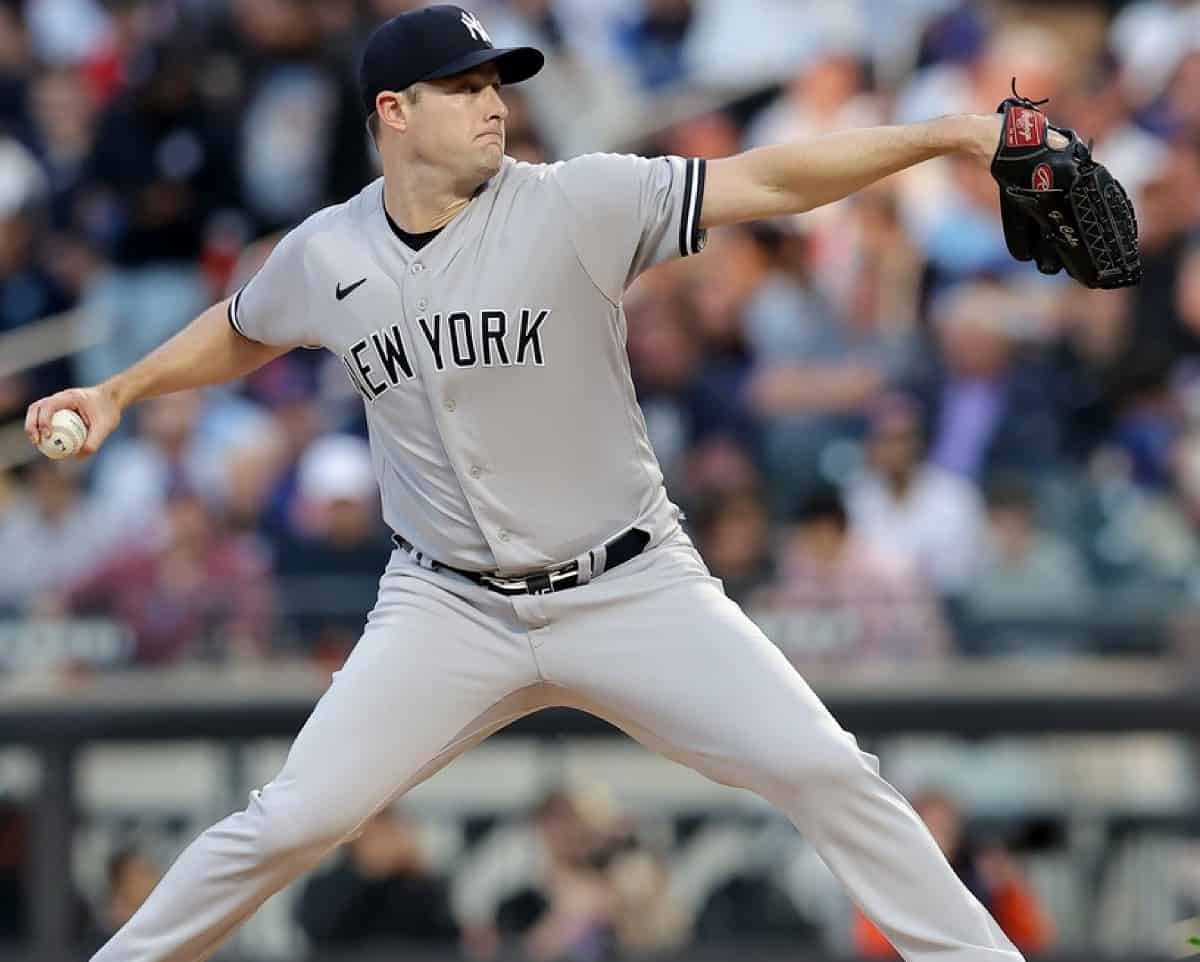
NEW YORK — It was just another chilly May night in the Bronx, but the tension on the mound was unmistakable. Clarke Schmidt took the ball against the Cleveland Guardians and surrendered three quick runs before recording an out.
The New York Yankees’ bats never recovered in what became a lifeless 4-0 loss. But the final score was only part of the story. The deeper question, echoing throughout Yankee Stadium and into front offices across baseball: Is Clarke Schmidt about to follow the Jordan Montgomery path — from Yankees’ uncertainty to someone else’s postseason weapon?
A familiar pattern: Solid but expendable arm

Schmidt’s 2025 line through nine starts might look serviceable on the surface — a 4.04 ERA, 50 strikeouts over 49 innings. But zoom in closer, and warning signs emerge. His sinker — a key pitch in his arsenal — has been torched to the tune of a .471 batting average against and a staggering .941 slugging percentage. Those are not typos. Those are alarm bells.
“I’ve never seen a number that high on a single pitch,” said podcast analyst Gary Sheffield Jr. during a recent episode of Yankees Unloaded.
This isn’t a one-game concern. The trend has lingered. Schmidt’s cutter hasn’t fared much better either, allowing a .271 average and a .424 slugging mark. In a rotation backed by one of the sport’s most expensive payrolls, the Yankees need more than flashes. They need October dependability.
Jake Ellenbogen, co-host of Yankees Unloaded, put it bluntly: “Right now, the Yankees are asking a No. 5 to be a No. 3. And that’s not sustainable.”
Echoes of 2022: The Montgomery parallel
The parallels to Jordan Montgomery are impossible to ignore. In 2022, the Yankees soured on Montgomery’s postseason value and dealt him to the Cardinals at the deadline. The lefty went on to thrive, even starting pivotal playoff games for Texas in their 2023 World Series run.
Montgomery was considered solid but not playoff material. The Yankees made a calculated move based on trust, or lack thereof. Today, Schmidt appears to be on a similar trajectory.
“They didn’t trust him to pitch in the postseason,” Sheffield noted. “Why would they trust Schmidt now, especially with a deeper, more desperate playoff push in 2025?”
What comes next: Trade chips and targets
The Yankees’ rotation, once thought to be a fortress, has sprung leaks. Gerrit Cole remains the ace. But Carlos Rodon’s inconsistency, Luis Gil’s IL stint, and overburdening Max Fried have forced Schmidt into a higher-leverage role. The result? Unease.
That’s where the trade market looms.
Freddy Peralta of the Brewers is a name gaining traction. With a 2.92 ERA and 75 strikeouts in 13 starts, Peralta checks multiple boxes — swing-and-miss stuff, durability, and team control beyond 2025.
“I think they trade Schmidt and Spencer Jones for Freddy Peralta,” said Ellenbogen, floating a package that could turn heads at the deadline.
Other targets include Arizona’s Merrill Kelly and possibly even Mason Miller from the Athletics. While Zac Gallen’s name gets mentioned, his contract year makes him a costly and uncertain rental. Miller, despite a down year, still possesses electric upside and is under team control through 2029.
“If Miller can’t be fixed by Matt Blake, no one can,” Sheffield added, referring to the Yankees’ revered pitching coach.
Deadline decisions: Gamble or cut bait?
For Yankees GM Brian Cashman, the calculus is clear. The franchise isn’t building for 2026 — they’re all in for 2025. That means every roster spot must scream October readiness. Clarke Schmidt, despite his talent, may not meet that bar.
He’s 29. This isn’t about development anymore.
“This is who he is,” Sheffield said. “Good arm, good guy, but not someone you want on the mound when the season’s on the line.”
His high whiff rate (28.6%) shows promise, but the contact damage is devastating. And that’s a fatal flaw come October, when games are decided on inches and execution. A sinker getting torched and a cutter that’s too predictable make Schmidt a postseason risk.

Still, his value isn’t zero. There are teams across the league desperate for a middle-of-the-rotation starter with cost control and some upside. His mid-3s ERA and strikeout totals would draw suitors, especially if the Yankees pair him with a top prospect like Spencer Jones.
BaseballTradeValues.com places Mason Miller’s value at 31.2 — similar to the Yankees’ George Lombard Jr. A Schmidt-plus-prospect deal could unlock a high-upside arm without overpaying.
Will Cashman break history?
Last season, the Yankees stood pat at the deadline. That hesitation cost them. Fans haven’t forgotten, and neither has ownership. Cashman won’t be allowed to make the same mistake twice.
With the AL East tighter than ever and the Orioles and Blue Jays charging hard, the Yankees can’t afford “maybes” in the rotation. They need rock-solid October options. And right now, Schmidt doesn’t project as that guy.
The question becomes: Does Cashman cut bait now, or hold and hope?
If history is any guide, the smart move is proactive. Trade Schmidt while his value holds. Don’t wait for the postseason lights to expose his flaws — again. And don’t let another Montgomery situation unfold.
Not ruled out: Trade likely
The Yankees’ front office operates with a clear mandate: win now. There’s little tolerance for waiting on upside when the present demands certainty. If a deal for Peralta or Miller materializes, expect Schmidt to be included.
Ellenbogen summarized it best: “You don’t win playoff games with questions. You win them with answers.”
For Clarke Schmidt, the writing may be on the wall. And for Yankees fans, the next chapter may feel all too familiar.
With the trade deadline just weeks away, the Yankees must decide whether Schmidt remains part of the plan or becomes a chip in a bigger one. For now, all eyes are on the Bronx — and the clock is ticking.
What do you think? Leave your comment below.