NEW YORK — Aaron Judge called for the Yankees to match his championship ambitions after their latest October exit. Five weeks later, the roster still has vacancies across several crucial areas, and general manager Brian Cashman has identified one problem that takes priority over the rest.
The Yankees must replace important late-inning pitchers, confront an unsettled infield and find a way to prevent their offense from disappearing when the postseason arrives. Those demands are competing for attention as free agency begins.
New York has not won a World Series since 2009. Judge, who turns 35 in April, has five seasons remaining on the nine-year, $360 million contract he signed to stay in the Bronx. Another winter devoted to repairing existing weaknesses raises the stakes for the captain.
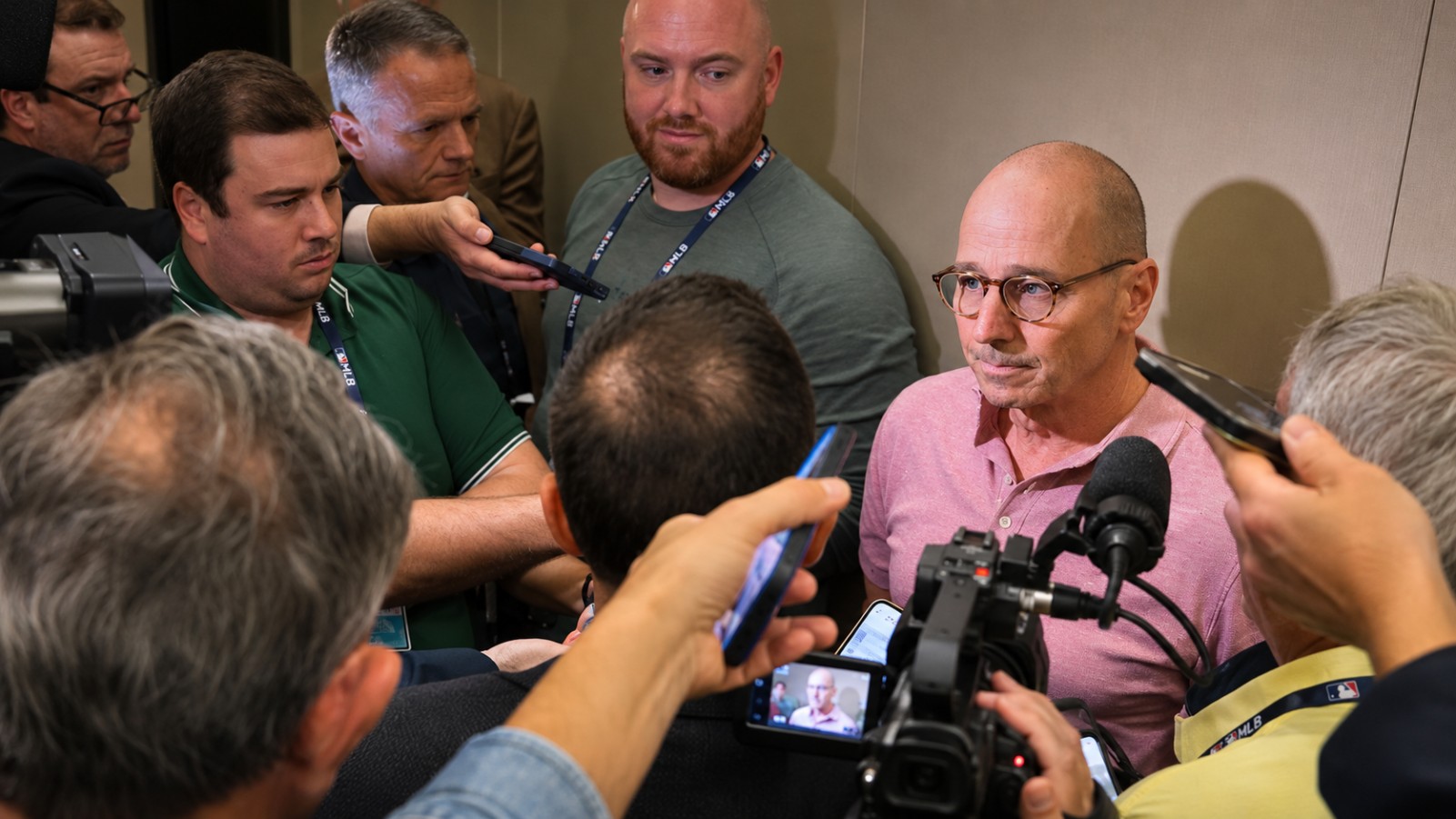
Cashman made the size of the pitching problem unmistakable Wednesday while speaking with Jim Bowden and Jim Duquette on SiriusXM MLB Network Radio.
“What bullpen?” Cashman said. “I don’t have one now. I’ve got to figure it out.”
Cashman reveals top winter priority and it stings
The Yankees have several relievers on the open market, including David Bednar, Paul Blackburn, Tim Hill, Ryan Yarbrough, John Schreiber and Michael Fulmer. Left-hander Brent Headrick remains under team control, while Fernando Cruz faces uncertainty after a partially torn ulnar collateral ligament.
Bednar has until Nov. 17 to decide whether to accept a $23.15 million qualifying offer. Until then, the Yankees cannot count on having their closer for 2027. Blackburn and Hill also supplied important late-inning work last season.
Cashman explained why the front office is searching broadly, even as dependable high-leverage options remain hard to acquire.
“It’s our main priority, to be quite honest, obviously, with the vacancies currently,” Cashman said on the radio show. “Bednar is sitting on a qualifying offer, but he’s still a free agent, so he’s not ours.”
The problem extends beyond retaining one closer. Cashman must rebuild the bridge to the ninth inning, determine which internal arms can handle more responsibility and decide how aggressively to pursue proven bullpen help through trades.
Aaron Judge already told Yankees ownership what he expects
Judge delivered his message Oct. 8 after Tampa Bay completed a three-game American League Division Series sweep with a 4-3 victory at Yankee Stadium. A calf injury kept the Yankees captain out of the postseason, leaving him unable to help as New York was eliminated.
His response was aimed at the people responsible for the roster, not merely the players who finished the series.
“We’re the Yankees,” Judge said. “I feel like they should go all in and do what they need to do and find. If we’ve got holes, if it’s finding certain players or personnel, whatever we need, you’ve got to go out there and get it.”
Judge also made clear that reaching the playoffs is not the standard he signed up to defend. Cashman’s bullpen assessment now illustrates how many roster decisions stand between that demand and a more complete team.
Owner Hal Steinbrenner has defended the club’s willingness to spend, pointing to Cody Bellinger’s six-year, $162.5 million agreement last winter. But a major investment in one position does not resolve needs elsewhere.
Second and third base part of same championship equation
Jazz Chisholm Jr.’s free agency leaves the Yankees without a settled everyday second baseman. At third, Ryan McMahon’s offensive struggles have prompted questions about whether New York should seek another bat rather than commit to the same arrangement.
Those are different problems from bullpen construction, but they are not less relevant to the Yankees’ postseason chances. Cashman also faces choices at center field, where the organization has considered internal prospects and external coverage.
The offense ranked eighth in the majors in runs per game and 11th in OPS during 2026, according to the season-ending figures cited during the general managers’ meetings. That overall production did not carry into the division series, where the Yankees were swept by the Rays.
The important distinction is between restoring regular-season depth and building a lineup capable of surviving October pitching. Judge’s return would provide a major lift, but the Yankees have already acknowledged that one hitter cannot address every weakness.
A thin relief market could force an expensive Yankees decision
The free-agent calendar adds another complication. Cashman has said that reliable late-inning relievers are scarce, and bidding for established pitchers could consume resources that New York might otherwise direct toward the infield or additional offense.
Bednar presents the immediate test. The Yankees have rarely made major multiyear commitments to relievers in recent seasons, but Cashman said at the general managers’ meetings that he is open to an exception when the price and player make sense.
“I’ve done it before, I’m not afraid to do it,” Cashman said when asked about paying heavily for a relief pitcher.
The financial comparison is significant. Bednar’s qualifying offer alone is worth $23.15 million for one season. Securing him on a longer deal, then adding setup options, would require a broader investment before the Yankees address every remaining position-player question.
The Yankees also face a possible labor shutdown after the collective bargaining agreement expires Dec. 1. Bednar’s Nov. 17 decision therefore arrives as an early measure of how quickly the front office can move.
For Judge, the unsettled roster is the central issue. Cashman has identified the bullpen as the Yankees’ most urgent repair, but the captain’s championship demand also puts the lineup, infield and the allocation of resources under scrutiny heading into 2027.
What do you think? Leave your comment below.