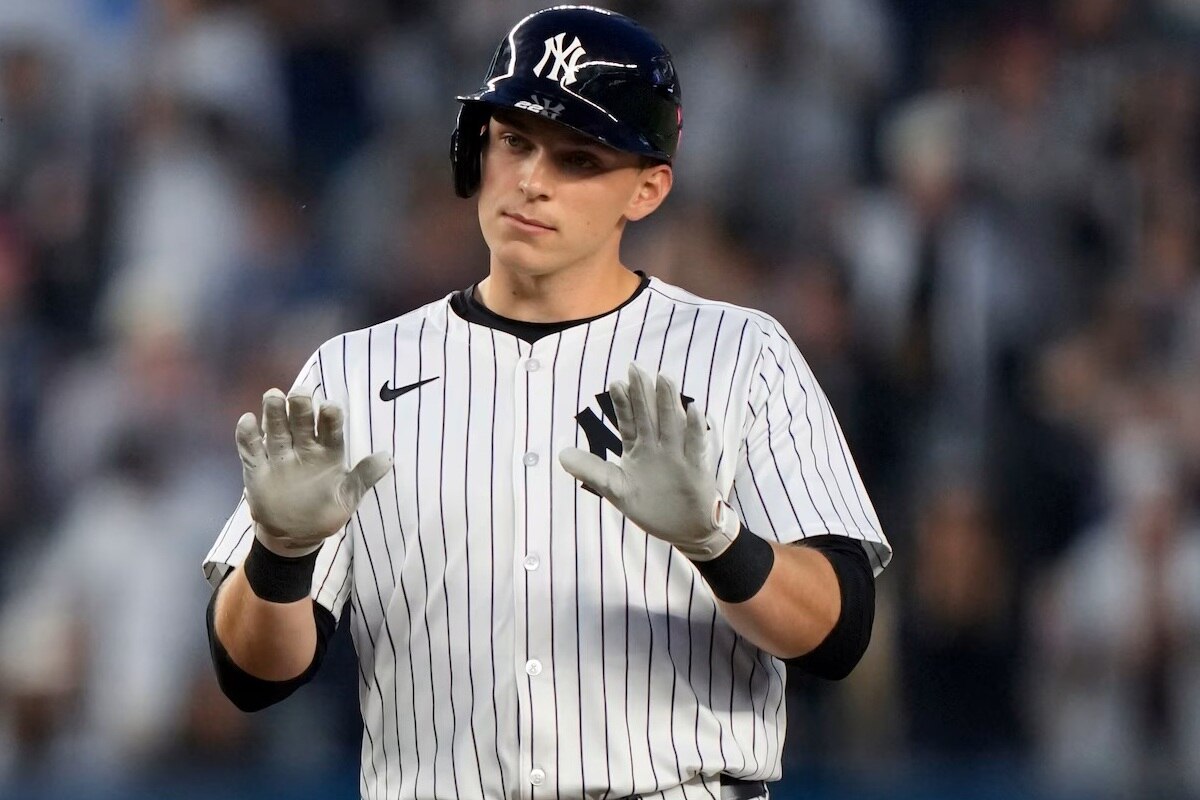
NEW YORK — Ben Rice is already one of the best hitters in baseball. The wild part is that the Yankees could squeeze even more value out of him with a single, bold decision.
That move would be putting Rice back behind the plate. It is an idea that keeps surfacing around the team, and for good reason, even if manager Aaron Boone keeps it on the back burner for now.
The logic is simple. Catching Rice unlocks the Yankees’ most dangerous lineup. The complications, though, are anything but simple.
A logjam on the horizon
The conversation starts with a roster math problem for the Yankees. When everyone is healthy, they cannot fit all their best bats into the lineup at once.
Giancarlo Stanton is working his way back from a calf injury, and his return creates a crunch. With Stanton at designated hitter and Paul Goldschmidt at first base, there is suddenly no room for Rice, unless he moves.
That is what makes the catcher idea so appealing. Rice behind the plate is the only alignment that lets Stanton, Goldschmidt, and Rice all play on the same day.
The catching hole the Yankees can’t ignore
The other half of the equation is a glaring weakness for the Yankees. Their catchers have been among the least productive in all of baseball.
Entering the recent stretch, Yankees backstops ranked at or near the bottom of the majors in offense, with a combined OPS hovering around .526, second-lowest in the sport. Austin Wells, the primary catcher, has scuffled badly at the plate with an OPS in the low .500s.
The situation grew more urgent when Wells landed on the injured list with cervical headaches, forcing a shuffle of backups like J.C. Escarra and Ali Sanchez. None of those options have hit, leaving an obvious void in the order.
With Aaron Judge already sidelined for weeks by a fractured rib, the Yankees can ill afford another empty spot in the batting order.
Just how good Rice has been
To understand the temptation, you have to appreciate Rice’s season for the Yankees. He has been nothing short of spectacular.
Rice has been hitting .293 with a .998 OPS, which ranked second in the majors, and his 19 home runs lead the team. He has also paced the American League in extra-base hits while ranking among the leaders in OPS and homers.
He has done all of this while bouncing between first base and designated hitter, starting 37 games at first and 24 at DH. Plugging that bat into the catcher position, where the Yankees get almost nothing offensively, would be a dramatic upgrade.
Boone weighs the temptation

Boone has not dismissed the idea, but he has not embraced it either for the Yankees. He acknowledges the appeal while stressing the caution required.
The manager has called the possibility tempting, given how little the catcher spot produces. Still, he keeps returning to what Rice means to the heart of the order, and the risk of disrupting that.
“Obviously he’s so important to our lineup,” Boone said. “You start ramping him up in a demanding position.”
Asked directly whether it was part of the plan, Boone left the door open without committing.
“Not yet,” Boone said. “We talk about it a lot. That’s not in the plans right now, but we’ll see.”
The risks behind the reward
Here is why the Yankees keep hesitating. Catching is the most physically taxing job on the field, and the downside is significant.
Building Rice back up to catch would be a gradual process, not an overnight switch into nine-inning games. It would also expose him to greater injury risk and wear that could sap the very offense that makes him so valuable.
There is also the matter of defense and game-calling. Wells is an elite framer, ranking in the 93rd percentile with plus-four framing runs, while Rice graded poorly behind the plate in a small sample last season with minus-one framing runs.
Wells has also drawn praise for steering a starting rotation that owns one of the lowest ERAs in baseball. Handing the primary game-calling duties to Rice, who has not done it all year, could throw a strength into flux.
A bat that belongs behind the plate’s debate
None of the hesitation changes Rice’s own feelings about the position for the Yankees. He came up as a catcher and still embraces the craft.
Rice has been catching occasional bullpen sessions and sitting in on game-planning meetings with the other catchers, staying connected to the role even without playing it. He has made clear he would welcome the work.
“I love catching,” Rice said. “Right now, it hasn’t been in the equation as much. With that being said, I always appreciate the position so much. That’s why I still enjoy sitting in on the meetings and talking with our catchers about game planning.”
Last season offered a glimpse that he can handle it, as Rice hit .221 with a .537 slugging mark and six homers across 29 games behind the plate. The question is whether his current elite production would survive the move.
A decision with no easy answer
For now, the Yankees appear content to wait and see. With Stanton hitting a calf setback, Rice and Goldschmidt have more runway to play daily without forcing the issue.
The team also seems inclined to make do with its internal catching options before potentially pursuing an upgrade at the trade deadline. That buys time to decide whether the risk is worth the reward.
But the core truth remains. If Boone eventually makes the change, the Yankees would be able to field their most potent lineup, with three premium bats in the order at the same time. It is a high-ceiling gamble that could define their summer. Rice has already raised expectations with his bat. Putting on the gear might just raise the Yankees’ ceiling even higher.
What do you think? Leave your comment below.