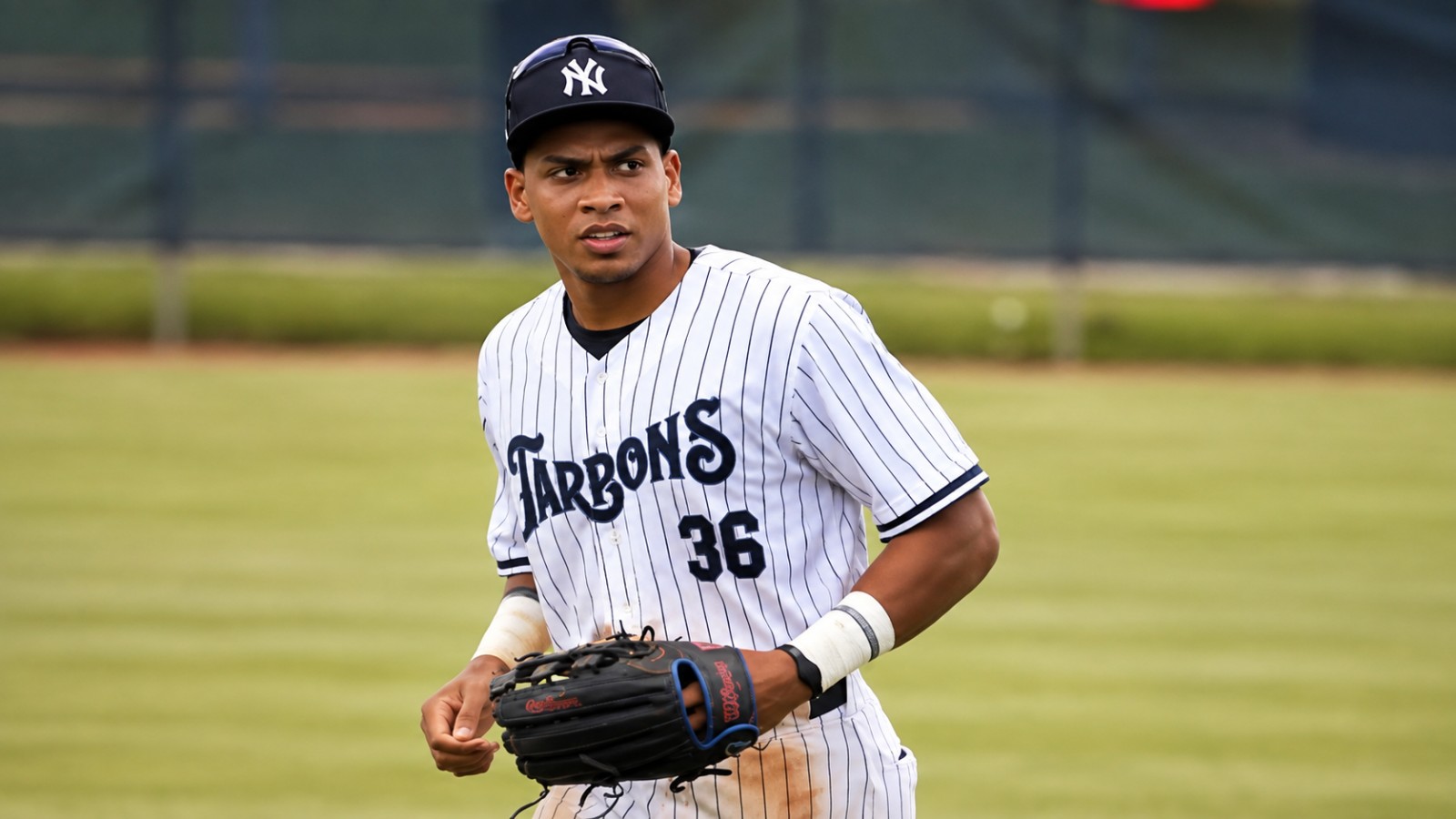
TAMPA, Fla. — The Yankees did not need Yostin Pena to become a top prospect when they signed him late last year. They needed the gamble to make sense.
At the time, almost nothing about Pena’s route into professional baseball looked routine. The Dominican outfielder had already appeared on MLB’s 2025 international signing list with the St. Louis Cardinals. He did not play for them. Months later, his name resurfaced in the Yankees organization with a different contract and a cloud of unanswered questions around the collapse of the original deal.
That made Pena less like a conventional international signing and more like a second-chance evaluation. New York was taking on a player whose first agreement had disappeared before his professional career started. The Yankees also were doing it at a moment when their international scouting operation was under scrutiny and undergoing leadership changes.
Ten months later, the uncertainty has been replaced by production. Pena has gone from an unheralded late addition to one of the fastest-rising young hitters in the Yankees farm system, forcing his way from the Dominican Summer League directly into Single-A Tampa before his 19th birthday.
Only now does the unusual financial detail begin to stand out. St. Louis had listed Pena at a $300,000 signing bonus in January 2025. The Yankees later signed him for a reported $350,000, effectively paying $50,000 more for a player whose first deal never turned into a Cardinals career.
Gamble starts to look very different
Pena, 18, has hit .367 with a .432 on-base percentage and .633 slugging percentage across 51 professional games this season. He has 12 home runs, 76 RBIs and 31 stolen bases in 241 plate appearances, good for a 1.065 OPS.
The performance has survived a major jump in competition.
The Yankees moved Pena out of the Dominican Summer League after only 37 games. His transaction log briefly routed him through the Florida Complex League before Tampa received him the next day, but he never needed a developmental stop there. The practical result was a rare jump from rookie ball in the Dominican Republic straight into full-season Single-A.
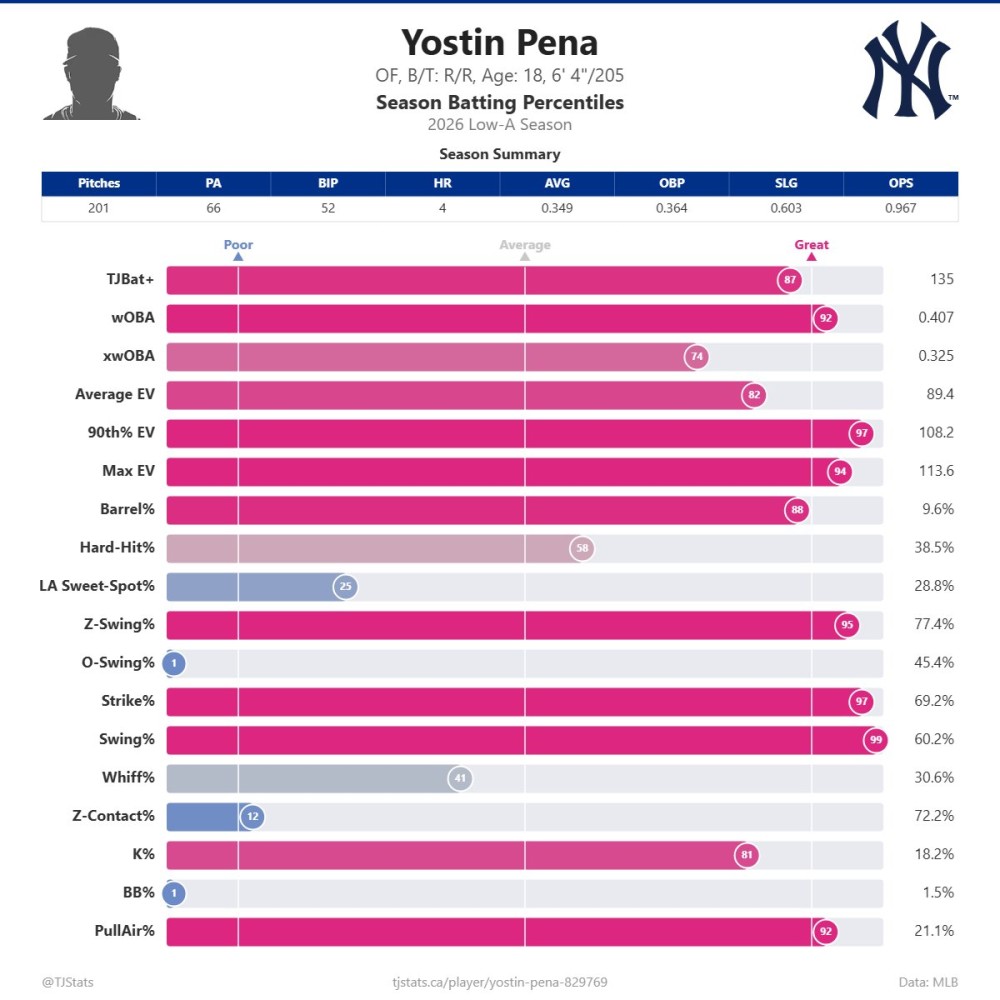
Pena has responded by hitting .349/.364/.603 in his first 14 games with Tampa. He has four home runs and 19 RBIs in 66 plate appearances at the level, along with four stolen bases and a 143 wRC+.
His latest surge has included some loud performances. Pena went 4-for-6 with a home run and five RBIs in a 15-3 Tampa win over Dunedin on Aug. 20. Two days later, he homered twice and drove in six runs as the Tarpons beat Daytona 11-0.
The Cardinals chapter remains murky
The reason Pena became available to the Yankees is less clear than the reason they are excited about him now.
MLB’s official international signing coverage listed the Cardinals as signing Pena for $300,000 in January 2025. Yet he never appeared in a professional game for St. Louis, and his official transaction history now shows his first completed professional transaction with the Yankees on Dec. 1, 2025.
Reports around the canceled Cardinals agreement cited age or documentation concerns. Sports Illustrated reported that no official reason for the deal’s failure had been made public. There is no publicly available MLB or Cardinals statement confirming that an investigation formally declared Pena’s identity indeterminate.
That distinction matters. The circumstances around his first agreement were unusual, but the public record does not support turning unanswered questions into a definitive accusation.
What is established is that New York stepped in after the St. Louis arrangement disappeared, committed a reported $350,000 and put Pena into its system.
The power is becoming impossible to dismiss
The most compelling part of Pena’s rise is not simply the slash line.
Baseball America now ranks Pena as the Yankees’ No. 10 prospect and gives his raw power a 70 grade on the traditional 20-to-80 scouting scale. Its broader scouting data measured his 90th-percentile exit velocity at 107.9 mph and his maximum at 115.1 mph, while his Low-A-only tracking line sits at 108.2 mph and 113.6 mph, respectively.
Those numbers are extreme for an 18-year-old.
Low-A data exposes the upside and the risk
The underlying Low-A numbers make Pena’s power case even harder to ignore. Through 66 plate appearances with Tampa, he has a .407 wOBA and a .325 expected wOBA. His average exit velocity is 89.4 mph, which places him in the 82nd percentile for the level, while his 108.2 mph 90th-percentile exit velocity ranks in the 97th percentile.
His hardest Low-A contact has reached 113.6 mph, a 94th-percentile mark, and his 9.6% barrel rate sits in the 88th percentile. His 21.1% pull-air rate is in the 92nd percentile. Those figures help explain why the Yankees see impact power beyond the four home runs he has already produced in Tampa.
The same tracking data also shows why Pena remains a developmental bet rather than a finished hitter. His 60.2% swing rate is in the 99th percentile, while his 45.4% chase rate sits at the bottom of the scale. His zone-contact rate is 72.2%, his walk rate is only 1.5% and his whiff rate is 30.6%. He attacks strikes aggressively, but advanced pitchers will test whether he can stop expanding the zone when they refuse to challenge him.
That aggressive profile is the central question attached to the breakout. Pena has walked only once in his first 66 plate appearances for Tampa, compared with 12 strikeouts. Baseball America’s scouting report similarly questions how much his hit tool will develop as he climbs and faces pitchers capable of exploiting chase tendencies.
That is the developmental question the Yankees now have to answer. The power already looks real. The speed has been productive. His physicality at 1.93 meters and 93 kilograms gives him the frame of a much older player. The next test is whether advanced pitching can force enough weak contact and bad decisions to separate the raw tools from the results.
A $50,000 difference now looks small
International bonuses in this range do not usually command attention on their own. The Yankees routinely spend far more on premium amateur talent.
But Pena’s case is different because New York did not simply identify a low-cost player before everyone else. The Yankees acted after another organization had already agreed to sign him, after that agreement vanished and after questions followed him into the market.
The return so far has been striking.
Pena has driven in 76 runs in 51 games, an average of nearly 1.5 RBIs per game. He has produced 27 extra-base hits and stolen 31 bases. He earned a Dominican Summer League All-Star selection, then forced a stateside promotion that skipped the normal rookie-level progression.
Baseball America has not elevated Pena to the top of the Yankees system. Its latest ranking places him No. 10, not No. 1. But his 70-grade power and rapid adjustment to Single-A have already moved him from obscurity into a legitimate prospect conversation.
The Yankees paid a reported $50,000 more than the bonus attached to his failed Cardinals agreement. Less than a year later, that small difference has become one of the more intriguing bets in the organization.
For a player whose professional career began with uncertainty, Pena is starting to give the Yankees something much more concrete: production that keeps demanding a higher level.
What do you think? Leave your comment below.