SCOTTSDALE, Ariz. — A young Yankees hitter arrived in the desert with a swing that already produced strong contact numbers. Within days, the mechanics that helped Dax Kilby reach base consistently were changing in a way that could alter his power ceiling.
The experiment carried unusual risk. The prospect had barely played during an injury-interrupted season, yet New York’s development staff wanted Kilby to make a major adjustment while facing more advanced competition in the Arizona Fall League.
The early returns have been difficult to ignore. A previously ground-ball-heavy approach has given way to a run of extra-base hits, and the Yankees are getting a live-game look at whether a contact-oriented hitter can add damage without giving up his strengths.
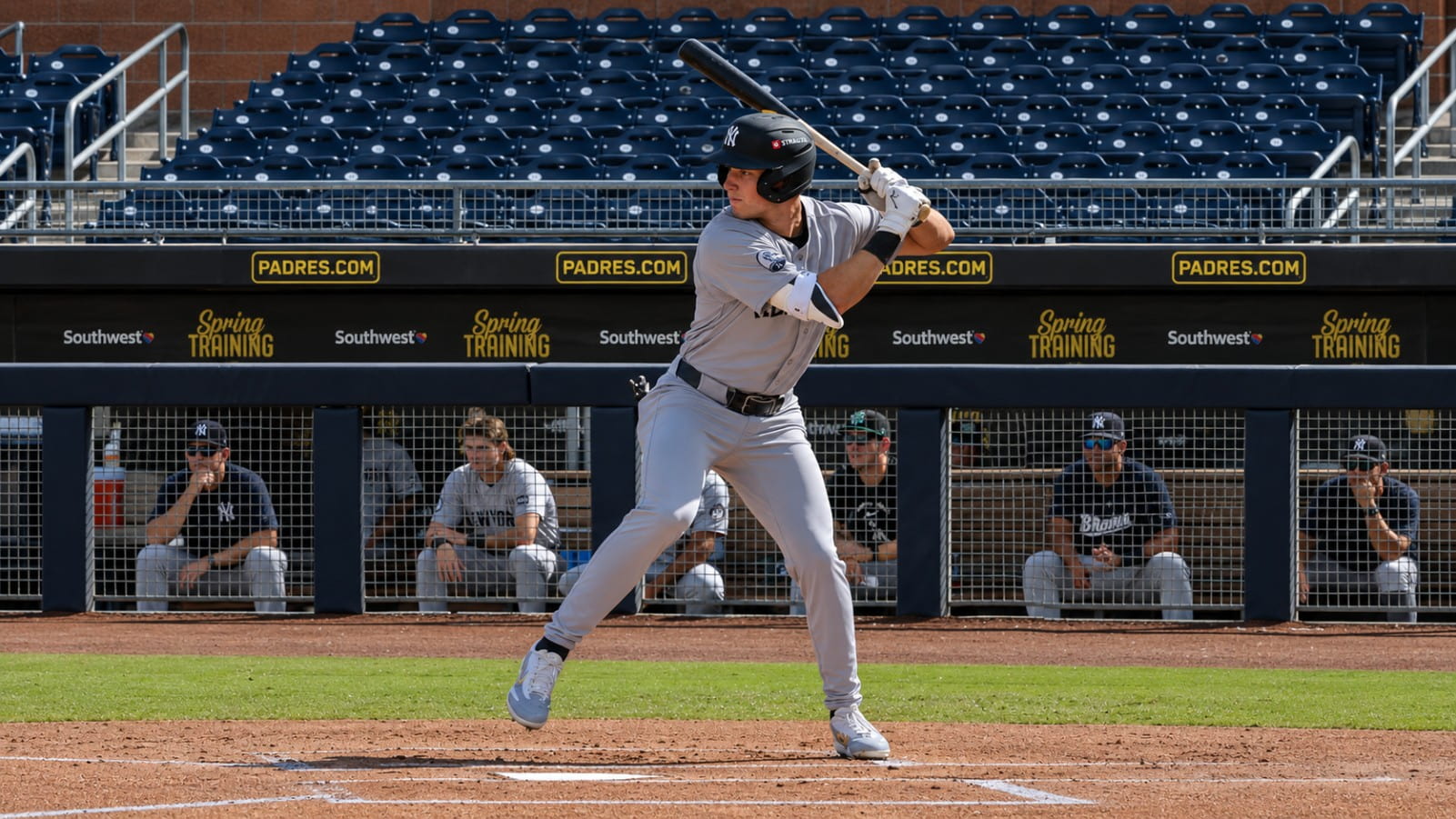
Kilby is 19-year-old shortstop and the Yankees’ top prospect. His new stance took shape in approximately one week of work with the organization’s hitting staff before he joined the Salt River Rafters, and his performance has earned him a spot in Sunday’s Fall Stars Game.
One week of work produces a different look
Kilby reported to the Yankees’ Tampa complex in late September and worked with hitting director Jarret DeHart and other player-development staff. The change was not designed to replace his natural bat path. It was intended to improve his balance, control of his forward movement and ability to drive the baseball in the air.
Previously, the left-handed hitter began from a wide, closed stance. He now starts narrower and more open, giving his hips room to rotate and allowing him to use his legs more effectively. Yankees instructors believed he had been making contact too deep in the hitting zone, turning potentially damaging swings into grounders.
FanGraphs measured Kilby’s ground-ball rate at 40.2% during the 2026 minor league season. The adjustment aimed to increase lift without taking away the bat-to-ball skill that helped him draw 39 walks against 31 strikeouts in 32 games at Single-A Tampa.
DeHart did not expect the adjustment to work so quickly. Asked about the immediate results, the Yankees hitting director acknowledged the unexpected speed of the transition.
“Yeah, I was surprised,” DeHart said.
Fall League production supplies immediate evidence
Through his first 15 games in Arizona, Kilby hit .295 with a .357 on-base percentage and .623 slugging percentage. His 18 hits included two home runs, six doubles and four triples, giving him 12 extra-base hits and a .980 OPS.
Those figures establish an especially striking split: two-thirds of Kilby’s hits went for extra bases. The Yankees also have harder-contact data behind the conventional numbers. He recorded a 45.3% hard-hit rate, with a top exit velocity of 109.8 mph, according to MLB’s Fall League reporting.
The strong contact is not coming at the expense of every other part of his game. Kilby had six walks, nine strikeouts and five stolen bases in those 15 games. His three sprint-speed ‘bolts’ ranked second among Salt River players, providing another reminder that his profile involves more than power.
A separate October 20 highlight showed the Yankees shortstop driving a leadoff home run at 107.1 mph. The shot came during his early run of extra-base production and supplied an example of how quickly the revised setup was translating against live pitching.
Why the change matters more than a hot streak
Kilby’s professional baseline helps explain the significance. The Yankees selected him 39th overall in the 2025 draft and signed him for $2,797,500. He entered the Fall League ranked No. 78 on MLB Pipeline’s Top 100 Prospects list, with his contact skill and strike-zone judgment already regarded as major strengths.
His 2026 season offered limited opportunity to test those tools. Hamstring injuries cost him two months, then another six weeks after he returned May 28 and took just two at-bats. He played 36 games overall, including 32 with Single-A Tampa, where he posted an .883 OPS. Yet his 24.4% walk rate led Yankees minor leaguers with at least 160 plate appearances, and his swing-and-miss rate was 9%.
There is a measurable difference between a hitter simply putting balls in play and one turning the same contact ability into extra bases. The Yankees do not need Kilby to become a high-strikeout slugger for the mechanical work to matter. More airborne contact, paired with his existing on-base skills, could substantially raise his offensive value as he advances.
That is a developmental possibility, not a projection established by 15 games. A full minor league season would provide a more reliable test of whether the power gains hold up once opposing pitchers adjust.
A younger prospect draws unusually strong reviews
Kilby is nearly three years younger than the average hitter in the Fall League. His teammate and Arizona roommate Kyle West has praised his maturity, as has pitcher J.T. Etheridge, who also played with him at Tampa. Salt River hitting coach Scott Nestor and manager Ted Tom have echoed those assessments. The feedback offers the Yankees a second measure of progress beyond exit velocity and extra-base hits.
All of Kilby’s defensive appearances since his return, including those in Arizona, have come at shortstop. The Yankees have not publicly settled his eventual major league position or set an arrival date. His immediate assignment is Sunday’s Fall Stars Game, followed by offseason strength work and a longer test of his new swing in 2027.
What do you think? Leave your comment below.