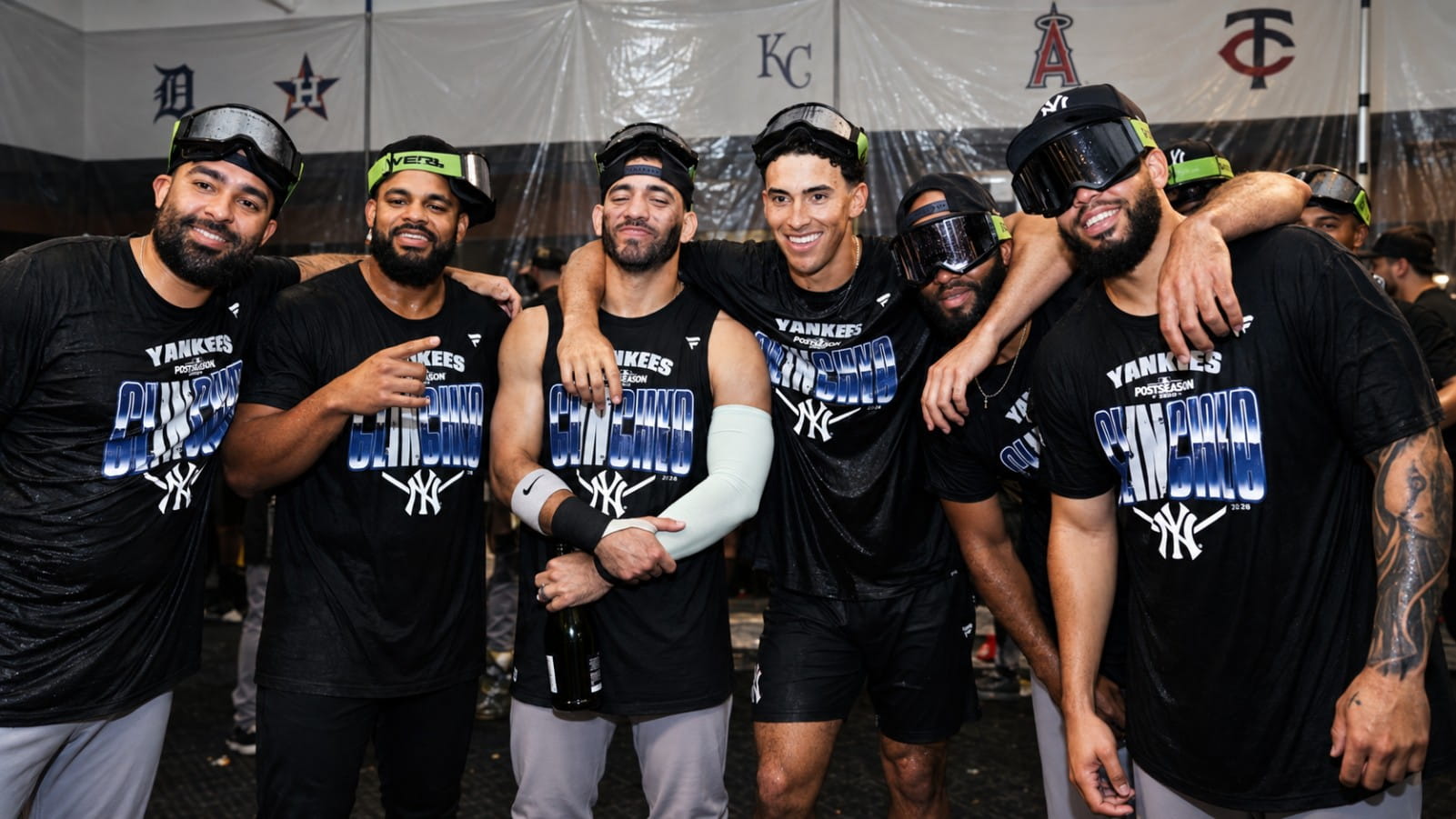
NEW YORK — The Yankees watched an AL East rival end their season, then watched that rival reach a World Series won by Milwaukee. The contrast has left the organization answering questions about something more difficult to purchase than another middle-of-the-order bat: consistent execution.
Tampa Bay swept Aaron Boone’s club in the American League Division Series. The Yankees’ mistakes on the bases and in the field became part of the explanation for another October ending without a championship.
Austin Wells’ baserunning mistake in Game 1 and Jazz Chisholm Jr.’s errant throw in Game 2 drew particular attention. Former manager Joe Girardi subsequently questioned the club’s accountability, extending the discussion beyond individual errors.
The issue has also reached roster construction. Jorge Posada has pointed toward players who reach base, put the ball in play and handle the smaller assignments that help win games.
That criticism connects two parts of the Yankees’ offseason review. One concerns the players available to Boone. The other concerns how reliably those players execute once they reach the field.
The Yankees have also faced questions about an offense built around Aaron Judge. Their struggles during his injury absence exposed how much responsibility rested with their biggest star.
Milwaukee and Tampa Bay offered a different point of comparison during the postseason. Their advancement put greater attention on offensive variety and the ability to create opportunities without waiting for one decisive swing.
For the Yankees, that discussion extends into player development. The organization’s prospects are learning approaches that will eventually help determine what its major league lineup can do.
Their progress matters to the roster debate Posada raised. Developing useful players creates options for the club, whether those players advance to New York or become part of trade discussions.
The next championship roster therefore involves more than selecting an established name from the market. It also depends on which skills the Yankees develop, reward and carry into their major league clubhouse.
Young infielder points to the teams that kept playing
Now Core Jackson, a shortstop prospect in the Yankees system, has added an uncomfortable comparison by praising the style used by the Brewers and Rays.
Speaking on Foul Territory, Jackson connected their approach to his own baseball upbringing. His remarks described a preference for a more varied offense as the sport emphasizes power.
“The game is trending to home runs and turning into power and all that, but the Brewers and the Rays, the way they played is the way I grew up knowing how to play and was taught how to play,” Jackson said.
The Yankees connection gives those comments their sting. One of their own developing infielders sees familiar winning habits in the team that eliminated New York and the team that won the championship.
Two-strike execution sits at the center of his message
Jackson’s description included home runs, but placed them alongside other ways to produce. He emphasized contact that keeps an inning moving and forces defenders to make plays.
“It’s you have your home runs but it’s line drives in the gaps, back-side singles, getting it done with two strikes, not striking out, putting pressure on the defense and doing whatever it takes to a score a run,” Jackson said.
That approach overlaps with Posada’s broader concern about the Yankees’ personnel. The former catcher has argued for greater attention to the qualities that defined roster building under Gene Michael.
Posada acknowledged the difficulty of improving at the trade deadline when other teams seek valuable young players. He also emphasized the importance of the prospects already moving through the system.
“The on-base percentage, the guys that put the ball in play, the guys that are going to do the little things to win ballgames, and I feel we got away from that,” Posada said.
Jackson’s numbers show power and patience can coexist
Jackson’s season provides a useful test of that offensive balance. Before his promotion to Double-A Somerset, he produced 12 home runs, 47 RBIs and 32 stolen bases while drawing 45 walks against 72 strikeouts in 352 plate appearances.
Those totals yield a 12.8% walk rate and a 20.5% strikeout rate. He succeeded on 82.1% of his 39 stolen-base attempts. The calculations describe a player producing power while also reaching base and advancing himself.
They are pre-promotion figures, not his final season totals. Across his completed 2026 minor league season, Jackson hit .262 with a .360 on-base percentage, an .819 OPS, 14 home runs, 62 RBIs and 41 steals.
For the Yankees, his record makes the discussion more specific than choosing between home runs and contact. Jackson’s production includes both extra-base damage and other ways to help an offense.
A development question follows offseason criticism
The Yankees selected Jackson in the fifth round of the 2025 draft. He reached Somerset on Aug. 11 and subsequently joined Salt River in the Arizona Fall League.
He remains a prospect building his own case while the major league club faces scrutiny. His preference concerns how the game is played, and his development gives the organization a chance to evaluate that approach over time.
Jackson closed his explanation by describing the direction he sees baseball taking. His assessment leaves the Yankees with a pointed contrast between the habits he values and the mistakes that followed them into the offseason.
“So I would love to see the game go back to that but I think it’s turned into more power and more strikeouts and more home runs and power on power,” Jackson said.
What do you think? Leave your comment below.