NEW YORK — The Yankees enter baseball’s most consequential labor negotiations in years with more at stake than almost any club. Major League Baseball’s latest proposal would create a $258.2 million salary cap in 2028, a level well below New York’s estimated 2026 luxury-tax payroll.
MLB says eight clubs, including the Yankees, Dodgers, Mets, Phillies, Blue Jays, Padres, Red Sox and Cubs, would have to cut a combined $528 million from 2026 payroll levels to fit under the proposed ceiling. The players union remains opposed to a hard cap as the current collective bargaining agreement nears its Dec. 1 expiration.
For the Yankees, the gap is substantial. The Associated Press, citing Spotrac data, put New York’s 2026 luxury-tax payroll at $341.9 million, or $83.7 million above the proposed cap. That comparison illustrates the scale of the proposed change rather than a finalized 2028 payroll obligation.
The labor fight also carries an unusual Yankees connection. A former New York All-Star who once closed games in the Bronx has moved from the mound into the union’s bargaining operation as negotiations intensify.
Andrew Miller takes bigger MLBPA bargaining role
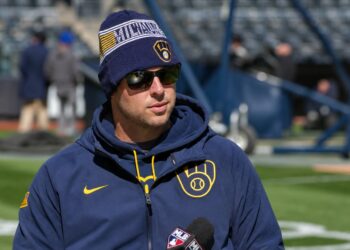
Andrew Miller, who pitched for the Yankees in 2015 and 2016, is now director of collective bargaining and strategic initiatives for the Major League Baseball Players Association. A Nov. 7 report said Miller became more heavily involved in bargaining after executive director Tony Clark resigned in February and now works closely with interim executive director Bruce Meyer.
Miller returned to the MLBPA in 2024 as a special assistant for strategic initiatives after completing an MBA at the University of North Carolina’s Kenan-Flagler Business School. He was later promoted to his current director position. The precise promotion date has not been publicly established.
Miller said his attachment to the union and the sport drew him back after retirement.
“I always said I wouldn’t do this, but I like the people and I like the cause too much, and I love the game so much,” Miller told the Globe.
The union role keeps Miller connected to a cause he supported late in his playing career. He remained on the MLBPA executive board through the end of the 2021-22 lockout and retired shortly after the new collective bargaining agreement was ratified.
Miller described protecting players’ rights as a central reason for staying involved.
“My loyalties to the PA were strong and trying to help players protect their rights. I just find that fascinating,” Miller said.
Leadership change raises stakes before December
Clark resigned Feb. 17, and the MLBPA executive board unanimously appointed Meyer interim executive director the next day. Meyer, previously the union’s deputy executive director, remains its chief negotiator for the next labor agreement.
Miller’s work goes beyond negotiating sessions. He also contributes to the union’s business and philanthropic efforts, although his bargaining involvement has increased during 2026.
“It’s not a very narrow job description,” Miller said. “I feel like it’s evolved. I’m very happy with it.”
MLB’s November proposal would keep the current competitive balance tax and revenue-sharing structure for 2027, then introduce a $258.2 million cap and a $180.2 million spending floor in 2028. The players association continues to reject a hard cap, arguing it would restrict player compensation and rights.
Yankees payroll underscores impact of proposal
The Yankees would be among the clubs most affected if a hard cap were adopted. Their 2026 payroll exceeded the proposed 2028 ceiling by tens of millions of dollars, although the final implications would depend on the terms of any agreement and subsequent roster changes.
Competitive balance tax payroll uses the average annual value of multiyear contracts and includes benefits rather than simply matching cash salary paid within one season. That accounting makes the Yankees’ future commitments a central consideration in any cap discussion.
Miller’s Yankees career built his reputation as an elite reliever
Miller’s Yankees history makes his labor role particularly relevant in New York. In 2015, he recorded 36 saves, a 2.04 ERA and 100 strikeouts in 61 2/3 innings. Before the Yankees traded him to Cleveland on July 31, 2016, he had a 1.39 ERA, nine saves and 77 strikeouts in 45 1/3 innings that season.
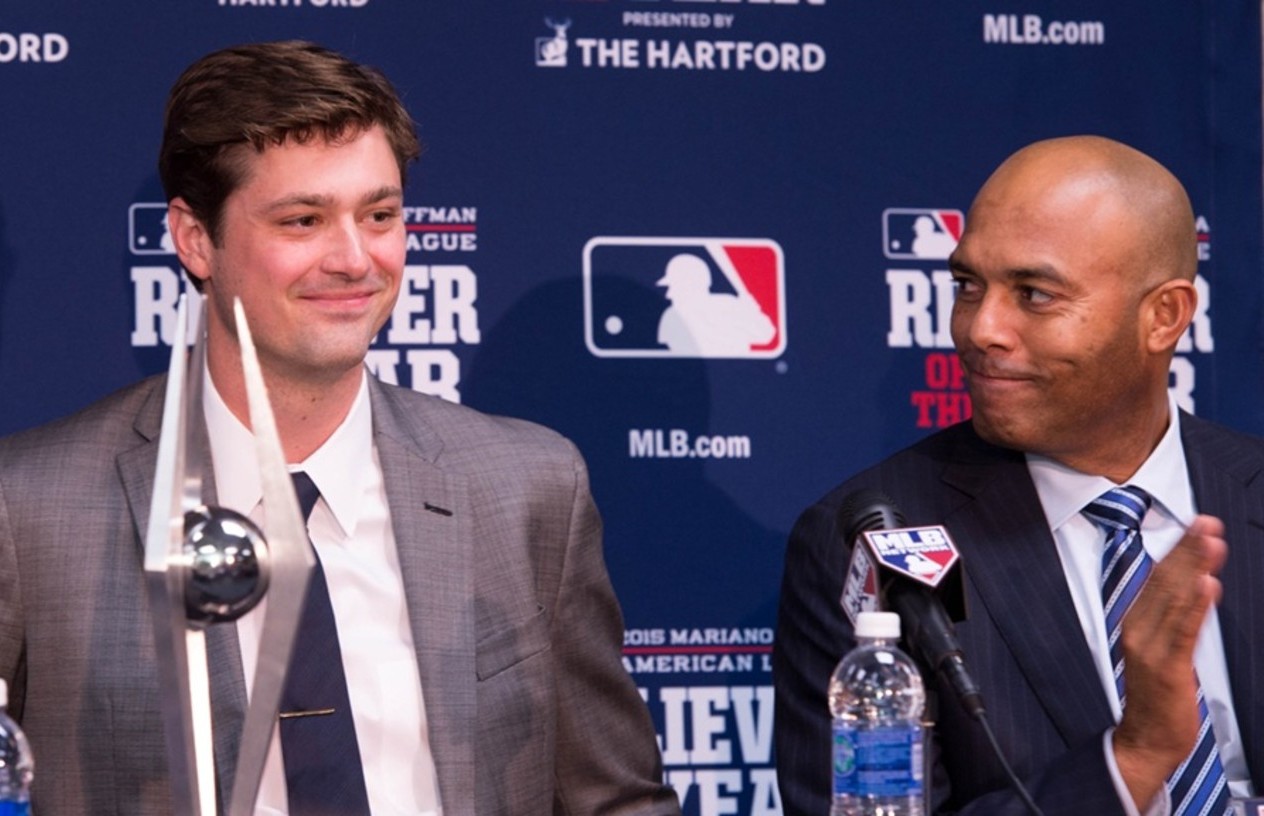
Miller earned the 2015 Mariano Rivera AL Reliever of the Year Award, strengthening his standing before the Yankees traded him in 2016.
Across his Yankees tenure, Miller worked 107 innings with a 1.77 ERA, 45 saves and 177 strikeouts. New York received Clint Frazier, Justus Sheffield, Ben Heller and J.P. Feyereisen in the trade.
Miller’s path now runs through labor talks
Miller’s post-playing career has moved steadily toward union strategy. After retiring in March 2022, the former Yankees star completed his MBA, returned to the MLBPA in 2024 and advanced into a director role that places him directly in collective bargaining work.
The ex-reliever has said his commitment to helping players protect their rights made the union more appealing than coaching, a front-office job or a career outside baseball.
Negotiations have yet to produce a breakthrough on the salary cap dispute. With the agreement expiring Dec. 1, Miller’s work alongside Meyer could help shape decisions that directly affect how the Yankees build and finance future rosters.
What do you think about a hard salary cap in baseball, and how should the Yankees respond? Share your views in the comments.