ST. PETERSBURG, Fla. — The Yankees flew home Tuesday with the kind of loss that puts every choice under October scrutiny.
Tampa Bay’s 5-2 win in ALDS Game 2 at Tropicana Field pushed New York into an 0-2 hole in the best-of-five series. The Yankees committed four errors, including three in the first inning, and managed only four hits. Ben Rice accounted for both runs with solo homers in the fourth and eighth.
The game remained tied longer than the defense deserved. Cam Schlittler worked around traffic and held the Rays to one run through four innings. New York then loaded the bases with two outs in the fifth while the score was 1-1, but Cody Bellinger’s hard drive to center was caught. Tampa Bay answered with four runs in the bottom half.
Cam Booser earned the win in relief of Freddy Peralta. Schlittler took the loss after allowing four runs, two earned, in 4 1/3 innings. Bryan Baker worked a perfect ninth for his second save of the series.
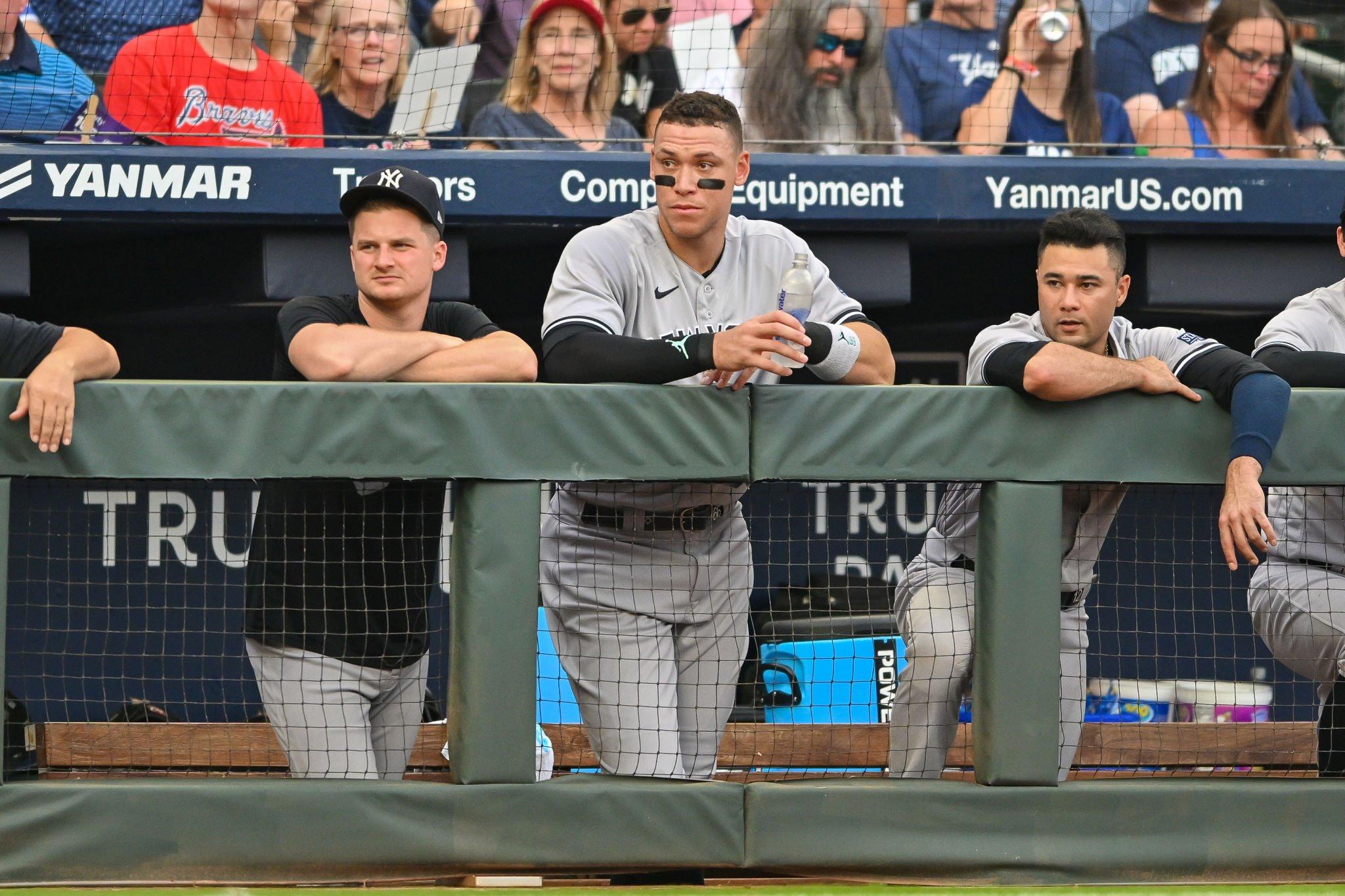
The Yankees now need three straight victories, beginning Wednesday at Yankee Stadium, to reach the ALCS. Aaron Judge remains unavailable because his strained right calf kept him off the ALDS roster, further shrinking the lineup’s margin for error.
That margin already had vanished in Game 1. The Rays had spent the season pressuring defenses with balls in play, speed and contact. The Yankees knew another low-scoring game could turn one missed out or one empty at-bat into the difference.
Instead, both problems followed them into Game 2. Only then did two pregame decisions by manager Aaron Boone become impossible to separate from the result.
Boone’s defense-first call failed on the second pitch
Boone’s second decision centered on third base.
He specifically considered alternatives at third base. McMahon entered 1-for-14 against the right-hander. Compared to Volpe’s favorable career history against Freddy Peralta. He considered Volpe and Caballero but stayed with McMahon, preferring the established third baseman on Tropicana Field’s turf.
“I feel like I want to prioritize the defense,” Boone said.
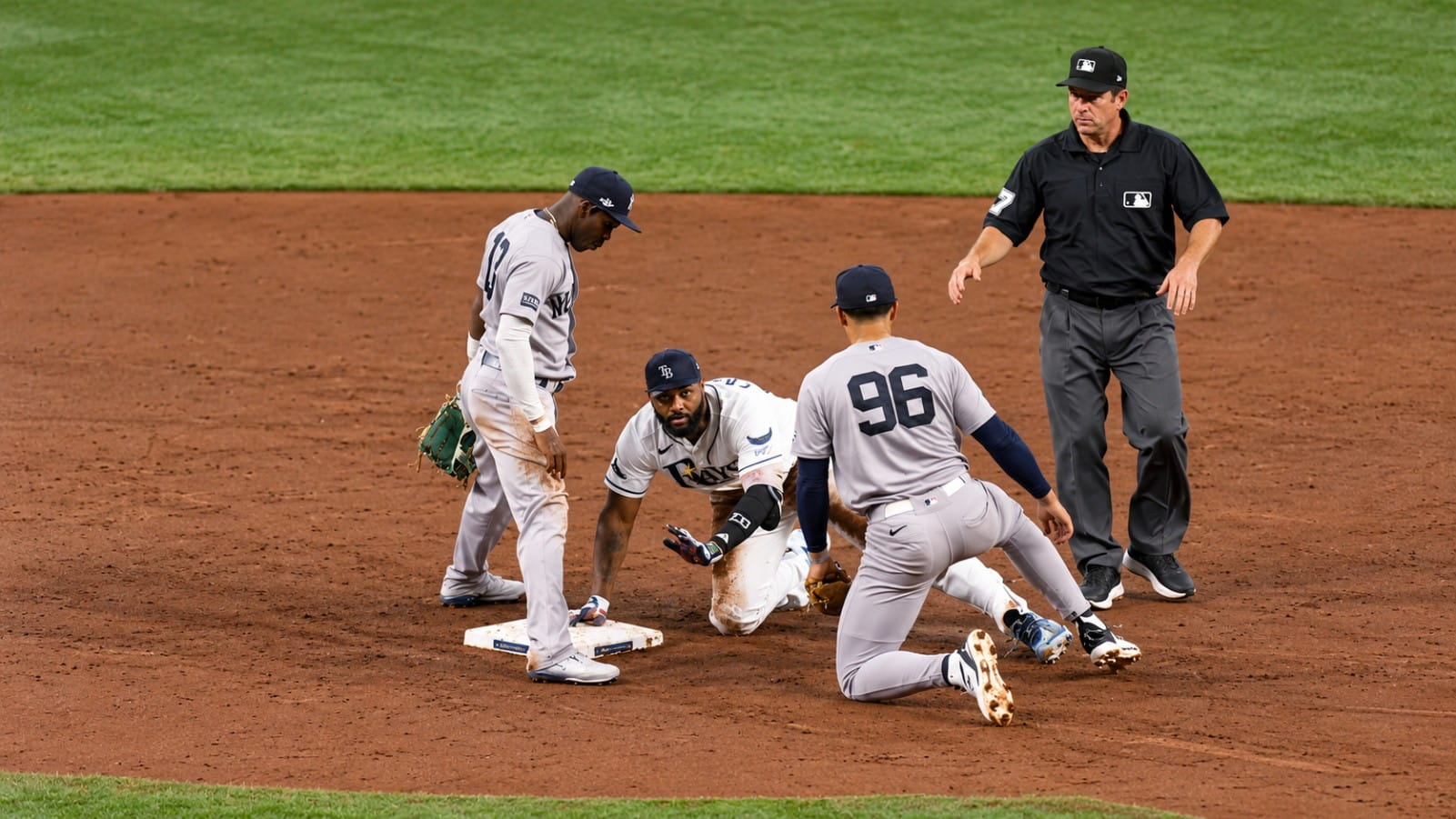
Two pitches into Schlittler’s start, Yandy Díaz hit a ground ball to third and McMahon failed to handle it. Chisholm later made an off-line throw while trying to complete a double play, allowing Díaz to score. Wells was then called for catcher’s interference.
Three errors in the first tied a postseason record for the most in a first inning. The Yankees escaped down only 1-0, but the reason for keeping McMahon in the lineup had already backfired.
“Just spun up on me; it had a little more topspin than I was anticipating,” McMahon said. “Not our best start. I thought Cam did a great job keeping us in the ballgame, giving up only one. But it wasn’t great.”
The numbers weakened the defense-first case
McMahon’s 2026 season made the choice harder to defend on performance alone.
He finished at .213/.279/.357 with 11 home runs in 360 plate appearances and a 78 wRC+. FanGraphs credited him with 0.5 WAR. Final Statcast data listed him at zero Outs Above Average at third base, while Baseball-Reference had him at minus-3 Defensive Runs Saved.
McMahon also entered Game 2 just 1-for-14 against Peralta. He popped out, drew a walk and was later removed for Paul Goldschmidt. Through four postseason games, he was 1-for-7 with two walks.
The broader organizational issue is that Boone’s options came from a roster built by Brian Cashman’s front office. There is no evidence Cashman dictated Monday’s lineup, but McMahon’s guaranteed $16 million salary for 2027 makes the third-base question more complicated beyond October. Releasing him would create significant dead money. Keeping him without a rebound would preserve the same production problem.
Boone’s lineup bet blows up
Boone considered changing the Yankees lineup after Game 1, then sent out the same nine starters against Peralta.
“Maybe stewed on a couple, but I was going to roll it back out,” Boone said.
That left Anthony Volpe on the bench despite a favorable career matchup. Volpe entered 2-for-4 with a home run against Peralta. Jazz Chisholm Jr. was 2-for-11, a .182 average, with one homer and five strikeouts, although four walks lifted his on-base percentage in the matchup to .400.
The samples were small. The larger issue was that the Yankees had produced one hit Saturday, had an available right-handed hitter with prior success against Monday’s starter and still chose full lineup continuity.
The Yankees retained the same nine starters from Game 1. Ben Rice led off at designated hitter, followed by Cody Bellinger, Luis Garcia Jr., Spencer Jones, George Lombard Jr., Jazz Chisholm Jr., Trent Grisham, Austin Wells and Ryan McMahon.
The result did not provide the offensive correction the Yankees needed.
The offense again stalled. Rice went 2-for-3 with two homers. Bellinger and Austin Wells had the other two Yankees hits. The other six starters were hitless, and Chisholm finished 0-for-4.
Yankees’ long third-base search reaches another pressure point
Third base has rarely stayed settled since Alex Rodriguez’s prime ended. The Yankees have moved through short-term veterans, converted infielders and trade acquisitions while trying to balance offense and defense.
Game 2 compressed that long-running problem into one night. The Yankees chose McMahon partly for defense and lost an out on the second pitch. They chose lineup continuity and produced four hits, with Rice driving every run.
Max Fried will start Game 3 on Wednesday at Yankee Stadium against Rays right-hander Nick Martinez. Teams that take a 2-0 lead in a best-of-five postseason series have won 83 of 93 such series, or 89%, according to MLB.
Boone gets another lineup card with the Yankees’ season on it. After Monday, the reasoning behind his choices will matter less than whether they finally work.
What do you think? Leave your comment below.