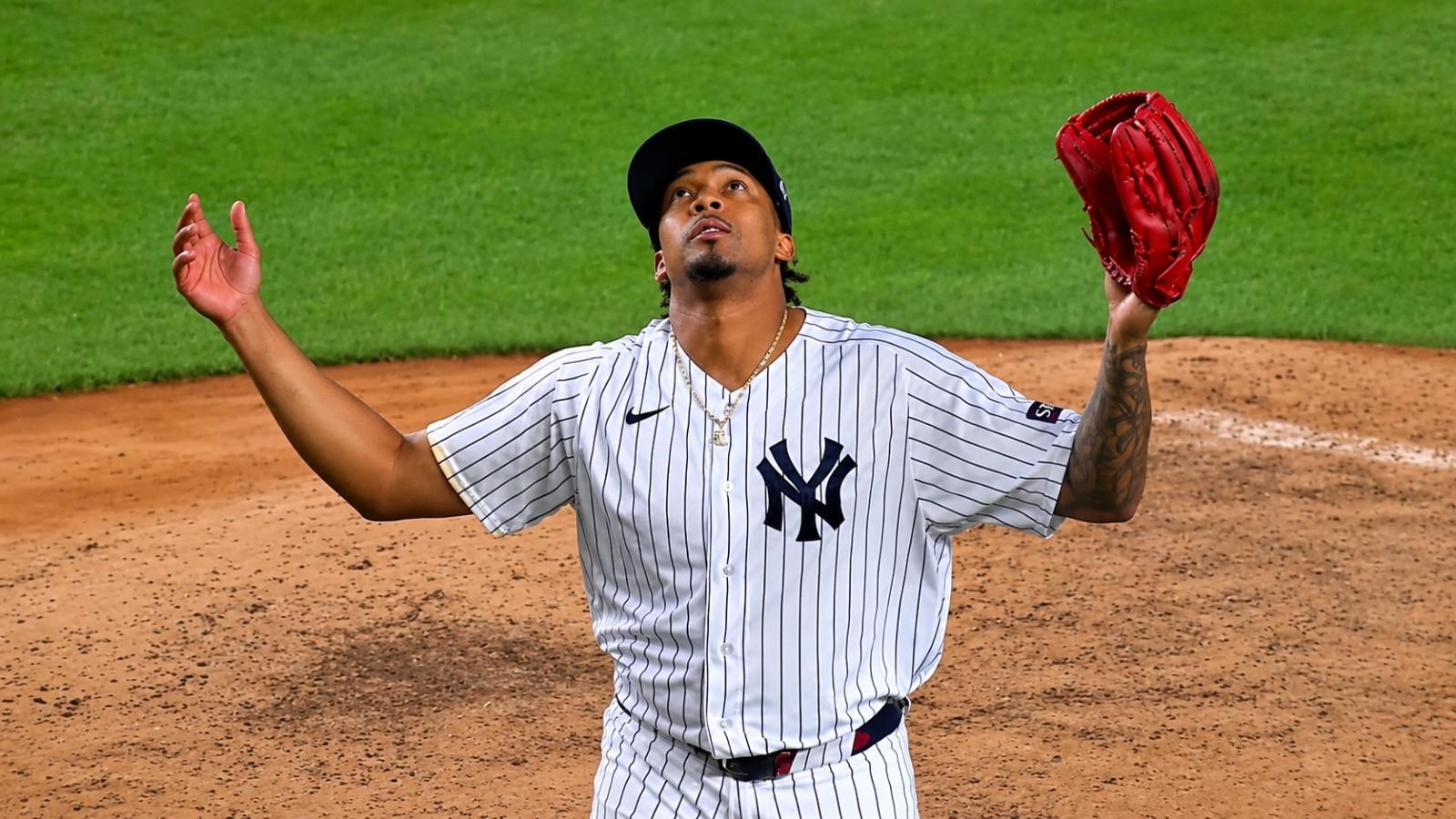
NEW YORK — The Yankees have a 100 mph arm with one of the nastiest sliders in their system. He throws strikes, misses bats at an elite rate, and showed promise in his brief look at the majors. He is also stuck in Triple-A while the big league bullpen struggles to hold leads. The longer that arrangement lasts, the harder it becomes to justify.
Yovanny Cruz sits at the center of a roster puzzle the Yankees have not solved. With each shaky relief outing in the Bronx, the case for keeping him buried in the minors grows weaker.
A promising debut, then a demotion
Cruz earned a promotion earlier this season and did not look overmatched. In his short stint with the Yankees, he struck out three of the nine Toronto Blue Jays hitters he faced, a strong ratio for a young reliever getting his first taste of the highest level. The performance suggested he belonged.
The Yankees sent him back to Scranton anyway. The move preserved the bullpen structure the team built on Opening Day. The only real change was the presence of Cade Winquest, a reliever who never actually pitched in a game for New York before the team moved on from him.
Since returning to Triple-A, Cruz has been excellent. Meanwhile, the Yankees bullpen has scuffled, posting a 5.33 ERA with a 4.67 xFIP. That gap between a thriving minor leaguer and a struggling big league unit is the heart of the problem, as detailed by Ryan Garcia of Empire Sports Media.
The roster habit that created the mess
Here is where the decision traces back to a deeper pattern. The argument is that the Yankees have a habit of hoarding pitchers and avoiding tough roster cuts, even when the math does not work.
The clearest example was Winquest, the Rule 5 Draft pick who made the Opening Day roster and then sat unused for two weeks before being let go. That spot, critics argue, could have gone to a more useful arm. It fit a season-long tendency to collect relievers rather than commit to the best ones.
The pattern is not entirely new. Last season, the Yankees nearly optioned Will Warren to Triple-A to hold onto veteran Carlos Carrasco, a move only interrupted by early injuries to Clarke Schmidt and Marcus Stroman. Carrasco was cut in early May, while Warren developed into a number two caliber starter. Forcing that demotion could have stalled one of the team’s best young arms.
A bullpen being run into the ground
The cost of clinging to the current group shows up in the workload. Several Yankees relievers are being used at an unsustainable rate, and that is the danger that makes the Cruz decision so pressing.
Brent Headrick, who has been outstanding with a 27 percent strikeout rate, had already appeared in 29 of the Yankees’ first 60 games. That pace is a red flag. He battled velocity dips and multiple injuries last season, and wearing him out now risks leaving him spent or hurt by October. Veterans Tim Hill and Fernando Cruz had each pitched in 28 games, carrying their own injury concerns heading toward the trade deadline.
At the same time, the Yankees are not using the depth they already have. Ryan Yarbrough has pitched just five times across 32 games since the calendar turned to May. The criticism is pointed. If a long man is not absorbing innings to protect the high-leverage arms, his roster spot is hard to justify.
The profile the Yankees actually need
This is the part that makes Cruz so frustrating to leave in the minors. His skill set matches the exact areas where the Yankees bullpen falls short.
Cruz throws a fastball that touches 100 mph and pairs it with an elite slider. The Yankees rank outside the top 10 in bullpen fastball velocity, Stuff+, and strikeout rate, so a power arm like his addresses multiple needs at once. The underlying numbers are eye-popping. Cruz sits in the 100th percentile in swinging strike rate, the 91st percentile in chase rate, and the 72nd percentile in ball rate, meaning he fills the zone.
That combination of velocity, swing-and-miss, and control is precisely the profile teams covet in a late-inning reliever. For a Yankees club lacking exactly those traits, leaving him at Triple-A looks like a missed opportunity. The team’s own actions hint they know the bullpen needs help, having just moved hard-throwing prospect Carlos Lagrange from the rotation to relief in the minors.
The window closing on a clean fix
The timing adds urgency to the whole debate. Because teams must wait 15 days to recall a pitcher after optioning him, the Yankees cannot simply summon Cruz on a whim. That waiting period makes planning ahead essential.
The warning is blunt. If the Yankees do not clear a spot for Cruz by cutting one of their underused long relievers when he becomes eligible, they risk real long-term damage. Headrick could be worn down or rendered ineffective for the postseason, and the team could keep dropping winnable games, much like a recent loss to Tampa Bay in which a lead slipped away.
None of this guarantees Cruz would thrive in a full big league role. He has a small major league sample, and relievers are notoriously volatile. But the argument is about process as much as one player. A contender with a clear bullpen weakness is sitting on a high-velocity, high-strikeout arm while overusing tired veterans and barely using others. For the Yankees, that is a decision that gets tougher to defend with every passing series, and the clock on fixing it cleanly is already ticking.
What do you think?