NEW YORK — Jazz Chisholm came into 2026 with enormous ambitions. A 50-50 season. MVP consideration. A World Series ring. And at the end of it all, a contract worth $35 million per year over eight to 10 years.
Five weeks into the season, the Yankees are 24-11. Chisholm is hitting .215 with three home runs and a 23-game power drought to start the year. The gap between what he wants and what he is producing has opened into something the Yankees front office can no longer ignore.
The question is no longer just whether the Yankees can afford to extend him. It is whether they should.
Chisholm’s slow start and the numbers behind it
The surface statistics are bad. Chisholm has three home runs through May 5. He declared himself a 50-50 candidate before the season. He is not on pace for 15, let alone 50.
The metrics are worse. Per MLB.com, Chisholm recorded the fifth-largest year-over-year drop in barrel rate in baseball, down 8.4 points from 2025. His expected slugging percentage fell by .151, the third-largest decline in the sport.
In 2025, he hit .242/.332/.481 with 31 home runs and 31 stolen bases. He made the All-Star team and won a Silver Slugger. His 126 wRC+ was the best of his career. None of that production has carried over.
He is still walking and stealing bases. But the power that makes Chisholm worth $300 million is missing and the Yankees are watching.
What Chisholm wants and what the Yankees are willing to give
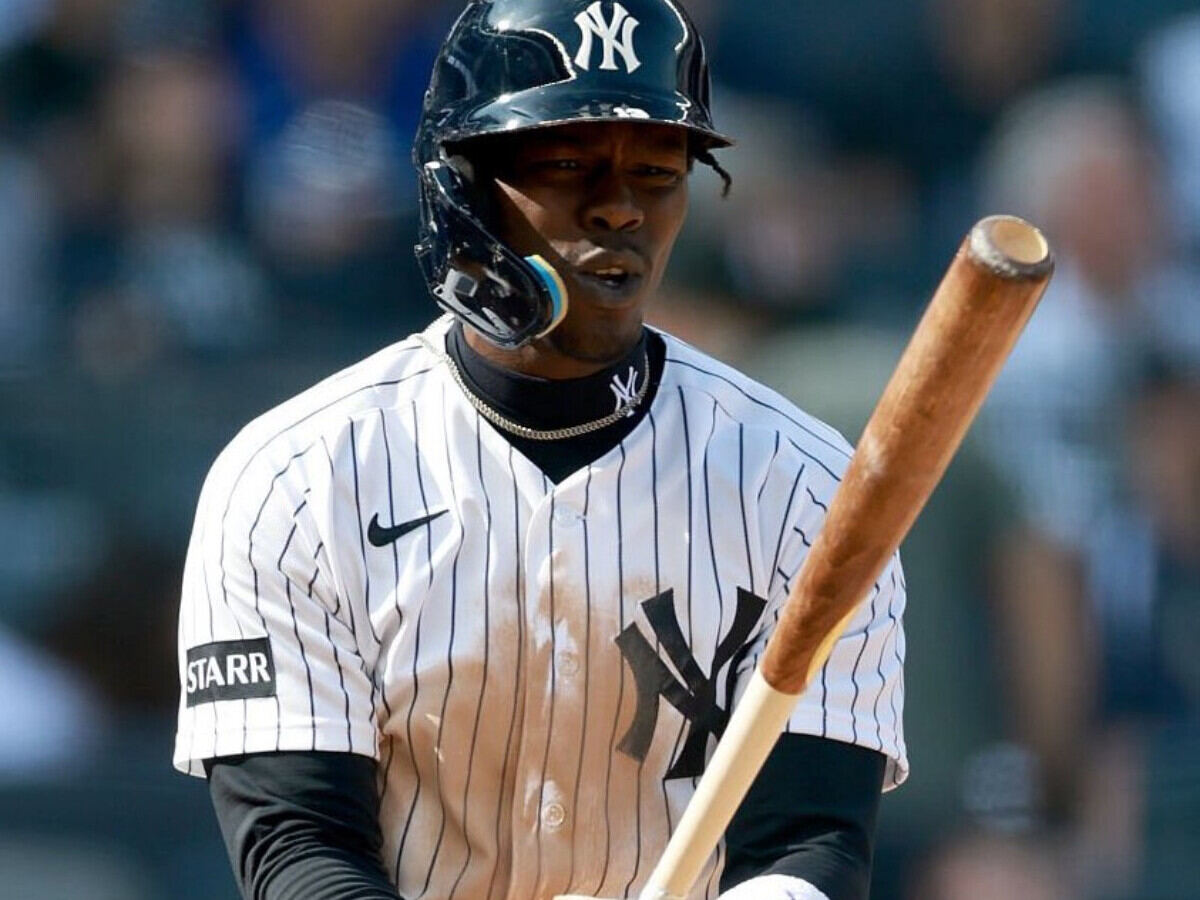
The financial gap between Chisholm and the Yankees is significant.
Chisholm told before the season that his asking price would be $35 million per year over eight to 10 years. The total value of that contract sits between $280 million and $350 million.
The Yankees infielder made clear he would not accept less. Asked if he would take a Yankees offer of $25 million annually, he was direct.
“I’d say no because I know I can get $35 million somewhere else,” Chisholm said. “That’s $10 million less a year. I’m 28. I want 8-to-10 years.”
The Yankees are under $10.2 million of obligation to Chisholm in 2026. General manager Brian Cashman has historically been reluctant to extend players mid-season. He confirmed that posture last winter.
Cashman was asked about Chisholm’s contract situation at the Winter Meetings. His response pointed toward patience rather than urgency.
“We let these things play out, for better or worse,” Cashman said. He added that Chisholm is part of the Yankees’ solution, but offered no indication that a long-term deal was being actively pursued.
Internal and external alternatives the Yankees are watching
The Yankees have internal options at multiple infield positions. With Jose Cabbalero set at shortstop, Anthony Volpe is in Triple-A working to reclaim his shortstop spot. The Yankees are open to use him in new role. George Lombard Jr., the organization’s top prospect and a natural shortstop, is also at Triple-A Scranton. Both could factor into the Yankees’ long-term infield picture.
Oswaldo Cabrera, Amed Rosario, Max Schuemann, and Marco Luciano represent additional infield depth with cheaper cost structures. None carries Chisholm’s ceiling, but all come without the financial risk of a long-term deal.
On the external market, several players could become available. Brendan Donovan of the Cardinals is a versatile left-handed hitter who plays multiple infield positions and is currently earning well below market rate. Luis Arraez, whose contact profile is elite, remains a possible target. Ozzie Albies of Atlanta is another name the Yankees could monitor depending on how the Braves’ rebuild unfolds.
The Bellinger precedent and what it suggests
The Yankees let Cody Bellinger play out his one-year deal in 2025 rather than extend him mid-season. Chisholm is in the same structure in 2026. Based on how the Yankees handled Bellinger, the pattern points toward Chisholm reaching free agency this winter without an extension being offered in the Bronx.
The Yankees second baseman said publicly that he does not think about free agency and wants to remain in New York. But his asking price, combined with his slow start, has made the Yankees more comfortable waiting.
Even if Chisholm rebounds, it may not be enough to generate a mid-season extension. A rebound could simply price him out of the Bronx entirely by driving up his market value before the Yankees have to decide.
Chisholm’s career numbers and what they mean
Since arriving in a trade from Miami on July 28, 2024, Chisholm has posted a .251 batting average with 42 home runs, 103 RBIs and 103 runs scored across 176 Yankees games, per StatMuse. He is one of seven players in MLB history to record a 30-30 season, which he accomplished in 2025.
That track record is what makes the extension conversation complicated. The talent is real. The ceiling is real. The 2026 production, through five weeks, is not.
The Yankees will not decide anything before the season ends. But the decision is already being shaped by every at-bat Chisholm takes between now and October.
What do you think?