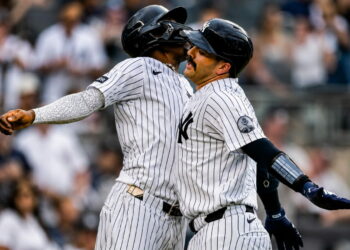
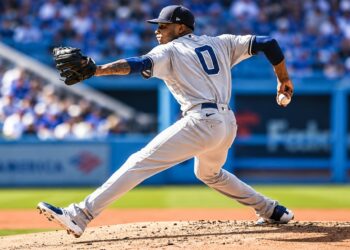
NEW YORK — Aaron Judge and Munetaka Murakami are neck to neck this MLB season. One is at 16 home runs and the other has 15. One has won three MVP awards and holds the American League single-season home run record. The other arrived in the United States four months ago from Japan with a power reputation and has never played a full professional season in his life.
Through Mother’s Day weekend, two sluggers were tied for the major league lead. Then the Yankees captain stepped up and broke the tie with his blast against the Brewers.
But for the power surge both sluggers have displayed, the race is as close as baseball gets. And that fact is making people ask a question nobody expected this early in the season: Can Murakami actually keep pace with Aaron Judge across 162 games?
The numbers make a case. But the numbers also tell a more complicated story if you know where to look.
Two records, two countries, one race
Both men arrived at 2026 carrying the weight of historic power seasons. Judge hit 62 home runs in 2022, breaking Roger Maris’s American League record of 61 that had stood since 1961. It remains the most celebrated power season in the Yankees’ long history. Murakami hit 56 that same year in Japan’s Nippon Professional Baseball, setting the Japanese-born record and breaking Sadaharu Oh’s 55 from 1964. He also won the NPB Triple Crown that year at age 22.
The two men were shattering records on opposite sides of the Pacific at the same moment. Now they are sharing the same league, and the same leaderboard.
What the Statcast numbers reveal
When you line up both players’ metrics side by side, the contrast is sharper than the home run totals suggest.
| Metric (through May 11, 2026) | Aaron Judge (NYY) | Munetaka Murakami (CWS) |
| Games Played | 41 | 40 |
| Home Runs | 16 | 15 |
| AVG / OBP / SLG | .267 / .406 / .637 | .232 / .364 / .556 |
| OPS | 1.043 | 0.920 |
| Runs | 35 | 28 |
| RBI | 30 | 29 |
| BB | 32 | 30 |
| SO | 53 | 60 |
| SB | 5 | 0 |
Judge’s slash line of .267/.406/.637 with a 1.043 OPS represents elite production across every category. His 32 walks against 53 strikeouts show a patient hitter who is punishing mistakes without giving away at-bats. Judge’s 5 stolen bases add a dimension most home run leaders do not offer.
Murakami’s line of .232/.364/.556 with a .920 OPS is strong but carries a significant gap in on-base percentage and slugging. His 60 strikeouts in 40 games remain the central concern. He has drawn 30 walks, which shows he is learning the strike zone. But those 60 strikeouts translate to a pace of over 240 for a full season, a number that puts enormous pressure on his power to carry the offense.
The table tells the story in one glance. Murakami hits the ball harder than anyone in baseball right now. His 63.3% hard-hit rate leads the entire major leagues. His 95.5 mph average exit velocity ranks third. These are the numbers of a generational power hitter. Judge ranks right behind him by those measures but surpasses him in every contact quality and discipline metric that matters for sustainability.
The gap that gives Judge the edge
Murakami’s strikeout rate sits between 33 and 36 percent depending on the week. Judge is at approximately 29 percent, which itself is not a small number for a batting champion. But Murakami’s in-zone contact rate of around 65 to 73 percent is the figure analysts have circled. Every qualifying MLB regular is above that floor. The players who have built careers around that kind of zone-contact rate, such as Joey Gallo and Chris Davis, have historically topped out at 35 to 46 home runs in their best seasons. Not 60.
Murakami’s .920 OPS is excellent. But Judge’s 1.043 OPS reflects a more complete offensive player. The barrel rate and expected wOBA numbers that drove the original comparison still favor Judge. He is simply the more complete power hitter. Murakami hits the ball hard when he makes contact. But Judge’s is historic. The Yankees cpatin makes better contact more often and still hits it almost as hard.
Why Murakami’s start is still unprecedented
None of the above should diminish what Murakami has done. He reached 15 home runs in under 40 career games, the second-fastest pace in MLB history behind Rhys Hoskins. Before hitting his 14th home run, he had not recorded a single double or triple, setting an all-time record for most home runs to open a career before any other extra-base hit.
He hit a 431-foot, 114.1 mph grand slam on April 17 off a 98.2 mph fastball, just the 14th home run of that combined exit velocity and pitch speed in the Statcast era. His 63 percent hard-hit rate and 95.5 mph average exit velocity are still among the best marks in the sport. He is doing this in the American League, against the same pitchers every other contender faces.
The contract that explains everything
How dominant was Murakami’s reputation coming into this offseason? The industry expected more than $100 million. Projections from FanGraphs and ESPN’s Kiley McDaniel had him between $80 million and $180 million. The Mets passed. The Red Sox passed. The White Sox signed him in December 2025 for two years and $34 million, a figure so far below projections it became a genuine news story.
The reason was his 30 percent-plus strikeout rate in Japan, limited games played in 2025, and questions about whether his swing would hold up against premium MLB velocity. Every team that passed on him has watched these 40 games and been forced to sit with that decision.
What the projections say about the rest of 2026
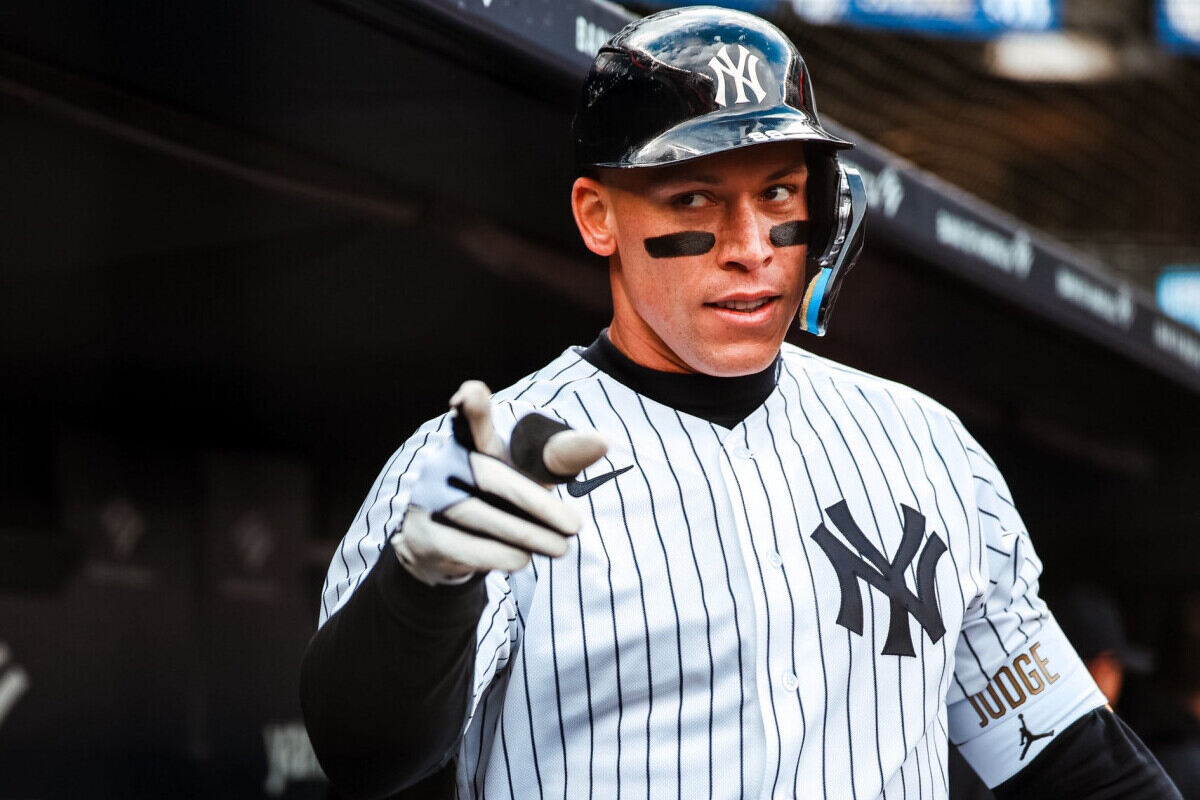
Judge’s current pace of 16 home runs in 41 games projects to roughly 63 over a full season. That is almost identical to his pace at the same point in 2022, which ended at 62. At 34, he is unlikely to maintain that exact rate. A realistic full-season projection lands between 52 and 58 home runs, with 60-plus a live possibility if he stays healthy.
Murakami’s pace extrapolates to roughly 61 home runs based on his May 11 totals, which is almost certainly not where he finishes. Pitchers have already made adjustments. He has never played 162 games in any professional league. His strikeout rate figures to climb. A realistic projection lands between 38 and 46 home runs, with downside risk in the mid-30s if teams successfully exploit his in-zone contact weaknesses.
The race the Yankees captain cannot ignore
Judge has won the American League home run title in three of the past four full seasons. He is the reigning AL batting champion. Judge plays in Yankee Stadium, one of the more home-run-friendly parks in the American League, while Murakami plays his home games at a neutral-tier White Sox facility. The structural advantages favor Judge.
But Murakami is 26 years old, hits the ball as hard as anyone in the sport, and is being paid $17 million a year. He has nothing to lose and every incentive to keep swinging exactly the way he has been swinging. He will not stop.
As of May 12, Judge stands alone at the top. One swing separates first from his competitor. In a race this tight, every at-bat counts — and the most interesting home run battle in baseball has three genuine contestants, not one.
The Yankees captain has seen challengers before. He has outlasted them all. The 2026 race will test that record more seriously than any in recent memory. As the season continues into summer, the home run board may force Judge to acknowledge that the most interesting power race in baseball does not end on his own roster.
What do you think? Leave your comment below.