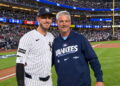
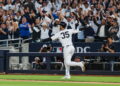
NEW YORK – The New York Yankees were among the most active teams at the 2025 MLB trade deadline, swinging multiple trades to strengthen their roster for a postseason push. They addressed their needs by acquiring seven players in the week leading up to the July 31 deadline.
General Manager Brian Cashman declared “we are better today than we were yesterday,” expressing confidence that the Yankees’ deadline haul achieved its goal.
Below is a breakdown of who the Yankees acquired, each player’s track record (overall and in 2025), how they fit the team’s needs, as well as the prospects and players New York gave up and whether the cost might come back to bite.
New York Yankees: 2025 trade deals
| Who’s in |
| RP Jake Bird (from Rockies) |
| RP David Bednar (from Pirates) |
| 3B Ryan McMahon (from Rockies) |
| INF Amed Rosario (from Nationals) |
| OF Austin Slater (from White Sox) |
| SS José Caballero (Rays) |
| OF Wilberson De Pena (Angels) |
| RHP Camilo Doval (Giants) |
| Who’s out |
| INF Oswald Peraza (to Angels) |
| INF Roc Riggio (to Rockies) |
| SP Ben Shields (to Rockies) |
| C Edgleen Perez (to Pirates) |
| C Rafael Flores (to Pirates) |
| OF Brian Sanchez (to Pirates) |
| SP Griffin Herring (to Rockies) |
| SP Josh Grosz (to Rockies) |
| RP Clayton Beeter (to Nationals) |
| OF Browm Martinez (to Nationals) |
| SP Gage Ziehl (to White Sox) |
| OF Everson Pereira (to Rays) |
Infield upgrades: McMahon, Rosario strengthen the lineup
Ryan McMahon (3B) – The Yankees’ first significant move came on July 25, when they acquired third baseman Ryan McMahon from the Colorado Rockies in exchange for left-hander Griffin Herring (New York’s No. 8 prospect) and right-hander Josh Grosz (No. 21 prospect).
McMahon, 30, was an All-Star in 2024 and is a premium defender at the hot corner (a Gold Glove finalist four years running). He led the majors with 100 games started at third this season for Colorado and ranked in the 91st percentile in Outs Above Average, bringing instant defensive stability to a position that had been a revolving door for New York.
Offensively, McMahon provides left-handed power – he was batting .217/.314/.403 with 16 home runs and 35 RBIs for Colorado at the time of the trade. While his overall 2025 numbers were underwhelming (he led the NL with 127 strikeouts), McMahon had heated up after the All-Star break, hitting .292 with 3 homers in the week before the trade.
Importantly, McMahon is under contract through 2027 at a reasonable rate, giving the Yankees a steady solution at third base for the next 2+ seasons. He addresses a glaring need – Yankees third basemen had produced only a .645 OPS this year, 8th-worst in MLB.
Amed Rosario (INF/OF) – A day after landing McMahon, the Yankees further bolstered their infield depth by acquiring Amed Rosario from the Washington Nationals on July 26. Rosario, 29, is a versatile right-handed hitter with nine seasons of MLB experience and a .273 career average. He was once a top prospect (the former No. 1 prospect in the Mets system) and has developed into a useful utility player capable of playing second base, third base, shortstop and even the outfield corners.
In 46 games with Washington this year, Rosario hit .270 with 5 home runs, 18 RBIs and a .736 OPS. Notably, he thrives against left-handed pitching – posting an .816 OPS vs lefties in 2025 – making him an ideal platoon partner to pair with the lefty-hitting McMahon at third base. Boone indicated Rosario’s speed and defense off the bench would be assets, and indeed Rosario brings above-average foot speed (he stole 10+ bases each of the past five seasons) and postseason experience. The Yankees had been eyeing Rosario for a while; according to Boone, “he’s a player the team has tried to acquire the last couple of years.”
Bench and outfield depth: Austin Slater and Jose Caballero
Austin Slater (OF) – On July 30, New York added a right-handed outfield bat by trading for Austin Slater from the Chicago White Sox. Slater, 33, is a veteran outfielder known for his proficiency against left-handed pitching.
In fact, he effectively replaces the role of a righty platoon outfielder on the Yankees’ bench. Slater was slashing .236/.299/.423 with 5 home runs and 11 RBIs in 51 games for Chicago, and he posted an .859 OPS in 77 plate appearances vs left-handed pitchers this season.
A one-time San Francisco Giant, Slater has a solid MLB track record as a part-time player, entering 2025 with a .254 career average and .732 OPS over 7 seasons. He brings defensive flexibility (able to play all three outfield spots) and a bit of speed as well.
To acquire Slater, the Yankees sent Gage Ziehl, a 22-year-old right-hander ranked No. 18 in their farm system, to the White Sox. Ziehl profiles as a potential mid-rotation starter down the road, but the Yankees viewed Slater’s immediate value – especially with star slugger Aaron Judge on the injured list as of late July – as worth the move. Slater’s expiring $1.75 million contract made him a classic deadline rental to bolster the lineup against tough lefty arms in the pennant race.
Jose Caballero (UTIL) – In a buzzer-beater move during the July 31 deadline day game, New York acquired super-utility man Jose Caballero from the Tampa Bay Rays. Caballero, 28, literally switched dugouts mid-game at Yankee Stadium when the trade was finalized.
He brings a very specific weapon: speed. Caballero is tied for the MLB lead with 34 stolen bases this season, after leading the American League with 44 steals in 2024. Offensively, he’s hitting .226 with a .640 OPS in 86 games, with 2 homers and 27 RBIs – so he’s not a big bat, but he knows how to get on base (a solid .328 OBP) and make things happen on the basepaths.
Defensively, Caballero is a true utility player: he has started games at shortstop, second base, third base, and all three outfield positions for Tampa Bay this year. Essentially, he replaces what the Yankees had hoped to get from Oswaldo Cabrera earlier in the year – a jack-of-all-trades bench piece – and adds an elite base-stealing element that the Yankees have lacked.
Bullpen overhaul: Bednar, Doval and Bird
By far the Yankees’ biggest splash came in rebuilding their bullpen, which had been a trouble spot for weeks.
David Bednar (RHP) – The Yankees kicked off their bullpen shopping by landing Bednar from the Pittsburgh Pirates. Bednar, 30, is one of the premier closers in baseball and a two-time All-Star (2022, 2023). He had converted all 17 of his save opportunities for Pittsburgh this year with a stellar 2.37 ERA and 51 strikeouts in 38 innings.
In fact, after a brief early-April hiccup that saw him optioned to Triple-A, Bednar returned and rattled off 23 straight scoreless outings from May 24 to July 26. He features a high-90s fastball and a hammer curve, and already has 101 career saves under his belt. Importantly, Bednar is under club control through 2026, not just a two-month rental.
The Yankees envision him as a key late-inning arm for multiple pennant races.
Camilo Doval (RHP) – In a separate blockbuster just before the 6 p.m. deadline, the Yankees acquired Camilo Doval from the San Francisco Giants. Doval, 28, served as the Giants’ closer and was an All-Star in 2023, when he tied Bednar for the National League saves lead with 39.
After a down 2024 season, Doval rebounded in 2025 with a 3.09 ERA, 50 strikeouts, and 15 saves in 47 games for San Francisco. He is a fireballer who averages 100 mph on his fastball and has wipeout sliders – essentially giving the Yankees another closer-caliber arm to pair with Bednar and incumbent closer Devin Williams.
Doval is also under team control through 2027, adding long-term value.
Jake Bird (RHP) – Often overlooked amid the headline-grabbing closer acquisitions was the pickup of Jake Bird from the Colorado Rockies. Bird, 29, is a middle-relief workhorse who had a 4.73 ERA and 62 strikeouts in 53.1 innings for Colorado this year. While those surface stats appear modest, it’s worth noting Bird’s extreme home/road splits – he posted a 2.48 ERA at hitter-friendly Coors Field, but a 7.40 ERA on the road.
The Yankees are banking that a change of scenery and their pitching infrastructure can unlock more consistency from Bird. He has the ability to go multiple innings and has two minor-league options remaining, giving the Yankees flexibility in how they deploy him. Bird is also under team control for three more seasons beyond 2025.
With Bednar, Doval, and Bird aboard – all under control through at least 2026 – the Yankees dramatically improved their relief corps for both the current playoff race and the next couple of seasons. The importance of these moves can’t be overstated, as New York’s bullpen issues were threatening to derail their postseason hopes. Cashman’s relief trio was even lauded as a Deadline success around the league. The Yankees now have the kind of bullpen depth that championship contenders boast, easing the pressure on an offense that has been without Aaron Judge and on a rotation that didn’t get an extra starter at the deadline.
Prospect and player departures: Evaluating the cost
To execute this flurry of moves, the Yankees traded away a significant number of prospects and a young MLB infielder in the span of a week. In total, from July 25–31, New York parted with at least 11 minor leaguers (including five of their Top 30 prospects) and a couple of big-league pieces. Here’s a rundown of the notable names the Yankees gave up, and whether the Yankees might feel their loss in the future:
- Griffin Herring (LHP, to Rockies) – Yankees #8 prospect. A 22-year-old lefty starter with strong AA results, Herring was one of the highest-ranked prospects the Yankees dealt (for McMahon). He could become a mid-rotation starter; however, the Yankees have a surplus of similar-level pitching prospects. Losing Herring hurts, but McMahon fills an immediate need that justifies the move.
- Josh Grosz (RHP, to Rockies) – Yankees #21 prospect. A 23-year-old righty with a solid fastball, Grosz projects as a back-end starter or swingman. Again, part of the McMahon trade, and a reasonable price to pay given New York’s depth in Double-A pitching.
- Clayton Beeter (RHP, to Nationals) – Yankees #20 prospect. A former second-round pick, 26 years old, who actually debuted with the Yankees this season but struggled. Beeter has good stuff but was inconsistent; the Yankees viewed him as expendable (Rosario trade) with other arms ahead of him. Washington will try to unlock his potential, but New York likely won’t regret giving him up unless he dramatically turns a corner.
- Browm Martinez (OF, to Nationals) – Unranked prospect. Just 18 and playing in rookie ball, Martinez is a very young, raw outfielder. The Yankees have a large international pipeline, so parting with one lottery ticket (in the Rosario deal) is a minor cost.
- Gage Ziehl (RHP, to White Sox) – Yankees #18 prospect. A fourth-round pick in 2024, 22-year-old Ziehl has shown promise (4.15 ERA across three levels in 2025). The White Sox valued him enough to swap a veteran like Slater for him. If Ziehl blossoms into a mid-rotation starter in a few years, the Yankees might miss him, but as a developing arm in A-ball, he was not a sure thing. New York essentially traded future potential for present help in Slater – a classic deadline trade-off.
- Everson Pereira (OF, to Rays) – Yankees #14 prospect. This 22-year-old outfielder is one of the more significant losses. Everson Pereira was at one time a Top-100 prospect in MLB and had a brief audition in the Bronx in 2023 (though he hit just .151). He offers power and athleticism, and with Tampa’s track record, it wouldn’t be shocking if he develops into a solid MLB outfielder. However, the Yankees have a crowded future outfield (Domínguez, Spencer Jones, etc.), and Pereira’s swing-and-miss issues made him somewhat expendable. In exchange, New York got the uniquely skilled Caballero, so the trade addresses a need even if Pereira pans out elsewhere. The Yankees will watch his progress in Tampa with interest, but they deemed his loss acceptable.
- Rafael Flores (C/1B, to Pirates) – Yankees #8 prospect. Flores, 24, was quietly having an excellent season in the minors, demonstrating power (16 HR) and on-base skills as a switch-hitting catcher/first-baseman. Pittsburgh specifically coveted Rafael Flores’s bat as they have the worst offense in MLB. Of all prospects dealt, Flores could sting the most if he continues to rake – catchers who can hit are valuable. Still, the Yankees have catching depth (Austin Wells, Ben Rice, etc.) and were willing to trade from that position to secure Bednar. If Bednar helps deliver a championship, the loss of Flores will be an afterthought for New York.
- Edgleen Perez (C, to Pirates) – Yankees #13 prospect. A 20-year-old catcher with solid tools, Perez was another depth piece at a position of surplus. The Pirates adding two catchers in the Bednar deal shows the Yankees gave up real talent, but neither Flores nor Perez was in the Yankees’ immediate plans with Jose Trevino and others ahead of them. Losing two top-15 prospects in one trade is significant, but the Yankees evaluated Bednar’s impact as worth that cost.
- Brian Sanchez (OF, to Pirates) – Unranked prospect. A 19-year-old outfielder included in the Bednar deal, Sanchez is a lower-level prospect with some upside but far from the majors. His inclusion helped seal the deal for Pittsburgh. The Yankees won’t sweat losing him unless he breaks out years from now.
- Trystan Vrieling (RHP, to Giants) – Yankees #19 prospect. A 24-year-old pitcher with a mid-90s fastball, Vrieling was a solid arm in High-A. He headlined the four-player package for Doval. While Vrieling could become a back-end starter or reliever, the Yankees have a glut of similar pitching prospects and chose to cash him in for a proven All-Star closer. This is a calculated risk that any contending team would take.
- Jesus Rodriguez (C/3B, to Giants) – Yankees #25 prospect. Rodriguez, 23, is a bat-first catcher/infielder who was performing decently in the minors. Again, the Yankees had catching depth and could part with him in the Doval trade. San Francisco likely liked his offensive potential. Unless he exceeds expectations, Yankees fans won’t lose sleep over this departure given what they got in return.
- Parks Harber (3B, to Giants) – Unranked prospect. A 22-year-old infielder who was a mid-round pick, Harber has power but was not in the Yankees’ top prospect ranks. He was one of the complementary pieces for Doval.
- Carlos De La Rosa (LHP, to Giants) – Unranked prospect. A 21-year-old lefty, De La Rosa had some intrigue but was still in Single-A. Another complementary piece moved for Doval. The Yankees have many young pitchers, so he was deemed expendable.
- Roc Riggio (2B, to Rockies) – Yankees #10 prospect. Riggio might be the most intriguing name sent away in the bullpen shuffle (for Jake Bird). The 21-year-old second baseman was a 2024 draft pick who quickly rose into the Yankees’ top 10 prospects, known for his hitting polish and gritty play. Colorado coveted Riggio’s potential as a future starting infielder. Trading a top-10 prospect for a middle reliever raised some eyebrows, and if Riggio becomes a quality MLB second baseman down the line, this trade could be second-guessed. The Yankees, however, are fairly set at middle infield in the medium term (with Gleyber Torres, Anthony Volpe, etc.) and preferred to shore up the bullpen now. It’s a classic win-now vs. win-later gamble.
- Ben Shields (LHP, to Rockies) – Yankees #28 prospect. A 23-year-old lefty, more of a fringe prospect, included with Riggio for Bird. Shields was depth and not a major part of the Yankees’ future plans.
- Oswald Peraza (INF, to Angels) – Finally, it’s worth noting the Yankees traded away Oswald Peraza on deadline day in a separate move. Peraza, 23, was once a top prospect and opened 2025 as the Yankees’ primary third baseman, but his struggles at the plate (.147 average in 48 games) left him without a clear role. After New York’s infield additions, Peraza became expendable. The Yankees sent him to the Los Angeles Angels in exchange for 18-year-old outfielder Wilberson De Peña and international bonus pool money.
The Yankees undeniably gave up a hefty package of prospects and a young MLB-ready infielder to facilitate this roster overhaul. By one count, they traded away two of their top-10 prospects and several more from their top 30. However, they crucially held on to their elite prospects – notably outfield phenom Jasson Dominguez, infielder George Lombard Jr., outfielder Spencer Jones, catcher Ben Rice, and pitcher Cam Schlittler were all deemed off-limits.
This strategy allowed Cashman to improve the current team without sacrificing the franchise’s very best future pieces. The prospects that were dealt, while talented, are generally in the mid-tier category or blocked at their positions in New York. The Yankees’ farm system had depth that could be leveraged in these trades, and that’s exactly what they did. As Cashman said, “Some guys are more touchable than others…there’s a lot of guys that we like, and unfortunately, we parted with guys that we like” – the cost of doing business when you’re in win-now mode.
Bottom line: Pinstripes poised for the pennant push
The Yankees meaningfully improved their roster in the lead-up to the deadline. They addressed their weakest links – adding a reliable everyday third baseman (McMahon), a versatile infielder (Rosario), bench reinforcements (Slater and Caballero), and a trio of impact relievers (Bednar, Doval, Bird) – all of whom fill specific needs for the stretch run. The Yankees’ record stood at 60-49 on July 31, and these moves were made with October in mind.
Of course, only time will tell how these trades pan out.
For now, the Yankees and their fans can feel reinvigorated – the front office showed a clear commitment to winning, and the roster looks stronger on paper than it did a week before the deadline. The stage is set for an exciting finish in the Bronx, with a revamped bullpen, a fortified lineup, and October aspirations in full swing.
How do you rate the Yankees’ 2025 trade deadline activity?