NEW YORK — The New York Yankees are entering the offseason with a notable corner of their roster unresolved. Despite his breakout 2025, the club has not opened formal extension discussions with second baseman Jazz Chisholm Jr.
General manager Brian Cashman confirmed the absence of negotiations and cited several underlying reasons the team is choosing caution.
Chisholm’s milestone season provides context

Chisholm posted a 30-home-run, 30-stolen-base campaign for New York in 2025, becoming only the third Yankee ever to join the 30-30 club. He drove in 80 runs and logged a .242/.332/.481 batting line across 130 games. Yet, despite his offensive surge, the Yankees have held off on locking him into a long-term deal. According to the reports, that hesitation stems from both risk and timing.
Cashman’s caution: “Not sure how that would play out”
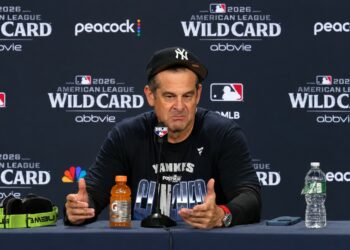
At the recent GM Meetings, Cashman said: “We have not had any conversations outside of, you know, he’s looking forward to playing next year. He loves playing here. If you want to have a legitimate conversation about value, open to a longer-term conversation as well. But that’s the extent of it.”
Cashman rarely shows his hand, but his reserved tone suggested the Yankees are not ready to commit.
His words underscore the Yankees’ reluctance to commit now, but with a desire to stay flexible rather than anchor the payroll to a risky extension.
The club has done few extensions in recent years—only one or two in the last two decades—and some of those did not validate the club’s hopes. That institutional memory appears to be driving the hesitancy.
Risk tied to injury history
One major reason the Yankees are holding fire: Chisholm’s durability and consistency remain in question. Before 2025, he had never played more than 97 games in a season. Injuries followed him from Miami to New York. He battled back problems, turf toe and oblique issues across multiple seasons.
Chisholm missed time in 2025 with a torn oblique despite reaching career highs. He plays aggressively. He runs hard on the bases. He slides aggressively into second. He takes risks in the outfield and infield. These traits make him exciting. They also elevate concern for long-term durability.
From the viewpoint of the Yankees’ front office, committing long-term when regression or injury remains a reasonable risk is a poor investment.
One insider put it plainly: “Even if Chisholm Jr. were amenable to an extension, the Yankees can’t do it now … Doing so would only present them with risk.”
Performance spike and valuation uncertainty
Another reason behind the Yankees’ hesitation is how unpredictable Chisholm’s value has become. He hit 30 home runs, stole 30 bases and posted career highs in runs and RBIs. His season placed him among the most productive second basemen in baseball.
But it was also a major spike compared with his earlier seasons. The Yankees want to know how repeatable that performance is before making a long-term bet. League insiders describe 2025 as a “career year” that raises questions about sustainability.
Analysts note his .813 OPS was some 50 points above his previous best. Even with his 2025 success, they say the Yankees cannot ignore his track record. One report called it “an obvious reason the Yankees can’t open Jazz Chisholm Jr. extension talks.”
Front offices often avoid extending players immediately after a breakout because of inflated cost and limited sample size. Chisholm fits that pattern. His arbitration price will rise sharply. His long-term demands could land in the nine-figure range. One report described the developing contract situation as “bitter one hundred sixteen million news,” comparing his potential valuation to stars like Ketel Marte.
For a team already operating near the upper end of payroll thresholds, the Yankees must be precise. An extension done too early could become a financial trap if the performance dips.
Yankees have been selective with extensions
New York’s recent history with extensions also shapes their thinking. The franchise has avoided early long-term agreements with position players for much of the last two decades. Notable past deals at young ages did not always provide ideal returns.
Cashman’s comment that the team is simply “open” to discussions, rather than engaging now, fits that cautious model. The Yankees often allow the arbitration process to play out. They prefer to evaluate players over a larger body of work before entering expensive negotiations.
Role uncertainty adds another layer
The Yankees have not firmly locked Chisholm into one defensive position. He played second base, third base and outfield. The shifting assignments were influenced by injuries across the roster. Yet the lack of positional consistency adds another layer of uncertainty when projecting long-term value.
If Chisholm commits permanently to second base and provides above-average defense, the extension math changes. If he settles in the outfield, his role evolves. The Yankees want clarity on where he fits in their future core before committing financially.
Cashman’s tone leaves door open but timeline unclear
During his interview sessions, Cashman did not shut the door on an extension. But his tone made it clear the Yankees are not rushing. He emphasized that Chisholm enjoys playing in New York. He also indicated that the club has no problem discussing value in the future.
At the same time, Cashman made no effort to suggest urgency. He kept the conversation general. He avoided describing any direct meetings or negotiations. That approach signals that the Yankees want to evaluate the situation deeper into 2026 before deciding.
Market comparisons complicate negotiations

Chisholm’s rising star power invites comparisons to other middle infielders who secured major deals. Marte’s extension was cited as one benchmark. Another analyst noted that Chisholm’s performance could push his next contract into a territory the Yankees may not be ready to match.
New York must also consider the growing cost of power-speed infielders. With several large contracts already on the books, every financial commitment must be timed well.
Financial and roster construction strategy factors in
The Yankees operate under luxury-tax and budget constraints. A multiyear extension at 20-plus million dollars annually for Chisholm would consume significant salary bandwidth. Meanwhile the club faces other pressing needs: rotation depth, bullpen reinforcement and outfield upgrades.
The club appears to be prioritizing flexibility over early commitment. The decision may reflect a broader strategy: allow the player to play out his arbitration year, demonstrate consistency, and then evaluate a deal with more certainty.
Chisholm’s desire to stay vs. Yankees’ timetable
Chisholm has publicly expressed his desire to remain in New York long term. He told reporters: “I feel like a lot of people in New York are just like me … I definitely want to stay in New York.”
He likes the market. He likes the energy. His connection with fans is evident. It is also clear that he would be open to discussions if the Yankees approached him.
Yet the Yankees’ refusal to engage suggests they are not persuaded that the moment is right.
If the Yankees continue without an offer, Chisholm will enter 2026 with one final year of team control before free agency. Should he replicate or exceed his 2025 level, his market will soar, and the Yankees may face a tougher negotiation—or risk losing him.
What do you think? Leave your comment below.