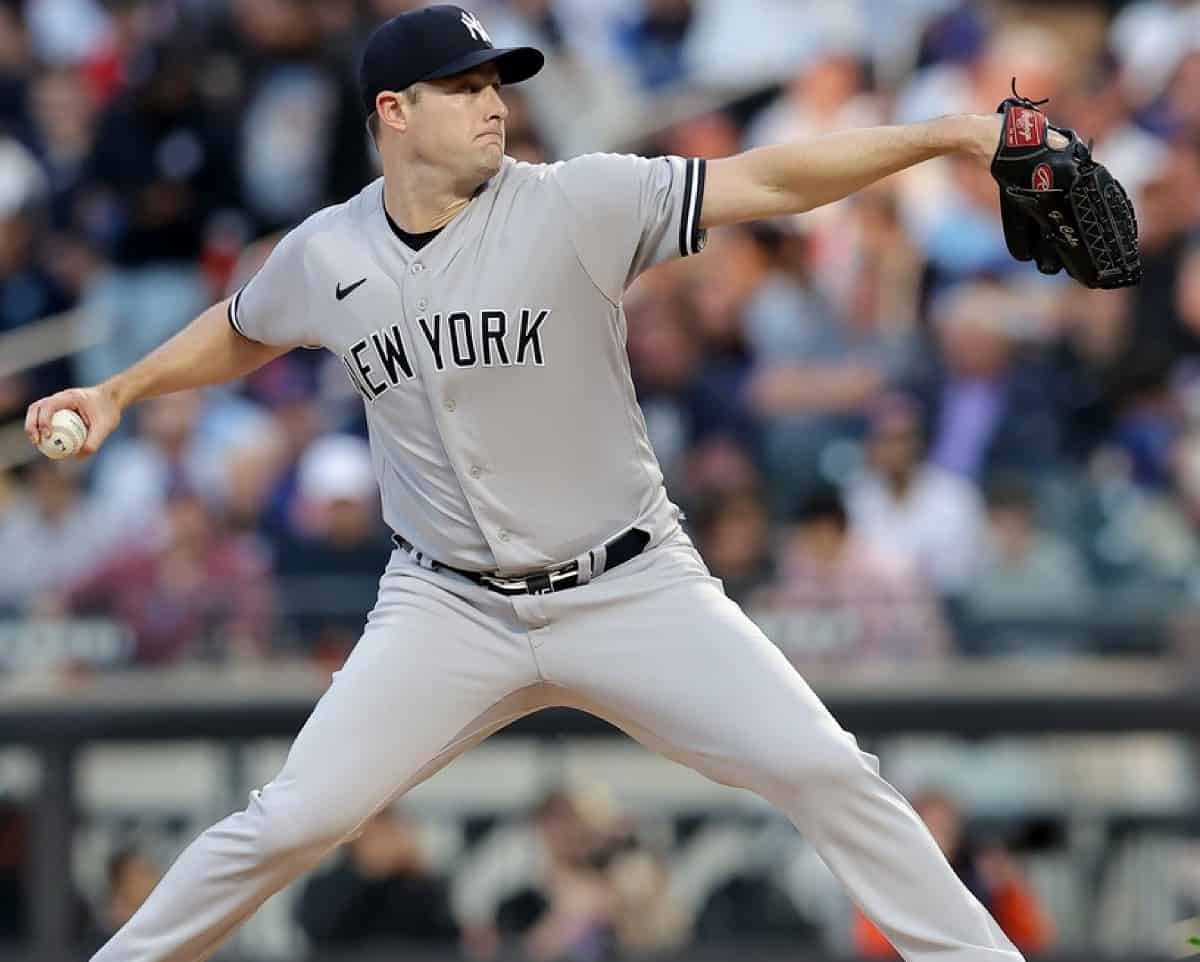
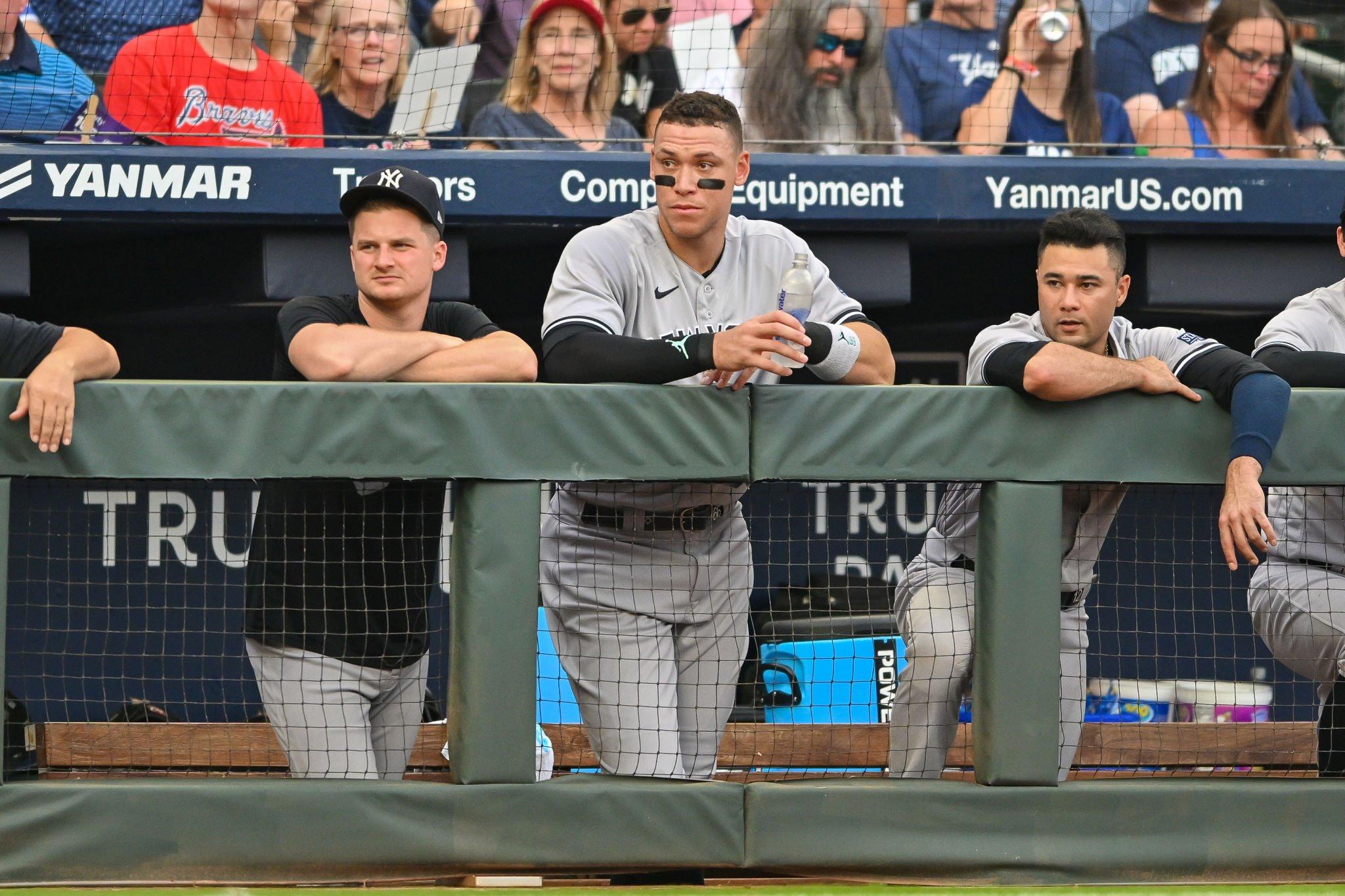
TORONTO — Max Fried leaned on the dugout railing with a blank stare. The Yankees ace looked on as the team’s postseason dreams started slipping away. Before the fourth inning ended, Fried’s outing unraveled in front of 44,764 fans at Rogers Centre, many of whom knew exactly what his early departure meant.
The left-hander, who had been the most consistent arm for the Yankees all season, failed to deliver in a moment when the team needed him most. His rocky Game 2 performance in the American League Division Series led to a crushing 13-7 loss. The Yankees now trail Toronto 2-0 in the best-of-five series and are facing elimination when they return home Tuesday.
Fried lasted only 3 1/3 innings. He gave up seven earned runs on eight hits. Manager Aaron Boone made the decision to pull him after just 51 pitches, none of which recorded an out in the fourth. The Yankees will now have to win three straight games if they want to keep their postseason alive.
Inside the clubhouse, Max Fried couldn’t find the words to explain what went wrong. The Blue Jays hit him hard from the start. Now, the Yankees sit just one loss away from being bounced from the playoffs.
His fastball velocity was up. His control felt fine. The movement on his pitches looked sharp. But nothing seemed to matter. Toronto hitters drilled him for seven runs in under four innings.
“I pride myself in being able to change speeds and keep guys off-balance,” Fried said. “And they weren’t off-balance.”
That summed up the issue for the Yankees. Fried, 31, had been rock solid all season. On Sunday, he threw his hardest pitch of the year — a 99.2 mph sinker to Alejandro Kirk. For comparison, his regular season sinker averaged 94 mph. In this outing, it averaged 96.1 mph across 20 sinkers.
On paper, everything pointed to success. On the scoreboard, the damage was clear.
When the stopper couldn’t stop anything
Jason Szenes / New York Post
Postseason baseball demands timely performances. Fried had been reliable all year, especially after team losses. He went 11-1 with a 1.82 ERA in 16 starts following a Yankees defeat during the regular season. The Yankees won 12 of those games.
His dominance continued down the stretch. Over his final eight regular season starts, Fried posted a 6-0 record with a 1.37 ERA. That included 6 1/3 shutout innings in the Wild Card Series against Boston. He had shown every reason to justify the Yankees’ eight-year, $218 million deal last December — the largest ever given to a left-handed pitcher.
But none of that mattered on Sunday. The Blue Jays attacked him right away. They jumped on first and second pitches early in the count. The three-time All-Star looked like a pitcher throwing batting practice. Line drives flew around the ballpark.
“They obviously had a really good approach,” Fried said. “They were on a lot of my pitches. Credit to them.”
The damage came fast and furious
It started in the second inning. Daulton Varsho doubled to right. Aaron Judge misplayed the ball, and Varsho advanced to third. Ernie Clement came up next and crushed a first-pitch curveball over the left-field wall for a two-run homer.
Clement had only nine homers in 588 plate appearances this season. His last one came on August 12. But the curveball hung in the zone, and Clement didn’t miss.
In the third, Toronto kept the pressure on. They loaded the bases through smart plate appearances. Kirk grounded out to drive in a run. Varsho then ripped another double. Clement followed with an RBI single, giving him three RBIs against Fried.
Vladimir Guerrero Jr. added a first-pitch single off a cutter. Fried was removed with the Yankees down 5-0.
The mystery deepened with every pitch
Fried’s collapse had no clear reason. Mechanics looked fine. His velocity was at a season-high. The six-pitch mix he used all year was working. Yet the Blue Jays lit him up. They collected eight hits and struck out just once.
“I felt like I was mixing a lot of different fastballs, and when I threw the offspeed, they seemed to be on it, too,” Fried said.
Boone didn’t see any major red flags either. He saw life on Fried’s pitches but questioned the command.
“He didn’t seem to have the same command. Probably not getting pitches to where he wanted to get them. Life and everything seemed fine,” Boone said. “They obviously had some hard contact. They were able to find some holes with their contact. Just not his sharpest, obviously.”
"Didn't seem to have the same command, probably not getting pitches to where he wanted to get them"
Boone’s comments highlighted the strangeness of Fried’s performance. Unlike Luis Gil’s Game 1 outing, where velocity was down and stuff looked off, Fried’s stuff was arguably the best it had been all season.
“Credit to them. I didn’t get it done. It’s frustrating, especially coming out in a game like this. I needed to have a good one,” Fried said.
Blue Jays explain what Fried could not
Toronto manager John Schneider offered more insight than Fried could. He said the Blue Jays had a plan to wear Fried down.
“We talked about kind of trying to grind him a bit,” Schneider said. “I thought our at-bats were tremendous against him. He’s one of the best in the league. Kind of just took what we got.”
The Blue Jays were disciplined. They avoided bad swings. They hit strikes. They made Fried work. It was a textbook game plan, executed perfectly.
Fried couldn’t explain what went wrong. And that might be the most troubling part for the Yankees. Great pitchers usually know when something is off. Fried said everything felt fine. But the scoreboard told a different story.
What happens next remains unclear
The seven earned runs tied Fried’s career high. He has given up that many runs only three times before in nine seasons, across over 220 games.
Now, the Yankees must win both Tuesday and Wednesday to stay alive. If they force a Game 5, Fried would line up to start again — at Rogers Centre, where things just fell apart.
Before that, the Yankees turn to Carlos Rodón in Game 3. With the team’s season on the line, Fried’s unexplained struggles now leave the Yankees with more questions than answers.
His confusion might be the most alarming sign. When elite pitchers struggle and can’t find the cause, recovery doesn’t come easy.
Esteban Quinones is a proud graduate of the S.I. Newhouse School of Public Communications at Syracuse University. Growing up just blocks away from Yankee Stadium in Upper Manhattan, Esteban developed a deep love for the New York Yankees, a passion that has been a constant throughout his life. Whether it's cheering for the Yankees or crafting strategic communications, Esteban brings dedication and enthusiasm to producing content around all things Yankees.