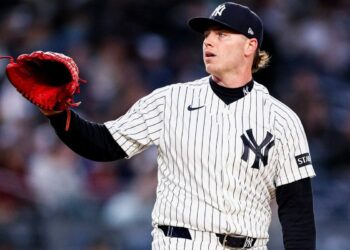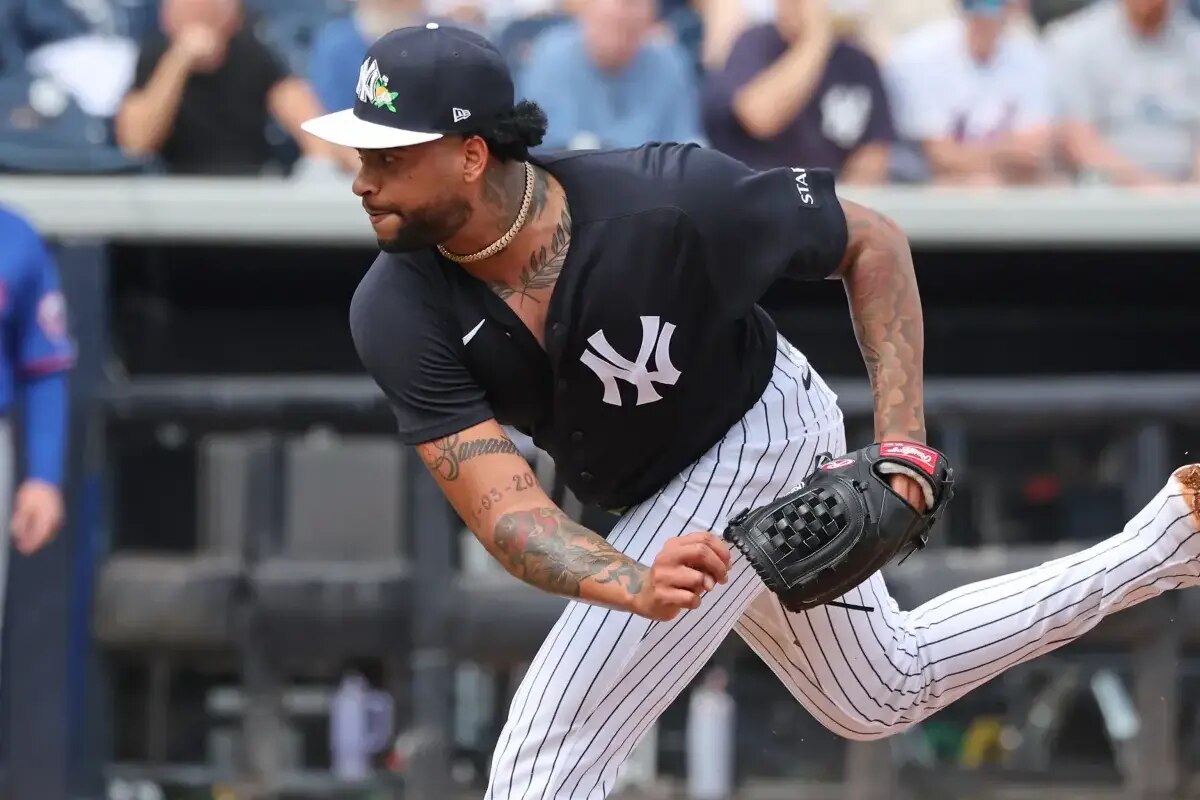
ST. PETERSBURG, Fla. — The Yankees needed a fifth starter for the first time this season. They turned to Luis Gil. That much was straightforward.
What is not straightforward is everything that follows.
Gil, the 27-year-old right-hander who won the 2024 American League Rookie of the Year award and then spent most of 2025 on the injured list, takes the mound at Tropicana Field on Friday to open the Yankees’ first series against the Tampa Bay Rays. It will be his first regular season start of 2026. His only Triple-A tune-up before the call-up was a single start in Rochester last Sunday, in cold, windy conditions that may have dampened an accurate read on where he actually stands.
The results in that outing were uneven. The pitch mix, however, told a different story.
A new pitch in the arsenal
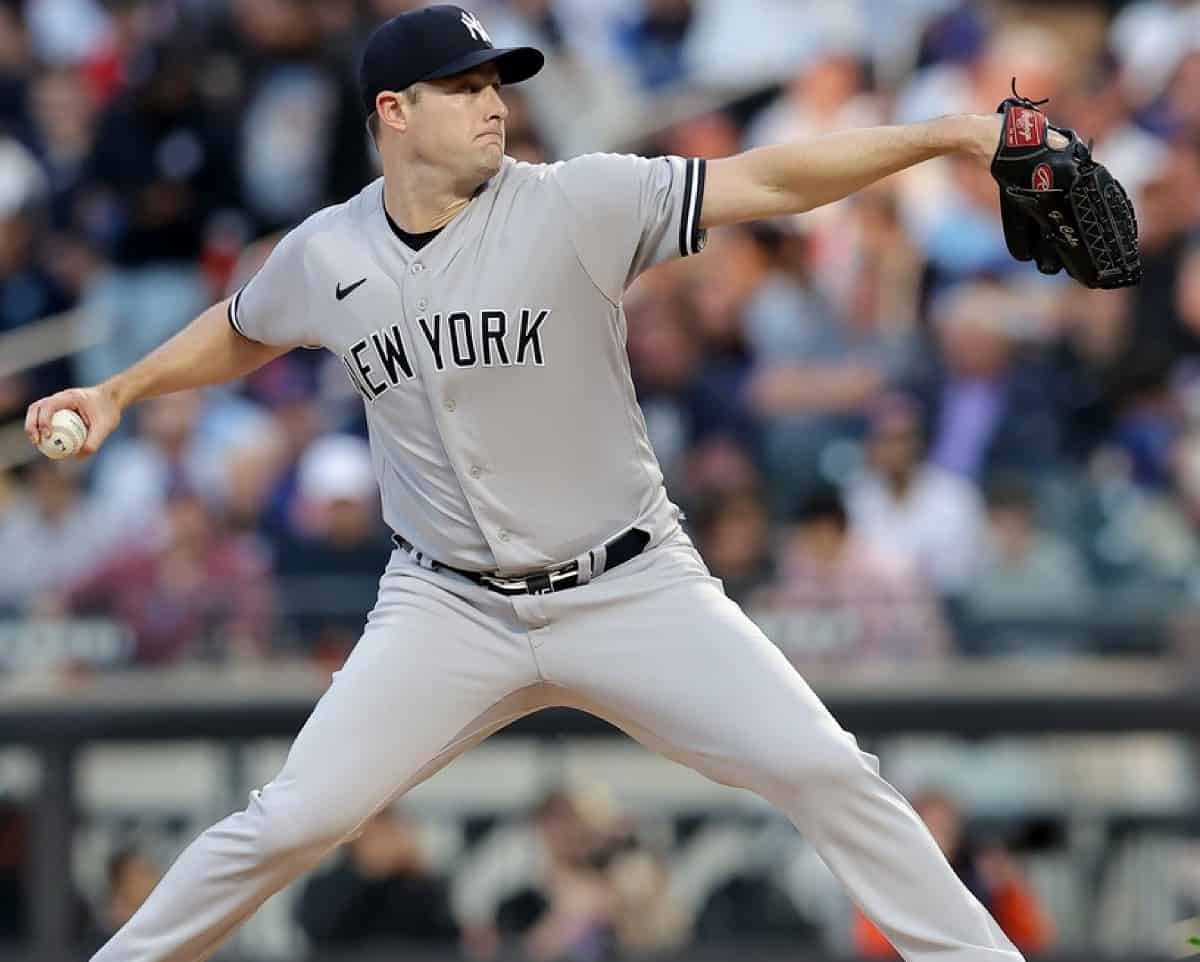
Of Gil’s 85 pitches against Rochester, 30 were sinkers. That is not a pitch he threw in either of his first two major league seasons. Previously, Luis Gil worked exclusively with a four-seam fastball, a slider, and a changeup. The addition of a sinker is a deliberate effort by the Yankees to give him a different look and to help his four-seamer play better in the zone.
Manager Aaron Boone, who watched the Rochester start on a monitor during a rain delay at Yankee Stadium, spoke to the reasoning behind the new pitch.
“Hopefully it’s just something that’s a little bit of a different look to help the four-seam play up a little bit and also help out with his secondary,” Boone said.
The logic is sound. Gil’s four-seamer averaged 95.3 mph in 2025, down from 96.6 mph in his Rookie of the Year season. His whiff rate on that pitch dropped from 28.5 percent to 18.8 percent over the same span. When hitters can sit on a fastball they know is coming and time it with some confidence, a pitcher’s entire arsenal suffers. A sinker with different movement and angle at a similar velocity gives batters a second look to process.
The Rochester start raised familiar concerns
Whatever the promise of the new pitch, the Rochester outing carried the same red flags that have trailed Gil for over a year.
He allowed three runs on four hits and four walks in 4 2/3 innings. He walked the first two batters he faced. His strikeout total of six was encouraging. His command was not.
Boone acknowledged the mixed picture while offering the cold weather as partial context.
“You could tell it was a really cold, windy day in Rochester,” Boone said. “That first inning, he gave up a couple runs. I think he struck out the side in the first inning. Managed contact pretty well. A little struggle in that first inning with his command, but overall threw the ball alright.”
The walk rate has been a persistent problem. Gil’s career walk rate of 12.7 percent is the second worst among starting pitchers with at least 240 innings since his 2021 debut. In 2025, his strikeout-to-walk percentage fell to 3.3 percent, compared to 14.8 percent during his award-winning 2024 campaign. Those are not numbers that suggest a pitcher ready to thrive in high-leverage situations.
What the Yankees actually need from him right now

The Yankees are three games into a stretch of 13 games in 13 days. The rotation will need five arms for at least a short window. Gil should get two starts in this stretch, which gives him a pair of real games to demonstrate something.
Those two starts may be the clearest look the Yankees get at which version of Gil they are dealing with. Is it the 2024 model, the one who posted a 3.50 ERA and 171 strikeouts across 151 2/3 innings? Or the 2025 version, the one who missed the first four months with a lat strain and came back with diminished velocity, a cratered strikeout rate, and a walk rate that climbed to 5.21 per nine innings?
For context, the Yankees’ starting pitchers have allowed just 16 runs through 12 games in 2026. That total is the fewest through 12 games in franchise history. The rotation Gil is rejoining has not had room for mistakes.
The bigger problem: where does he go from here?
The most pressing question around Gil is not whether he can pitch well in two starts. It is what happens after that.
Gerrit Cole and Carlos Rodon are both rehabbing from elbow surgeries. When either returns to full health, the rotation shrinks back to a group that does not include Gil. He is, realistically, the seventh starter when everyone is healthy. That is not a regular job.
The Yankees also cannot send him back to Triple-A after this recall. Gil has used all of his minor league options. A demotion at this point would require clearing waivers, and doing so would destroy whatever trade value remains on a pitcher who already saw his stock slide significantly in 2025.
The bullpen is one theoretical option, but putting a pitcher with Gil’s command issues into high-leverage relief situations, potentially entering with runners already on base, carries real risk. A trade is the other path. The Yankees refused to include Gil in a deal for Kyle Tucker before the 2025 season, which suggested genuine organizational belief in him at the time. That belief has been tested since. Whether another club still sees a potential front-line starter when they look at his file is the open question.
Gil takes the mound Friday in Tampa. Two starts. A new pitch. A familiar set of problems. What the Yankees learn in the next 10 days will shape every decision that follows.
What do you think? Leave your comment below.