New York — The New York Yankees have begun clearing prominent names from their baseball operation after another October failure, but the changes are not unfolding as a full-scale overhaul of the club’s decision-making structure.
Two accomplished former general managers are leaving. Several other personnel decisions remain unresolved. Meanwhile, the executives and manager most closely associated with the Yankees’ recent postseason record are preparing to return.
The contrast has raised a question about what the organization actually intends to change after Tampa Bay eliminated New York in a three-game American League Division Series sweep. The Yankees have not won a World Series since 2009.
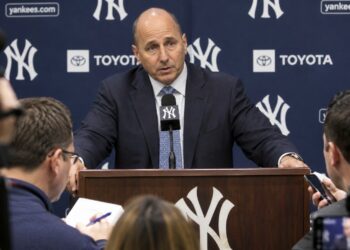
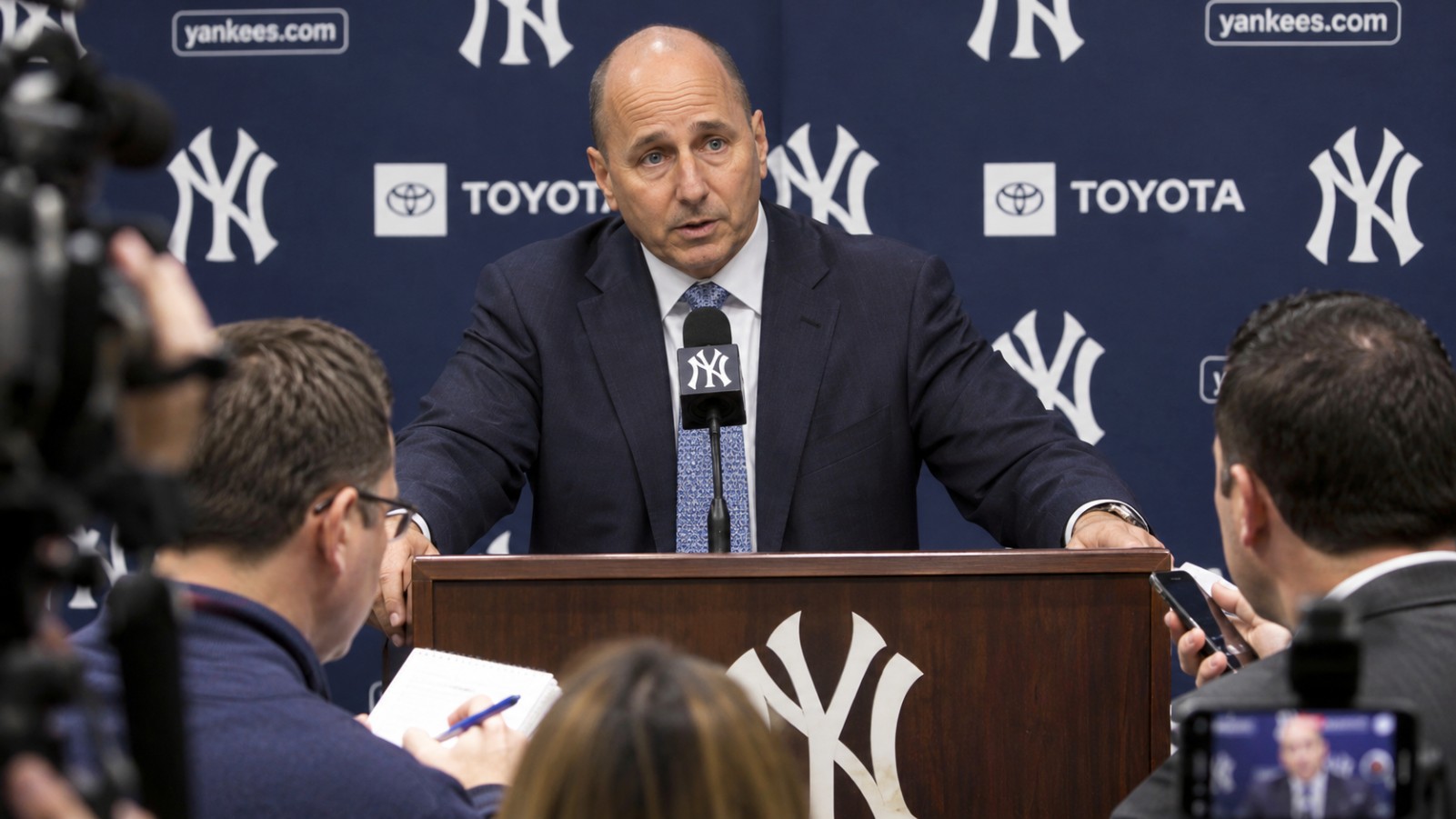
Brian Cashman addressed that question at MLB’s general managers meetings Tuesday, Nov. 10. His explanation separates a pair of high-profile departures from the wider baseball changes some fans had anticipated.
Cashman identifies the reason behind two departures
Cashman said the Yankees did not renew the expiring contracts of senior advisers Brian Sabean and Omar Minaya because of financial pressure. The two men joined the front office in January 2023 and brought decades of leadership and scouting experience.
The general manager said ownership had approved their additions, but the organization could no longer maintain those particular positions on the same terms.
“As costs continue to stretch here, I had to make some tough decisions,” Cashman said.
Cashman also said the Yankees do not intend to refill the two advisory jobs. That makes the move more than a routine switch from one set of veteran advisers to another.
His remarks provide a concrete explanation for a decision that initially appeared to signal a deeper internal response to another disappointing postseason. The announced plan removes positions rather than installing new voices in them.
Big payroll numbers create a different financial picture
The Yankees carried a reported $308 million player payroll in 2026 and approximately $31 million in luxury-tax obligations. Combined, those figures total roughly $339 million, although the tax is an additional expense rather than part of player payroll.
About $71.9 million in salary was scheduled to come off the books, but approximately $26.4 million in raises for returning players would absorb more than one-third of that amount. The difference is roughly $45.5 million before other roster moves and accounting adjustments.
Those figures help explain the pressure Cashman cited. They do not establish what Sabean and Minaya earned, how much the Yankees saved by letting them leave, or whether the payroll will be reduced in 2027.
Cashman said Hal Steinbrenner had given him a budget for offseason transactions. He did not disclose its size. The Yankees are evaluating deals and free agents within that limit as they try to address their roster needs.
The timing adds another complication. MLB faces labor uncertainty after the current collective bargaining agreement expires in December. No future salary cap or lockout outcome has been settled.
The distinction between an eliminated job and an open job
The Yankees’ personnel decisions now fall into two different categories. The advisory posts held by Sabean and Minaya are being discontinued. On the major league coaching staff, by contrast, Cashman is still weighing candidates and possible returns.
That contrast matters because the front-office decision is already final while the coaching structure is not. It also limits the argument that every departure is part of one sweeping philosophical reset.
James Rowson, who served as hitting coach for three seasons, has joined the SF Giants. Assistants Casey Dykes and Jake Hirst also have unsettled futures. Cashman said the club is considering internal and external options.
“We’re still working through our hitting coach situation,” Cashman said.
The Yankees already promoted Aaron Gershenfeld to major league field coordinator and catching coach after Tanner Swanson left for a bench-coach position in Seattle. Brad Ausmus also departed to take over the Astros’ managerial job.
Matt Blake, Preston Claiborne, Desi Druschel, Dan Fiorito and Luis Rojas are expected back on Aaron Boone’s staff. These are separate coaching developments, not announced replacements for the eliminated front-office advisory jobs.
Three coaching exits raise a harder question about replacement costs
The Yankees lost three developmental voices to other clubs. Tanner Swanson became Seattle’s bench coach. Shelley Duncan, the 2025 International League Manager of the Year, joined Boston’s major league staff.
Bench coach Brad Ausmus headed to take charge of the Astros while hitting coach James Rowson joined the SF Giants.
Spencer Medick left his Triple-A pitching-coach job to become Houston’s director of pitching. Those moves involved opportunities elsewhere, and Cashman has not linked them to budget cuts.
The losses test the Yankees’ spending approach. Comparable outside replacements could require greater investment. Internal promotions may preserve continuity, but do not automatically replace the experience that departed.
New York promoted Aaron Gershenfeld to succeed Swanson. Further appointments will show how the Yankees rebuild their support staff.
Veteran baseball experience leaves while leadership stays
Sabean’s Yankees history extends to the drafting of Derek Jeter, Andy Pettitte and Jorge Posada and the signing of Mariano Rivera. He subsequently led the San Francisco Giants’ baseball operation during their World Series championships in 2010, 2012 and 2014.
Minaya previously ran the Montreal Expos and New York Mets. Both joined the Yankees to provide experienced perspectives around Cashman, rather than to replace the club’s existing leadership.
Their exit therefore removes two established baseball voices, regardless of the stated budget rationale. Cashman is returning for a 30th season as general manager, and Boone is also returning after another early playoff elimination.
The Yankees have made a front-office reduction, hired Frank Herrmann for a player-evaluation and development integration role, and begun sorting their coaching vacancies. As of Nov. 11, Cashman’s public explanation for the Sabean and Minaya decisions remains cost control, not an announced strategic shakeup.
What do you think? Leave your comment below.