NEW YORK — The Yankees face another difficult decision at second base, with Jazz Chisholm Jr. on the open market and no settled answer waiting behind him. A familiar name has returned to the discussion, but a reunion would force New York to revisit questions it thought it had answered two years ago.
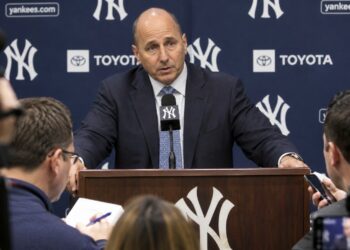
The Yankees need more reliable plate appearances after another early postseason exit. They also need dependable infield defense. Those priorities do not necessarily point toward the same player, complicating Brian Cashman’s search for a workable 2027 lineup.
Chisholm remains eligible to return, while Anthony Volpe and other internal candidates give the Yankees alternatives. None has yet eliminated the need to evaluate free agents who could take over second base without a long commitment.
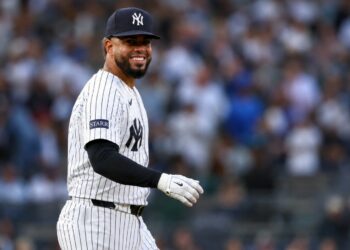
That search has brought renewed attention to Gleyber Torres, the former Yankees infielder who spent the last two seasons with Detroit. The three-time All-Star is a free agent after an injury-interrupted 2026 campaign, and his offensive strengths make a potential Bronx reunion worth examining.
Torres offers what Yankees have lacked at the plate
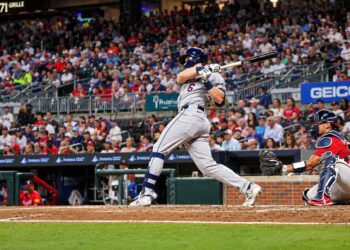
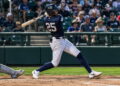
Torres hit .260 with a .364 on-base percentage, eight home runs and 38 RBIs in 96 games for the Tigers in 2026. Two left oblique injuries cut into his playing time, but his ability to reach base survived a decline in power.
His .727 OPS and 105 OPS+ reflected an above-average hitter, if not the 38-homer threat he was for the Yankees in 2019. Torres also finished with a .363 slugging percentage, a limitation for a club already seeking more production from several positions.
In 2025, his first year in Detroit, Torres hit .256 with 16 home runs, 74 RBIs and a .358 on-base percentage. He earned an All-Star selection before accepting a $22.025 million qualifying offer to remain with the Tigers for 2026.
A projected Yankees reunion remains a media proposal, not a reported agreement or confirmed negotiation. The Yankees would have to decide whether Torres’ approach at the plate outweighs the defensive concessions that come with his return.
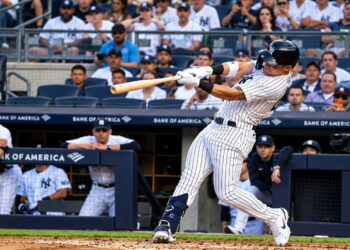
Torres has more than a passing history with the organization. He debuted in New York in 2018, was an All-Star in each of his first two seasons and stayed through the Yankees’ 2024 World Series appearance. His return would not require the usual adjustment to Yankee Stadium or to Boone’s expectations.
What it would require is a clear role. Signing a player for a narrowly defined offensive skill can help a roster, but it can also leave a general manager hunting for defensive replacements late in games. That balance is part of why the Yankees previously changed directions at second base.
A familiar disagreement still shadows a possible return
The concern goes beyond nostalgia. The Yankees moved on from Torres after the 2024 World Series season, following seven years that included two early All-Star appearances, uneven defensive play and a disagreement over his position.
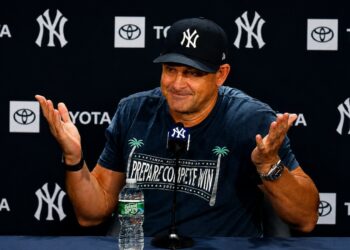
After the Yankees acquired Chisholm in July 2024, Cashman wanted Torres to move to third base. Manager Aaron Boone kept Torres at second and shifted Chisholm to third instead. Cashman later said Torres had been unwilling to change positions.
The earlier positional standoff is now part of the Yankees’ evaluation. A second-base commitment would be less disruptive than asking Torres to shift across the diamond, but it would also limit the roster flexibility New York could gain from another signing.
The offensive argument for a reunion has been advanced by Joe Najarian, whose assessment of the former Yankee highlighted both sides of the decision.
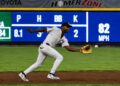
“On one hand, Torres would strictly be brought in for his bat, as his glove at second base remains mediocre (-5 OAA, -2 FRV),” Najarian wrote.
The position question matters again. The Yankees could seek a second baseman, but Torres has not established himself as a third-base solution. Re-signing him would not automatically address the club’s separate concerns at the hot corner.
The defensive cost of a higher on-base percentage
A comparison of Gleyber Torres‘ 2026 offensive and defensive numbers illustrates the tradeoff facing New York. His .364 on-base percentage was 104 points higher than his .260 batting average, reflecting his value in extending innings and reaching base without a hit.
At second base, however, Statcast credited Torres with minus-5 outs above average in 2026. It was the third consecutive season in which he finished at minus-5, according to Baseball Savant. That consistency complicates the case for signing him to strengthen the middle infield.
The distinction is particularly relevant for a Yankees club balancing its pitching staff, bullpen and infield needs. Improved on-base production would help the offense, but additional missed outs could put more pressure on the pitchers Cashman is also trying to support.
Torres’ situation also makes his contract more important than his name recognition. His $22.025 million salary in 2026 followed a qualifying offer, not a new multiyear market agreement. The price of another contract would have to reflect his 96-game season and shrinking power output.
Toronto provides another possible complication
The Yankees may not be alone in examining Torres. Toronto has been floated as another possible destination, with his history against the Blue Jays and experience at Rogers Centre contributing to the speculation.
The Blue Jays would offer an AL East destination for a player who knows the division well. Any competition from Toronto would add another variable to Cashman’s effort to settle second base, although interest has not been established as an active bidding contest.
Torres also faces competition from other free agents. The available second-base class includes Brandon Lowe, Luis Arraez and Isiah Kiner-Falefa, alongside Chisholm. Each offers a different combination of power, contact, defense and cost, giving New York several ways to shape a replacement plan.
That market could shape how long Torres remains available. His next deal would come after an injury-shortened season in which his walks and on-base percentage remained useful, but his home run total and defensive range fell below the level the Yankees would ideally seek from a full-time regular.
For now, Torres is part of the wider free-agent conversation rather than a confirmed Yankees target. The Yankees’ internal options and Torres’ defensive limitations remain central to whether a reunion develops into a realistic transaction.
What do you think? Leave your comment below.