NEW YORK — The New York Yankees anticipate their starting rotation will appear considerably stronger on paper heading into 2026, but theoretical depth doesn’t always convert to reliable April performance. Gerrit Cole and Carlos Rodón are both recovering from injuries and will likely face gradual workload increases, prompting the Yankees to continue surveying pitching additions. Michael King’s name keeps emerging in discussions. The rationale seems straightforward. The concerns are substantial.
A recent Newsweek examination advised the Yankees against chasing a reunion with the 30-year-old right-hander, even after his impressive results following his departure from the Bronx. The argument addresses the core of New York’s winter challenge. The Yankees require pitching dependability. King brings potential upside. He doesn’t provide guaranteed stability.
Rotation strength comes with risk


The Yankees view Cole as their staff anchor when healthy. His career accomplishments support that perspective. Rodón also represents a high-ceiling option, despite another campaign affected by physical limitations. Neither hurler, though, is projected to handle complete workloads when opening day arrives.
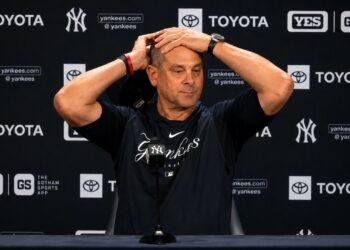
That circumstance carries significance. Early-season innings frequently determine standings outcomes later. Aaron Boone has stressed the importance of protecting his starters, particularly after recent years when injuries forced excessive bullpen deployment.
Beyond Cole and Rodón, the Yankees are counting on emerging talents. Cam Schlittler made positive impressions in October with his control and composure. His big-league experience remains minimal, however. The Yankees appreciate his development, but they don’t want to extend him past his current capacity.
The rotation appears skilled. It also appears vulnerable.
Michael King’s evolution away from New York
King’s progression with the San Diego Padres has received extensive coverage. Following five seasons with the Yankees working as a reliever and swingman, he shifted into a rotation position and produced strong results when available. His pitch arsenal advanced. His self-assurance grew alongside it.
That achievement drives reunion speculation. Supporters recall King as a reliable arm who never received a complete opportunity to start in New York. His output elsewhere indicates unrealized potential.
The Yankees aren’t assessing King as a sentimental narrative anymore. They’re evaluating him as a market-rate starting pitcher.
Expert caution enters the conversation
MLB.com’s Thomas Harrigan presented the argument against making a King reunion the top priority, a perspective featured by Newsweek and shared by evaluators throughout the league.
“All of that is to say that the Yankees may want to consider adding a starting pitcher this offseason, even if re signing Cody Bellinger is currently their top priority,” Harrigan wrote. “King is coming off an injury plagued campaign and has just one season as a healthy, full time starter on his resume, so he may not be the ideal fit for a team seeking more rotation certainty.
“King could also cost upwards of $20 million per year on a multiyear contract. The deals signed by Nathan Eovaldi three years $75 million, Sean Manaea three years $75 million and Yusei Kikuchi three years $63 million last offseason are reasonable comps. With other needs to address, a lower priced option might be preferable for New York.”
Those financial projections carry weight. The timing matters equally.
Contract math complicates the Yankees’ path
Jim Bowden of The Athletic forecasted King to land a three-year, $75 million agreement. That estimate matches the current marketplace for mid-rotation starters. It also creates stress on a Yankees payroll already managing competing priorities.
The Yankees stay concentrated on keeping Cody Bellinger. They also require bullpen reinforcements and infield depth. Committing $25 million annually to a pitcher with restricted starting durability generates consequences throughout the roster.
The Yankees have experienced this scenario previously. Extended commitments to pitching depth haven’t always maintained value over time.
Familiarity does not erase uncertainty

King’s existing relationship with New York represents an advantage. He comprehends the attention. He grasps the standards. Still, familiarity doesn’t alter the medical history.
King’s most recent season was disrupted by injury. His numbers when active were solid, but the Yankees are weighing availability equally with ability. Boone’s coaching staff prefers starters they can schedule every fifth day without continuous workload oversight.
That standard reduces the options considerably.
Boone’s emphasis on balance
Boone has regularly discussed balance over accumulation. The Yankees want pitchers who fit their roster blueprint, not overcrowd it.
Through that framework, a shorter commitment or cheaper acquisition may deliver greater value than a prominent signing. It would preserve flexibility while safeguarding Cole and Rodón early. It would also prevent blocking younger pitchers from established positions.
King’s expected cost and situation conflict with that approach.
The red flag behind the reunion idea
A Michael King return satisfies sentimental preferences. It also generates strategic uncertainties. The Yankees aren’t questioning whether King possesses talent. They’re questioning whether he matches their present risk capacity.
With Cole and Rodón already presenting health uncertainties, acquiring another starter with recent availability issues may multiply problems rather than resolve them.
That represents the warning signal. The Yankees need innings they can depend on. King provides possibility. He doesn’t remove questions.
For an organization pursuing consistency following recent rotation instability, that difference may determine the outcome.
The Yankees face a fundamental decision about how they construct their pitching staff. They can chase familiar names and hope injury histories don’t repeat. They can invest significant money in players whose recent track records include medical concerns. Or they can prioritize dependability over upside.
King’s situation embodies this dilemma perfectly. His talent isn’t disputed. His 2024 performance in San Diego, when healthy, showed genuine front-line capability. But one strong season as a starter, interrupted by injury, doesn’t establish the reliability pattern the Yankees desperately need.
The financial commitment required makes the gamble even steeper. Seventy-five million dollars represents substantial resources for a team already managing multiple roster requirements. That money allocated to King means less flexibility elsewhere.
The Yankees also must consider their organizational depth. Younger arms are developing. Blocking their pathways with expensive veterans who may not stay healthy serves neither short-term nor long-term interests.
Boone’s comments about balance reflect organizational philosophy. The Yankees learned expensive lessons about overcommitting to pitchers whose bodies couldn’t sustain the workload. Those lessons should inform current decisions.
King’s story with the Yankees was never fully written. His departure left questions about what might have been. But nostalgia makes poor roster strategy. The Yankees need answers, not additional questions.
The reunion concept appeals emotionally. Strategically, it presents more complications than solutions. For a Yankees team seeking rotation stability after years of injury disruptions, that distinction matters more than sentiment.
What do you think? Leave your comment below.