NEW YORK — At 27, Yankees emerging superstar Ben Rice is in his third MLB season. He is also, right now, one of the best sluggers in baseball.
Through the first three-plus weeks of 2026, Rice ranks second in the majors in OPS at 1.242. He ranks second in slugging at .774. Third in on-base percentage at .468. He is tied for fourth in extra-base hits. The young slugger has seven home runs, one behind Aaron Judge for the Yankees team lead. He has homered in three straight games for the first time in his career.
The Yankees get all these just at a cost of $845,800, the lowest salary for a Yankees slugger in 2026.
The clock on that arrangement is ticking. The Yankees need to make sure they are at the table before it runs out.
Boone’s words say everything the contract case needs
After Rice homered off a left-handed pitcher Saturday for the third time against lefties this season, Yankees manager Aaron Boone was asked to put what he is watching into words. Boone did not reach for cautious language or caveats about sample size.
“Benny’s just continuing to solidify himself as one of the really outstanding hitters in the league,” Boone said. “And we’re seeing that more and more, whatever hand you throw with.”
One of the really outstanding hitters in the league. From a Yankees manager describing a player earning $845,800. The gap between those two sentences is the entire point.
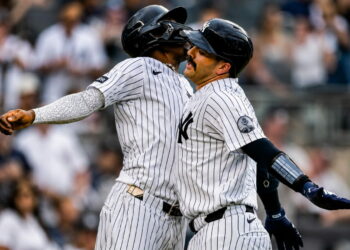
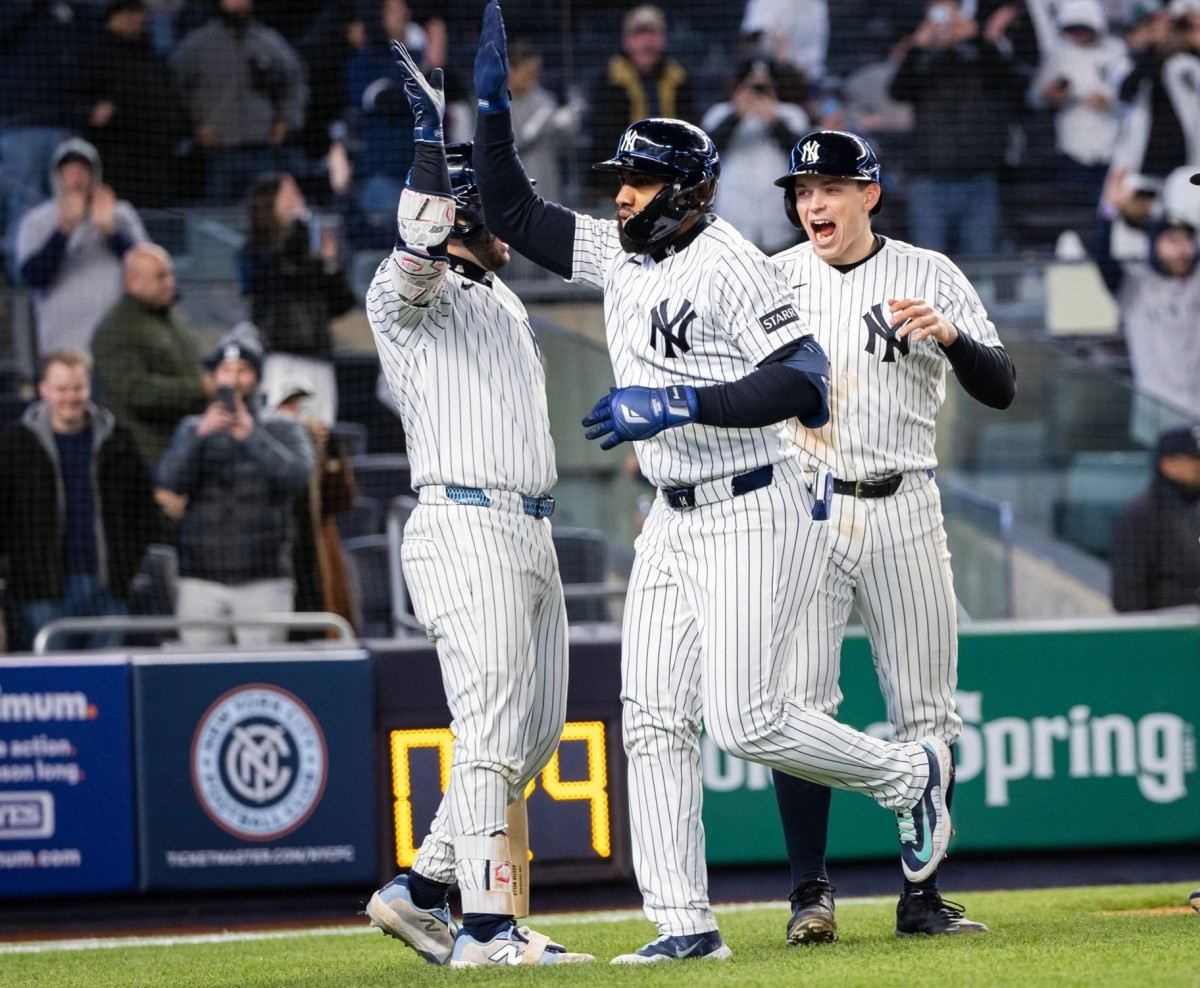
Rice went 1-for-3 in the 13-4 rout of the Royals on Saturday, the hit a second-deck homer to right field off lefthander Noah Cameron that capped a five-run third inning. He also walked twice. He reached base three times. Against a left-handed starter.
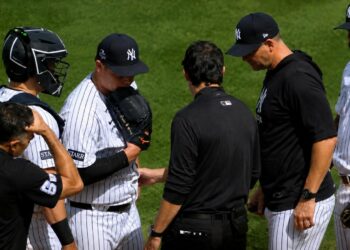
That last part matters specifically because earlier this week the Yankees sat Rice against back-to-back left-handed starters in the Angels series, which lit up social media and created a genuine debate about the team’s approach. Boone defended those decisions, noting that Paul Goldschmidt’s ability to punish lefties needs regular reps. Goldschmidt has hit .323 with a 1.005 OPS against left-handers in his career. The logic is real.
But as Boone himself acknowledged Saturday, it cannot be the default setting. Rice has hit .286 against lefties this season with a homer and a .833 OPS. Small sample. Positive direction. Not a reason to keep him in the freezer.
The numbers that make the extension case impossible to ignore
Entering Saturday’s blowout win, Rice was second in the majors in OPS at 1.205 and slugging at .746. He was third in on-base percentage at .459. The baby Bomber was one of only a handful of hitters in baseball producing at that level through three weeks.
He has hit lefties and righties. He has hit for power in three straight games. Rice has produced from the cleanup spot. He has been the Yankees’ most consistent bat through the season’s most grinding stretch.
Rice is also a former catcher learning first base at the big-league level. The Yankees knew this going in. They were willing to absorb the defensive awkwardness during development. The bet was that the bat would justify it. Through April 19, the bet is paying off at a level that exceeds even optimistic projections.
Rice entered the weekend slashing .339 with seven home runs and an OPS of 1.242. He was doing this on a pre-arbitration salary that is among the lowest on the Yankees roster.
What the Yankees must do and why history argues for urgency
The Yankees do not have a good recent record on extensions. The organization has not signed a player to a long-term deal since the Aaron Hicks extension in 2019, a contract that became a cautionary tale. Since then, they have let players reach free agency rather than commit early.
That posture works in some situations. It failed with Gleyber Torres, who walked away for less than expected but still left. It could fail again if Rice reaches arbitration, then free agency, before the Yankees act.
The comparable for Rice in the Yankees‘ own history is what the club described during the offseason as their vision: a middle-of-the-order bat at first base who can be their most potent presence at the position since Mark Teixeira. The Yankees said before spring training that Rice would be the everyday first baseman in 2026. He has made that look like an understatement.
Pre-arbitration extensions are typically signed at a discount to projected market value. The Yankees have the financial structure to absorb a Rice extension that keeps him in pinstripes through his prime. The question is whether the front office will act before the production makes the price prohibitive.
At $845,800, Ben Rice is the biggest bargain in the Yankees lineup. At 27, with three straight homer games and a 1.242 OPS, he is also a free agent waiting to happen if the Yankees are not paying attention. Aaron Boone has called him one of the best hitters in the league. The contract should reflect that before someone else makes the offer.
What do you think? Shouldn’t the Yankees make a move now?