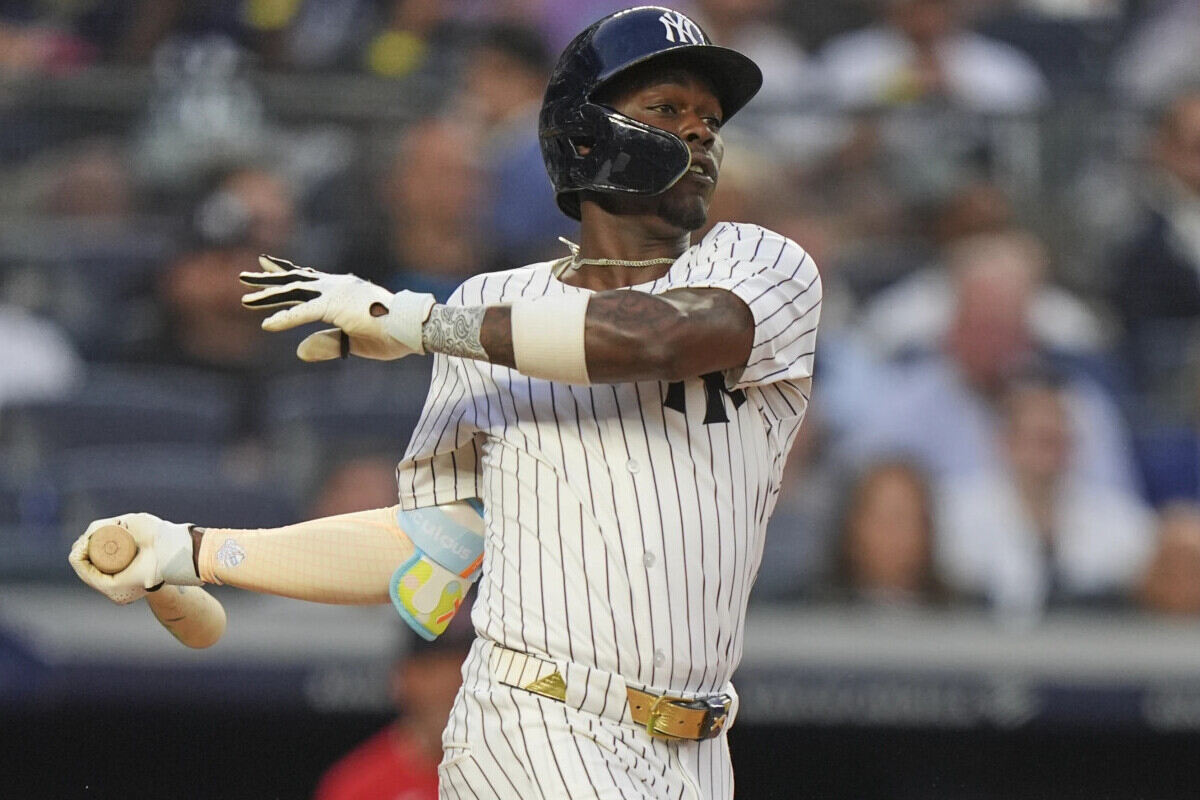
NEW YORK — Jazz Chisholm Jr. stood in front of reporters this spring and told them he wanted a 50-50 season. Fifty home runs, fifty stolen bases. He was not joking. He said it clearly, put his name on it, and moved on.
Through the first three-plus weeks, Chisholm has zero home runs for the Yankees. On Saturday, in a 13-4 blowout win over the Royals in which nearly every other Yankees bat contributed, Chisholm went 0-for-4 with three strikeouts and a walk. His slash line reads .164/.265/.233 across 73 plate appearances. His average exit velocity sits at 87.8 mph, ranking in the bottom 15 percent of the league.
This is Chisholm’s Yankees contract year. The gap between what he has produced and what he has publicly demanded is growing wider by the game.
A contract standoff already taking shape
Chisholm is earning $10.2 million in 2026 after avoiding arbitration in January. That number will not be the last figure either side discusses. Speaking to NJ.com’s Randy Miller before the season, Chisholm made his asking price clear.
“I’d say no because I know I can get $35 million somewhere else,” Chisholm said, when asked about a hypothetical Yankees offer below that number. “That’s $10 million less a year. I’m 28. I want 8-to-10 years.”
The Yankees front office has not initiated extension talks. That is consistent with the organization’s posture across the last six years. The front office has not offered a long-term extension since the Aaron Hicks deal in 2019, a contract that became one of the worst in franchise history and effectively ended the organizational appetite for locking up players before free agency.
General manager Brian Cashman offered a telling line at the Winter Meetings in December. He told reporters the Yankees were being open-minded about trade overtures for Chisholm. He also noted the lineup was too left-handed and needed balance. Chisholm bats left. So do Ben Rice, Austin Wells, Ryan McMahon and Trent Grisham.
Yankees trade speculation quieted when Bo Bichette signed with the Mets, closing the most logical replacement option. But the conditions that made Chisholm a trade candidate have not changed. And a slow start in a contract year reopens the conversation.
The numbers that make the case

Chisholm’s Statcast numbers through three Yankees weeks are not just a slump. The underlying numbers suggest a hitter who is not making hard contact. His expected weighted on-base average ranks in the sixth percentile. His expected batting average ranks 11th percentile. Thirteen strikeouts against one walk in 42 trips to the plate.
He is the only Yankees regular without a home run. Ryan McMahon finally hit one Friday. Cody Bellinger had zero through two months of spring and then hit two on Saturday alone. Chisholm, the player who had 31 home runs a season ago, has not left the yard once.
For context, last season he put up a .242/.332/.481 line with 31 stolen bases, earned a Silver Slugger award, and made his second All-Star team. He was one of only seven players in baseball to record a 30-30 season in 2025. The Statcast numbers that earned that kind of production have, for now, gone quiet.
Chisholm has pointed to the cold weather as a factor. The comment circulated quickly and raised eyebrows. A slow April he can survive. A slow April paired with a public statement that cold weather explains the struggles, in a city where October baseball regularly dips below 50 degrees, is the kind of thing that follows a player into contract negotiations.
What a trade could return and why it makes sense
The Yankees have genuine needs. The bullpen outside the top five arms is a revolving door of struggling relievers. Gerrit Cole and Carlos Rodon are weeks away from returning to the rotation, which will create a surplus of starters and force roster decisions. A trade involving the Yankees second baseman could address one of those problems while returning value for a player the organization will likely not re-sign.
Bleacher Report’s Joel Reuter projected Chisholm could command a deal approaching $200 million in free agency if he produces at last year’s level. That is precisely the price range the Yankees have shown no willingness to reach. GM Brian Cashman praised Chisholm in the offseason, telling reporters he is a winning player who brings energy and joy. High praise. Not a contract.
The Yankees’ top prospect George Lombard Jr. is the long-term answer at second base, but he is 20 years old and has not reached Triple-A. He is not ready in 2026. If the Yankees move Chisholm, Caballero and Rosario provide interim depth at the position.
Nothing is imminent in the Yankees organization. Chisholm has said he wants to stay in New York. The Yankees have not moved in his direction. A few weeks of production can change the narrative. But right now, in a contract year, hitting .200 with zero home runs while asking for $35 million per year, Jazz Chisholm Jr. is a trade piece that makes Yankees organizational sense.
What do you think? Leave your comment below.