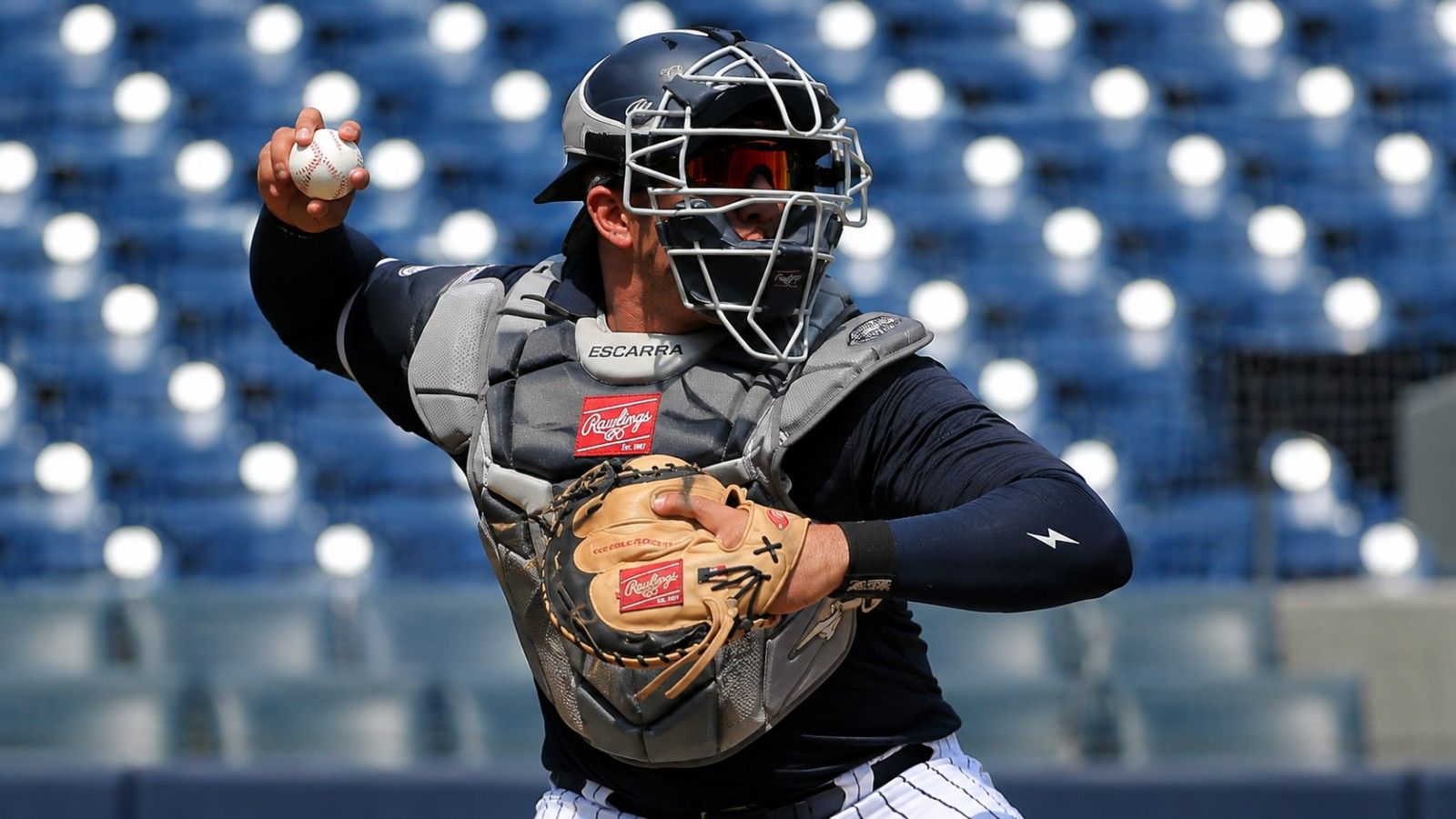
NEW YORK — Tyler Stephenson’s return to Cincinnati and Gary Sánchez’s reported agreement with Miami have narrowed the Yankees’ search for a right-handed catcher, leaving general manager Brian Cashman with fewer alternatives and a potentially more expensive negotiation.
The developments come after Ryan Jeffers accepted Minnesota’s qualifying offer last week. New York has spent the opening weeks of the offseason rebuilding its bullpen, but a position the club identified as an offensive weakness remains unresolved.
The Yankees want someone who can handle the pitching staff and give manager Aaron Boone a credible alternative to Austin Wells against left-handed starters. Finding that combination without paying for an everyday catcher is becoming increasingly difficult.
Three departures change the terms of Kelly’s pursuit
Carson Kelly, 32, is now the leading unsigned catcher in MLB.com’s rankings of the free-agent class, based on combined FanGraphs wins above replacement over the past two seasons. His 4.3 WAR puts him 2.2 wins ahead of Austin Hedges, the next available catcher on that list.
Cincinnati announced a two-year deal with Stephenson on Wednesday that includes a player option for 2029. The reported $30 million package establishes a $10 million annual benchmark across three seasons if the option is exercised.
Jeffers will earn $23.15 million in 2027 after accepting the Twins’ qualifying offer. Sánchez, a former Yankees All-Star, has reportedly agreed to a $6.5 million contract with the Marlins. Neither is a direct financial equivalent to Kelly, but both developments reduce the available supply.
Cashman’s warning becomes more pressing
At the general managers meetings earlier this month, Cashman identified defense and a right-handed bat as the priorities for the catching addition. He also acknowledged how difficult it would be to find that combination.
“If we can find a good-defending, right-handed-hitting option to level up, that’d be great,” Cashman said.
Kelly fits that description. He hit .258 with 10 home runs and a .712 OPS for Chicago in 2026. His .871 OPS against left-handers was considerably better than his .639 mark against right-handers, according to FanGraphs.
The Yankees have checked in on Kelly, according to Jon Heyman. The issue is whether they can offer sufficient playing time as well as a competitive salary. Kelly logged at least 110 games in each of his two seasons with the Cubs.
Kelly’s potential raise changes the economics of a platoon
FanGraphs’ median crowdsourced projection calls for a two-year, $20 million contract for Kelly. Its staff estimate is one year at $10 million. The projections were published before the latest catching agreements and are not confirmed salary demands.
At the median projection, Kelly would receive $8.5 million more than his previous two-year, $11.5 million Cubs deal. That amounts to a 73.9% increase in total contract value, with the average annual commitment rising from $5.75 million to $10 million.
For the Yankees, the calculation depends on usage. A catcher earning $10 million and starting 60 games would cost roughly $167,000 per start in annual salary. At 90 starts, that figure falls to about $111,000. Those illustrative figures exclude postseason play and other contributions.
A larger workload could justify Kelly’s salary. A conventional backup role would leave less money for the Yankees’ other needs.
Free-agent alternatives offer savings but require compromises
Austin Hedges would give the Yankees strong receiving skills and a .747 OPS against lefties in 2026. His limited overall offense makes him more suitable for a narrow backup role than regular duty.
James McCann brings experience and is accustomed to limited playing time. However, his defense has regressed, and he was more productive against right-handers last season, weakening his appeal as a platoon partner.
Kyle Higashioka knows the organization and offers power against lefties. The drawback is his declining throwing speed: He retired seven of 39 attempted base stealers in 2026 and suffered a flexor strain in July.
Elías Díaz offers solid defense and posted an .820 OPS against lefties in 2026. His limited on-base ability, however, reduces his offensive value beyond favorable matchups.
Jonah Heim is a switch-hitter who recorded an .855 OPS against lefties last season, according to Statcast. His .471 OPS against righties makes him a risky choice if Wells misses extended time.
Trade options offer upside at the cost of young talent
Heyman reported interest in two Padres catchers. Freddy Fermin offers reliable defense, but his .599 OPS over the past two seasons would do little to address the Yankees’ offensive weakness.
Luis Campusano offers greater offensive potential after batting .265 with a .795 OPS in 2026. His throwing has improved, although New York would need to evaluate whether his defense meets Cashman’s requirements and whether San Diego’s asking price is reasonable.
Ivan Herrera owns a career .863 OPS against lefties. The Cardinals catcher could strengthen the lineup, but he spent much of 2026 at designated hitter and has struggled to control the running game.
Pedro Pages offers St. Louis a defense-first alternative. His receiving skills could appeal to the Yankees, but his limited hitting would leave much of their platoon problem unresolved.
Agustín Ramírez, the former Yankees prospect sent to Miami in the Jazz Chisholm Jr. trade, offers power and a .755 OPS against lefties across two MLB seasons. His defensive shortcomings complicate a reunion, and Miami has not established that he is available.
As of Nov. 27, the Yankees have not announced a catching addition. A trade could preserve payroll flexibility, but Cashman would need to weigh the talent surrendered against the cost of signing Kelly before the expected transaction freeze.
What do you think? Leave your comment below.