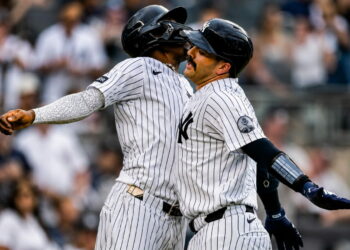
NEW YORK — The Yankees held firm on years. They refused to give Cody Bellinger the seven-year commitment he wanted. Agent Scott Boras pushed. Brian Cashman pushed back. The stalemate stretched deep into January.
Then the Yankees blinked in other ways.
To secure the 2019 National League MVP for another season, the team loaded the contract with concessions. Multiple opt-outs. A $20 million signing bonus. A full no-trade clause. No deferrals. The five-year, $162.5 million deal announced Wednesday gives Bellinger control over his future and leaves the Yankees with significant roster uncertainty just two seasons from now.
The opt-out problem the Yankees created

Bellinger can opt out after the 2027 season. He can opt out again after 2028. These clauses hand him future leverage the Yankees desperately tried to avoid conceding.
The math is brutal for the Bronx front office. Bellinger will pocket $85 million over the first two years thanks to the front-loaded structure and massive signing bonus. His salary is set at $32.5 million annually in 2026 and 2027. When his first opt-out decision arrives, he will have three years and $77.5 million left on the deal.
If Bellinger performs well, he walks. He hits free agency at age 32, still young enough to command another major contract. The Yankees lose their left fielder and start the search again. If Bellinger declines or gets hurt, he stays. The team is stuck paying $25.8 million per year for a player no longer producing at that level.
Opt-outs create a lose-lose scenario. Teams only keep the player when it benefits the player to stay. The Yankees agreed to this twice in the same contract.
No-trade clause limits future flexibility
The full no-trade clause adds another layer of complexity. If Bellinger struggles, the Yankees cannot move him without his approval. They cannot include him in a salary dump. They cannot trade him to clear roster space for emerging prospects.
Jasson Dominguez and Spencer Jones remain in the system. Both need playing time to develop. Both project as left fielders. If Bellinger declines but refuses to waive his no-trade clause, the Yankees face a roster logjam with no easy exit.
Bellinger has control. The Yankees surrendered it.
The compromise that forced the Yankees’ hand
Bellinger and Boras initially sought seven years and $266 million. The Yankees refused to budge past five years. They made at least two offers this month, bending on opt-out clauses and the signing bonus but holding firm on the length.
The reported “final offer” 11 days ago sat in the $155 million to $160 million range. The actual deal came in at $162.5 million. Someone sweetened the pot at the finish line. Reports suggest Cashman added contract incentives that Boras demanded to close the gap.
The word “fit” suggested a limit. But when the Mets traded for Luis Robert Jr. on Tuesday night and the Blue Jays dropped out, the Yankees had nowhere else to turn. Bellinger was the last premium bat available. The market dictated the terms. Cashman had to pay them.
Why the Yankees needed Bellinger back
The numbers explain the urgency. The Yankees led the majors in runs scored (849), home runs (274), and OPS-plus (118) last season. Bellinger was central to that production.
He batted .272 with 29 home runs, 98 RBI, and an .813 OPS in 152 games. His 5.1 WAR ranked second on the team behind Aaron Judge. His 13.7 percent strikeout rate was the lowest of any Yankees regular. He hit .353 with a 1.016 OPS against left-handed pitching.
Yankee Stadium fit his swing perfectly. He slashed .302/.365/.544 at home with 18 of his 29 homers coming in the Bronx. On the road, those numbers dropped to .241/.301/.414. No other ballpark would give him that advantage.
“I had an unbelievable time putting on this uniform,” Bellinger said after the Yankees’ ALDS loss to Toronto in October. “Yankee Stadium, the fans, the organization, the culture that these guys have created in this locker room. It really is special.”
The 2027 planning nightmare
The Yankees now face significant roster uncertainty. If Bellinger performs at or above his 2025 level, he will almost certainly opt out. He would be 32 years old with proven production at Yankee Stadium. Teams will pay premium prices.
That means the Yankees could lose their left fielder after the 2027 season. They would enter the 2028 offseason needing to replace a lineup anchor. Dominguez might not be ready. Jones might already be traded in a pitching deal. The farm system might be depleted.
The contract also includes a lockout protection clause. If the 2027 season is canceled due to a work stoppage, the opt-outs push back by a year. The Yankees negotiated that detail to guarantee at least two full seasons. But that protection only delays the uncertainty. It does not eliminate it.
Lessons from the Soto saga

Last winter, the Yankees played the bidding game trying to keep Juan Soto. They believed he would return. Owner Hal Steinbrenner offered 16 years and $760 million. The Mets swooped in with 15 years and $765 million plus perks. The Yankees lost.
This time, Cashman drew a different line. He set his price. He waited. Reports surfaced that the Yankees were prepared to let Bellinger walk if another team made a larger offer. Bill Madden of the New York Daily News wrote that Boras was “hoping to find one dumb owner” to drive up the price. The Yankees refused to be that owner.
They won on years. They lost on everything else.
The deal that might only last two years
The Yankees signed Bellinger to a five-year contract that might function as a two-year rental. They paid $162.5 million for the right to keep him through 2027. They surrendered control of everything beyond that.
This is the cost of patience. The Yankees waited. The market collapsed. Bellinger had no better options. But neither did the Yankees. Both sides compromised. Both sides gave up something valuable.
Bellinger gets security with flexibility. The Yankees get their left fielder back. But when the opt-out decisions arrive in 2027 and 2028, the leverage will shift again. Bellinger will hold the cards. The Yankees will wait.
The championship drought continues at 16 years. The roster is set. The compromises are complete. Now the Yankees must prove these terms were worth it.
What do you think? Leave your comment below.