NEW YORK — Former Yankees star Alex Rodriguez delivered a heartfelt tribute to Pete Rose during Fanatics Fest weekend that revealed deep personal connections to baseball’s complicated legacy questions. The New York Yankees legend suggested that Rose’s exclusion from the Hall of Fame may have shortened his life.
Rose died in September 2024 at age 83 without receiving Cooperstown recognition. MLB lifted his lifetime ban eight months later in May 2025. For Rodriguez, the timing represented a tragic missed opportunity.
“Pete Rose, a great friend of mine,” Rodriguez said on WFAN. “It just breaks my heart that he’s gonna get in now. But I actually feel that if he would have gotten in, he would have lived another five years.”
The emotional statement reflects Rodriguez’s own struggles with baseball recognition and legacy preservation.
Ban lifted too late for baseball’s hit king

Pete Rose accumulated 4,256 career hits but remained baseball’s most controversial figure. MLB imposed a lifetime ban in 1989 after discovering Rose bet on games while managing Cincinnati. Rule 21 made him ineligible for Hall of Fame consideration despite overwhelming statistical credentials.
Multiple appeals, presidential support, and public campaigns failed to overturn the decision during Rose’s lifetime. Commissioner Rob Manfred finally reversed the ban in May 2025, citing changed circumstances.
“In my view, once an individual has passed away, the purposes of Rule 21 have been served,” Manfred wrote, referencing the rule’s deterrent function and integrity protection goals.
The posthumous reversal brought both vindication and frustration. Rodriguez viewed it as justice delivered too late.
Rodriguez and Rose: Shared experience for controversial duo
Rodriguez sees parallels between his situation and Rose’s struggle for acceptance. Both players achieved remarkable success while battling lasting controversies. Rodriguez faced his own suspension and continues fighting for recognition.
“Baseball is tough, right?” Rodriguez said. “It was a lifetime sentence. I got to do my time and live with it forever.”
Rodriguez served a full-season suspension in 2014 for performance-enhancing drug use. His return to the Yankees proved contentious, ending without the ceremonial farewell afforded to other franchise legends. His final game came on August 12, 2016, when the team released him.
The Yankees have since assigned Rodriguez’s No. 13 to two different players. Monument Park’s recognition remains uncertain despite its statistical achievements.
Rodriguez’s Cooperstown candidacy stays in limbo despite overwhelming numbers. He ranks fourth all-time with 696 home runs, collected 3,115 hits, earned three MVP awards, and made 14 All-Star teams.
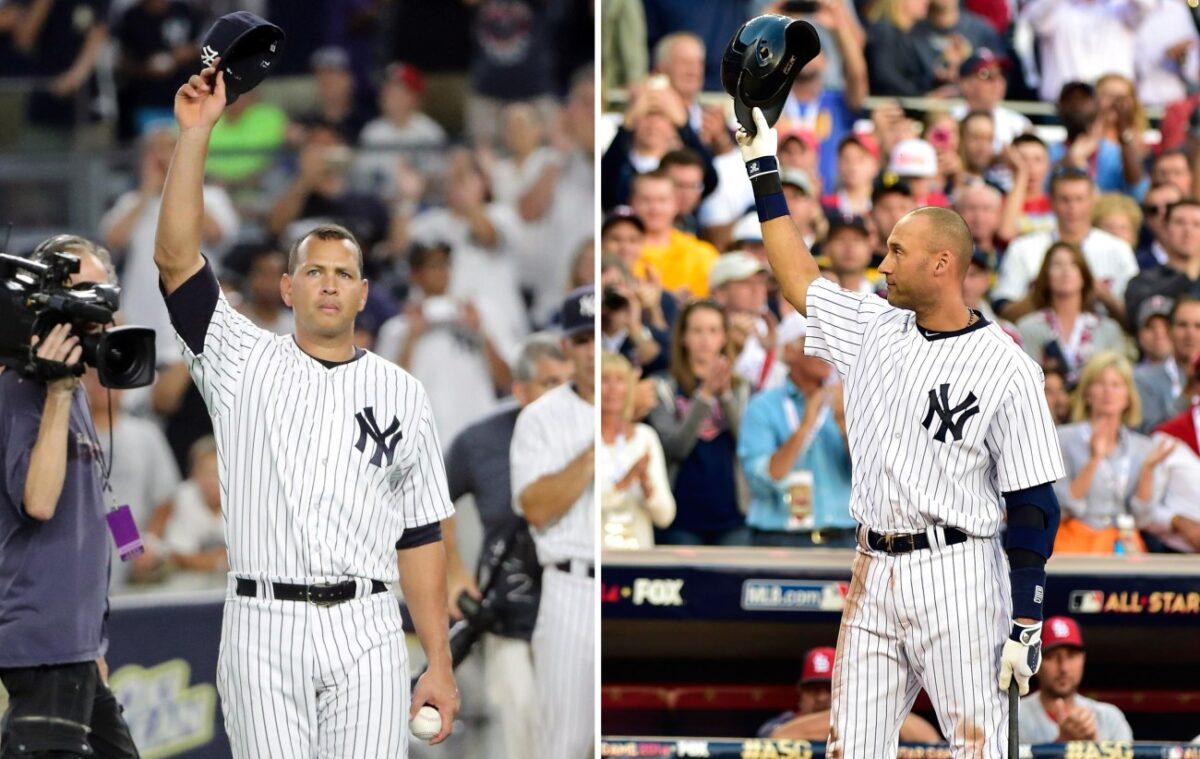
His Yankees tenure produced 351 home runs, ranking fifth in franchise history. He played a crucial role in the 2009 World Series championship, posting six homers, 18 RBIs, and a 1.330 OPS during the playoff run.
Rodriguez’s 51.5 fWAR in pinstripes ranks eighth in team history, placing him alongside Ruth, Gehrig, and Mantle. Yet his path to Monument Park remains unclear.
“I would love to be in,” Rodriguez admitted. “But that’s not my decision.”
Yankees recognition still uncertain
Rodriguez returned to Yankee Stadium for Old-Timers’ Day in 2024, celebrating the 2009 championship team. The appearance marked a significant warming in previously strained relationships. He shared the stage with Monument Park honorees Jeter, Rivera, Posada, and Pettitte.
Despite dominant performance during his Yankees career, Rodriguez remains viewed through controversy. The Biogenesis scandal, legal disputes, and executive conflicts continue to affect his standing. His statistics alone haven’t guaranteed recognition.
Two legends face similar judgement
Rodriguez’s Rose comments revealed deeper meaning beyond simple tribute. Both men achieved extraordinary baseball success while facing exclusion from the sport’s highest honors.
“I had never met anyone that loves baseball more than Pete Rose,” Rodriguez said. “And it broke my heart that he couldn’t get in while he was alive.”
The statement carries personal weight. Rodriguez understands how delayed recognition can feel punitive rather than redemptive.
Future remains uncertain
Rose’s reinstatement shifts attention to potential Cooperstown consideration. Rodriguez’s Monument Park inclusion continues generating debate among Yankees fans and officials.
Baseball historians remain divided on both cases. Statistical achievement conflicts with character concerns in determining legacy recognition.
Rodriguez’s numbers support inclusion, but perception issues persist. Like Rose, his ultimate fate may depend more on forgiveness than performance.
The parallel between these controversial stars highlights baseball’s ongoing struggle to balance achievement with accountability in preserving its history.
What do you think? Leave your comment below.