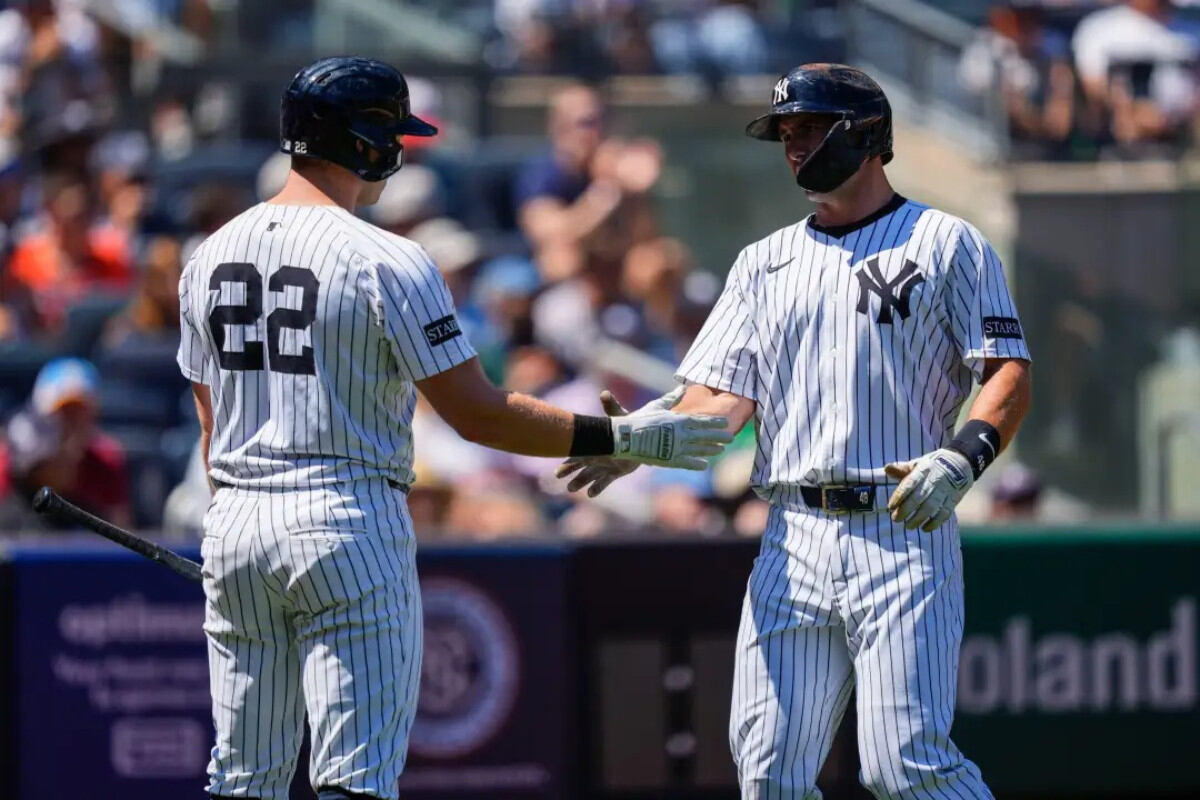
TAMPA, Fla. — Ben Rice was supposed to have the simplest job description on the Yankees this spring. Show up. Play first base. Hit in the middle of the lineup. The 26-home-run breakout from 2025 had settled the position. Rice was the guy.
Then the Yankees brought Paul Goldschmidt back on a one-year, $4 million deal. And what looked like a clean roster picture suddenly got a lot messier.
Aaron Boone appeared on MLB Network Radio on SiriusXM on Sunday and acknowledged what many fans had already suspected. Goldschmidt’s return does not just add a veteran bat to the bench. It reshapes how the Yankees plan to use their best young hitter on a daily basis.
Rice was the everyday first baseman until this happened
Ben Rice earned his spot the hard way. In 2025, he slashed .255/.337/.499 with 26 home runs across 530 plate appearances. He started 46 games at first base, 26 at catcher and 48 at designated hitter. He showed the Yankees he could hit MLB pitching with authority. He showed them he could handle multiple positions.
Before the Goldschmidt signing, Boone envisioned Rice as the everyday first baseman with emergency catching duties. A third catcher behind Austin Wells and backup J.C. Escarra. Someone who could step in late in a game if the Yankees made an aggressive bench move. Nothing more.
That plan changed on Feb. 6 when Goldschmidt agreed to return.
What Boone said about the ‘complication’
Boone did not sugarcoat it. He called the situation what it is.
“I don’t anticipate it affecting Rice because we think Rice is a star and we think he’s going to mash in the middle of the lineup for a long time,” Boone said.
But then he explained the shift.
“Before we signed Goldy back, I was thinking Rice is truly our third catcher. Protect you late in the game if you make an aggressive move with the bench or whatever, you got that coverage,” Boone said. “Now, it probably pushes him a little more into, I don’t expect a lot, but somewhat more of a catching role. There’s tough lefty days, we’re going to want Goldy in there, we could put Ben behind the plate because we feel he’s going to hold his own too against lefties.”
Then came the admission.
“So it complicates it there a little bit, but to finish off our roster with a really good player, we felt like we had to do it.”
The numbers that drove the decision
Goldschmidt’s overall 2025 numbers were modest. He hit .274/.328/.403 with 10 home runs in 534 plate appearances. But the splits told a different story. Against left-handed pitching, the 38-year-old posted a .336/.411/.570 slash line with a .981 OPS. That ranked fourth among all qualified MLB hitters in that split.
Rice, meanwhile, struggled from the left side against southpaws. He hit just .208 with a .271 on-base percentage in 119 plate appearances against lefties. His seven home runs in those matchups showed power, but the average and OBP were well below acceptable.
The math is straightforward. On days a tough left-hander takes the mound, Goldschmidt slides to first base and Rice moves behind the plate. The Yankees keep both bats in the lineup while upgrading their platoon advantage. It is a smart roster move. It is also an honest acknowledgment that Rice is not yet a complete hitter against all pitching types.
Goldschmidt was not the perfect fit and Boone knows it
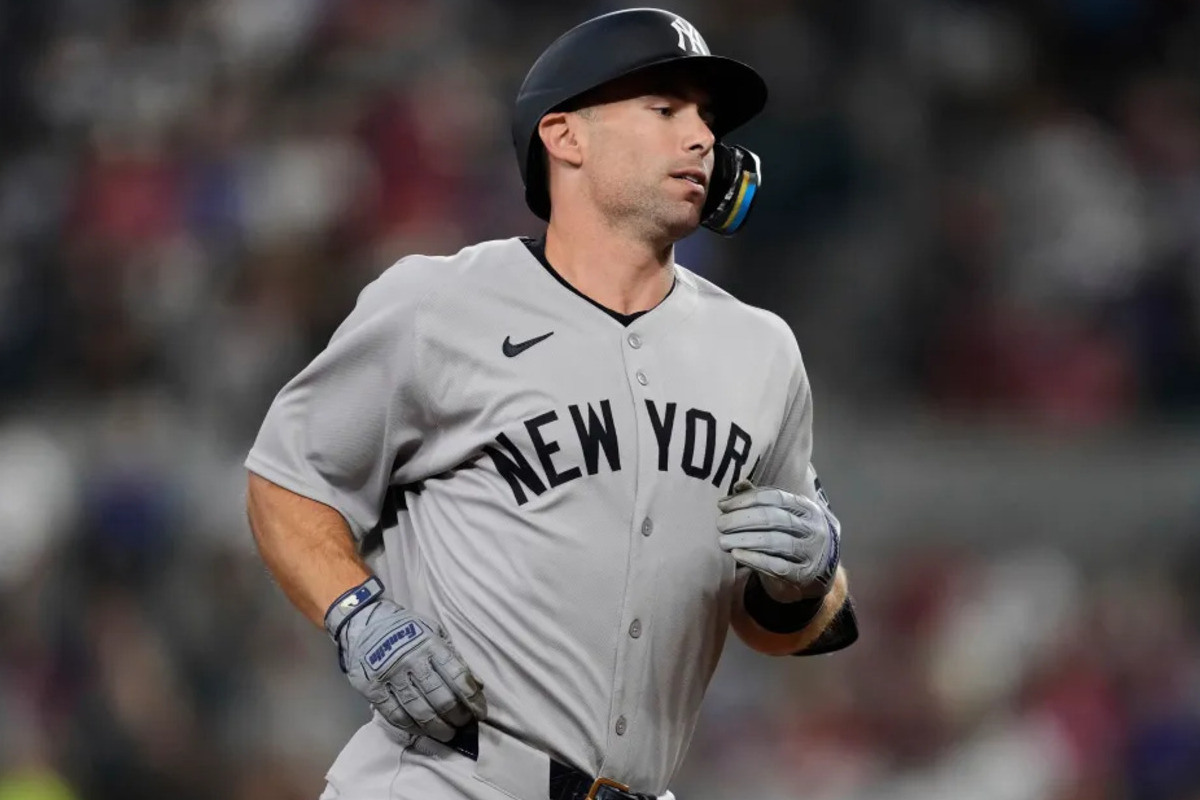
Boone was candid about the front office’s original wish list. The Yankees wanted a right-handed hitting outfielder. That would have addressed the lineup’s heavy left-handed lean without creating a positional overlap at first base.
Boone acknowledged that Goldschmidt “wasn’t necessarily the perfect fit” given the composition of the projected roster. But with few impact bats remaining in free agency, the Yankees chose the best player available rather than waiting for the ideal profile.
The club explored other options before circling back to Goldschmidt. They held discussions with Ty France as recently as Feb. 4. They offered Austin Slater a one-year, $1 million deal. They passed entirely on Miguel Andujar due to defensive concerns. In the end, Goldschmidt’s bat against lefties, his glove at first base and his willingness to accept a reduced role at $4 million made the most sense.
The bench battle that follows
Goldschmidt’s return triggers a chain reaction across the Yankees’ bench. If everyone stays healthy through spring training, the bench will include Goldschmidt, utility man Amed Rosario and two of the following three players: Escarra, Oswaldo Cabrera and Jasson Dominguez.
Escarra still projects as the primary backup catcher. But if Rice handles more catching duties against lefties, the Yankees could carry Cabrera and Dominguez instead of Escarra for some stretches.
Cabrera and Dominguez are both switch-hitters who produce better from the left side. The Yankees may need Cabrera specifically as a backup shortstop behind Jose Caballero. Boone indicated last season that the club was not comfortable playing Rosario at short.
As for Dominguez and top outfield prospect Spencer Jones, Boone made clear that a strict bench role is unlikely for either player.
“Probably not in either situation a case where we’d want them as bench pieces, that doesn’t mean there’s not a scenario where they’re part of a true rotation where there’s real regular playing time,” Boone said. “But there’s a lot to still happen between now and when we break camp in late March.”
Jon Heyman of the New York Post reported that Dominguez is likely headed to Triple-A to start the season. That now appears even more certain with Goldschmidt, Rosario and Cabrera filling the bench spots ahead of him. Pitchers and catchers report to Tampa on Feb. 11. The first full-squad workout is Feb. 17. Rice will be there with his first baseman’s mitt and his catcher’s gear, ready for whatever role the Yankees hand him.
What do you think? Leave your comment below.