PORT CHARLOTTE, Fla. — Remember the torpedo bat craze? It swept through baseball about a year ago like wildfire. Social media went nuts. Everyone had an opinion. Then the noise died down and most people forgot about it.
J.C. Escarra did not forget. The Yankees backup catcher tried one early last season but did not see immediate results. He went back to a standard bat. The experiment seemed over.
It was not. This spring, Escarra is back with a torpedo bat. But this one is different. And the results are turning heads inside the Yankees clubhouse.
A heavier Aaron Judge model redesigned for Escarra’s swing

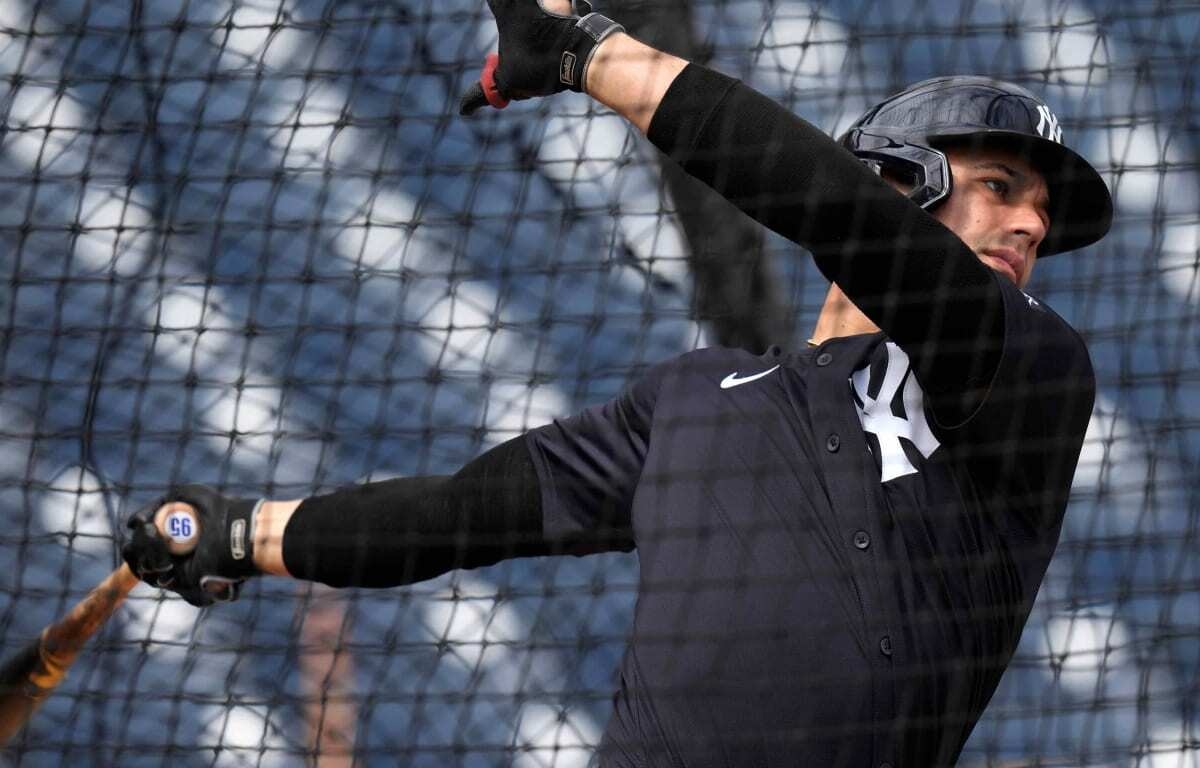
The Yankees analytics department got involved over the offseason. Zac Fieroh, the club’s manager of analytics and implementation in quantitative analysis, worked with Escarra to find the right fit. They took a heavier Aaron Judge model bat and turned it into a torpedo bat specifically designed to match Escarra’s swing.
The idea behind the torpedo bat is simple. It gives hitters a larger barrel, which means more surface area to make contact. For a player like Escarra, who hit .202 with just two home runs in limited action last season, that extra margin could be the difference between foul tips and line drives.
“I think it has to be the torpedo bats,” Escarra said after a three-hit day Tuesday that included a 438-foot home run off Rays starter Ryan Pepiot in a 3-2 Yankees win at Charlotte Sports Park. “My boy Zac in the analytic hitting department, he’s doing a great job with my bats. I bought into the torpedo bats and maybe it’s that. Maybe it’s not, but I like to think so.”
He added: “This year, I said I’m going to live and die by this bat.”
Exit velocity numbers tell the story
The early data backs up Escarra’s belief. His homer on Tuesday came off the bat at 108.4 mph. That was his second-highest exit velocity of the spring for the Yankees. His first home run on Feb. 27 registered at 109.6 mph. Both figures are higher than his regular-season career high of 107.1 mph.
Escarra came into Tuesday’s game with an average exit velocity of 94.1 mph this spring. That is up from the 90.8 mph he averaged during his first big league season with the Yankees in 2025. A 3.3 mph jump in average exit velocity is significant at this level.
“I found one that feels comfortable and they made it into how my swing works,” Escarra said. “So I’m seeing it through. I like to think it gives me a little bit of an edge.”
He explained the advantage in practical terms. “It gives me the biggest barrel that I can use, so maybe that pitch I used to miss, now I’m foul-tipping it and giving me another chance to hit. Maybe I just missed it and then the next one I hit it a little better. It’s all about the small advantages it gives me.”
Boone sees a top-half-of-the-league catcher

Yankees manager Aaron Boone has been saying it all spring. He believes Escarra is better than his numbers showed last season.
“J.C. is a really good player. I tell him this, too. He just hasn’t gotten a chance yet,” Boone said. “There’s no doubt in my mind that he’s a top-half-of-the-league catcher. He can play, man.”
Escarra won over the Yankees fan base last season as the former Uber driver who made the team out of spring training. He hit .202 with two homers and a .629 OPS across 40 games and 98 plate appearances. His defense was the stronger side. He posted above-average framing metrics behind the plate.
But playing time dried up in the second half. Ben Rice took on more catching duties as the Yankees looked to keep his bat in the lineup. Escarra was sent down to Triple-A.
The defensive side is improving too
Escarra is not relying only on the torpedo bat to make an impression this Yankees spring training. He has also made throwing out runners a point of emphasis this spring. Last season, he caught just one runner stealing on 20 attempts. The Yankees as a team had the 10th-lowest caught stealing percentage in MLB at 20.3% (26-for-128).
On Tuesday, Escarra threw out a runner trying to steal second. It was a small moment in a spring training game. But for a backup catcher trying to prove he belongs on the Yankees 26-man Opening Day roster, every rep matters.
“I know my role, and I’m going to try to be the best at my role,” Escarra said. “Whatever the team needs, I’m going to be ready for it.”
A crowded bench picture for the Yankees
Escarra is expected to make the Yankees roster as the traditional backup catcher behind Austin Wells. But the bench picture is crowded. Rice is now the starting first baseman. The question is how much playing time Escarra will actually see.
If the torpedo bat keeps producing exit velocities near 110 mph, that conversation could change. The Yankees analytics department built this bat for Escarra’s swing. Boone already believes he is an undervalued player. Now Escarra is trying to prove it with results.
He crushed a 438-foot homer on Tuesday. He is hitting the ball harder than he ever has. And he is doing it with an Aaron Judge model bat reshaped into something uniquely his own. If it keeps working, the Yankees may have found a weapon from an unexpected corner of the roster.
The torpedo bat craze may have faded from the headlines. For Escarra and the Yankees, it is just getting started.
What do you think? Leave your comment below.