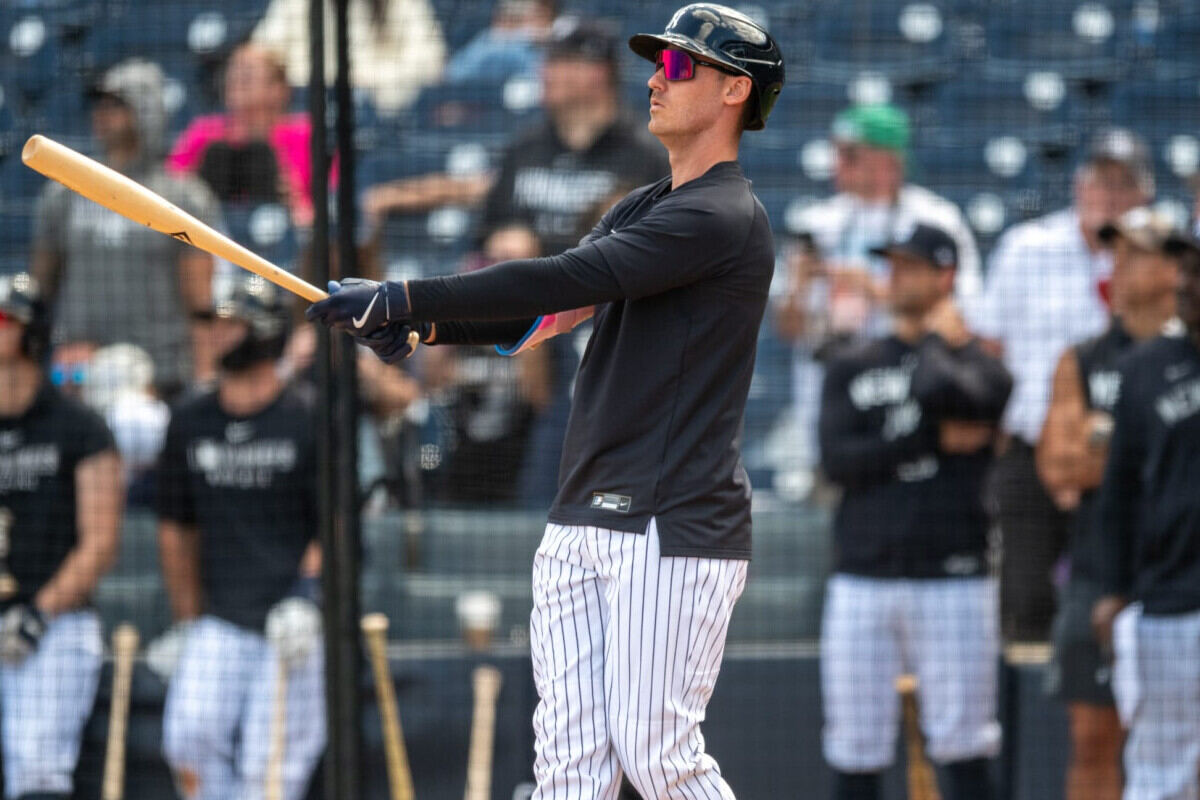
TAMPA, Fla. — Cody Bellinger was already at the Yankees’ player development complex before pitchers and catchers were required to report. He had been spotted on the field in recent days, putting in early work alongside several teammates as the club gears up for spring training.
The 30-year-old outfielder did not have to be there this soon. Position players are not due in Tampa until Feb. 15. But Bellinger wanted to get a jump on the 2026 season, and his presence sent a simple message. He is locked in.
What makes this offseason different for Bellinger is not just the early arrival. It is the contract that brought him back. The five-year, $162.5 million deal he signed with the Yankees on Jan. 26 has been dissected from every angle since the ink dried. And as spring training opens this week, more layers of the agreement continue to surface.
The latest? A provision buried in the contract language that has never appeared in an MLB deal before.
A clause built for a lockout that may be coming
Most player contracts tie opt-outs to specific calendar years. Bellinger’s does not. Instead of giving him the right to opt out after the 2027 and 2028 seasons, the way every other deal in baseball is written, his contract allows him to opt out after “the second and third Championship played.”
That is the key phrase. Championship played. Not calendar year. Not season on the schedule. Championship played.
The distinction matters because the current collective bargaining agreement expires in December 2026. Industry insiders widely expect the owners to lock out the players, just as they did four years ago. If a work stoppage wipes out the 2027 season entirely, Bellinger’s opt-outs would shift to after the 2028 and 2029 campaigns. The Yankees would be guaranteed at least two full seasons of his production.
“We have what I call kind of a glass of labor fluidity,” agent Scott Boras told Sports Illustrated’s Stephanie Apstein, describing the uncertainty both sides faced during negotiations.
According to SI, this is believed to be the only contract in baseball containing such language. It is a first-of-its-kind provision that could set a precedent for future deals signed in the shadow of labor unrest.
Why the clause protects both sides

The lockout-proof language may seem like a team-friendly detail, and in many ways it is. Without it, a canceled 2027 season would mean Bellinger could opt out having played just one year in the Bronx. The Yankees would have committed $85 million over two calendar years for a single season of on-field production.
But there is a benefit for Bellinger, too. If he wants to re-enter free agency, he needs two strong seasons to showcase his value. A lockout year would rob him of that opportunity. By tying the opt-outs to seasons actually played, both sides ensure the partnership gets a fair runway.
Bellinger also secured a $20 million signing bonus as a separate form of lockout insurance. Half was paid on April 1 and the other half on Aug. 1. If negotiations for a new CBA collapse and games are lost, Bellinger already has a substantial financial cushion in hand.
The hidden cost on the luxury tax ledger
The contract’s impact goes beyond the lockout clause. Because of the front-loaded salary structure and the opt-out years that follow, a CBA mechanism known as the “valley charge” inflates Bellinger’s competitive balance tax number well beyond his actual salary.
“Thus, Bellinger will count as $48.55 million in total for the 2026 season for luxury tax purposes,” Joel Sherman of the New York Post reported. That includes the valley charge pushing his CBT hit to $44.75 million, plus $3.8 million in “true up” costs from his previous contract with the Cubs.
That means Bellinger will count for more against the Yankees’ tax bill in 2026 than Aaron Judge, who earns $40 million annually on his nine-year deal. The irony is not lost on fans. But the front office considered it the cost of doing business.
Bellinger’s 2025 numbers back the investment
If the contract language is complicated, the on-field case for Bellinger is not. He hit .272/.334/.480 with 29 home runs, 98 RBI and 13 stolen bases in 152 games last season. His strikeout rate ranked in the 91st percentile among all MLB hitters. His whiff rate sat in the 81st percentile. His defense in the outfield graded at 12 Defensive Runs Saved and six Outs Above Average.
He posted a 4.9 fWAR, making him arguably the Yankees’ second most valuable position player behind Judge. His 1.016 OPS against left-handed pitching in 176 plate appearances showed he could handle same-side matchups, a key consideration in a lineup that skews heavily left-handed.
“I had an unbelievable time putting on this uniform,” Bellinger said before re-signing. “Yankee Stadium, the fans, the organization, the culture that these guys have created in this locker room, it really is special.”
What the early grind in Tampa signals
Bellinger’s decision to arrive in Tampa days before he was required speaks to where his head is at. He declined to participate in the World Baseball Classic to focus entirely on the 2026 season. While captain Aaron Judge prepares to lead Team USA beginning March 6, Bellinger is stacking quiet reps at the complex.
The Yankees open the Grapefruit League on Feb. 20 against the Baltimore Orioles in Sarasota. Opening Day is March 25 against the San Francisco Giants on Netflix. Between now and then, every detail of Bellinger’s contract will continue to be examined under a microscope.
But the man at the center of it all is not worried about clauses and tax numbers. He is in Tampa, taking swings, running routes in the outfield and getting ready for a season that he and the Yankees believe can end differently than the last one.
The contract is done. The work has already started.
What do you think? Leave your comment below.