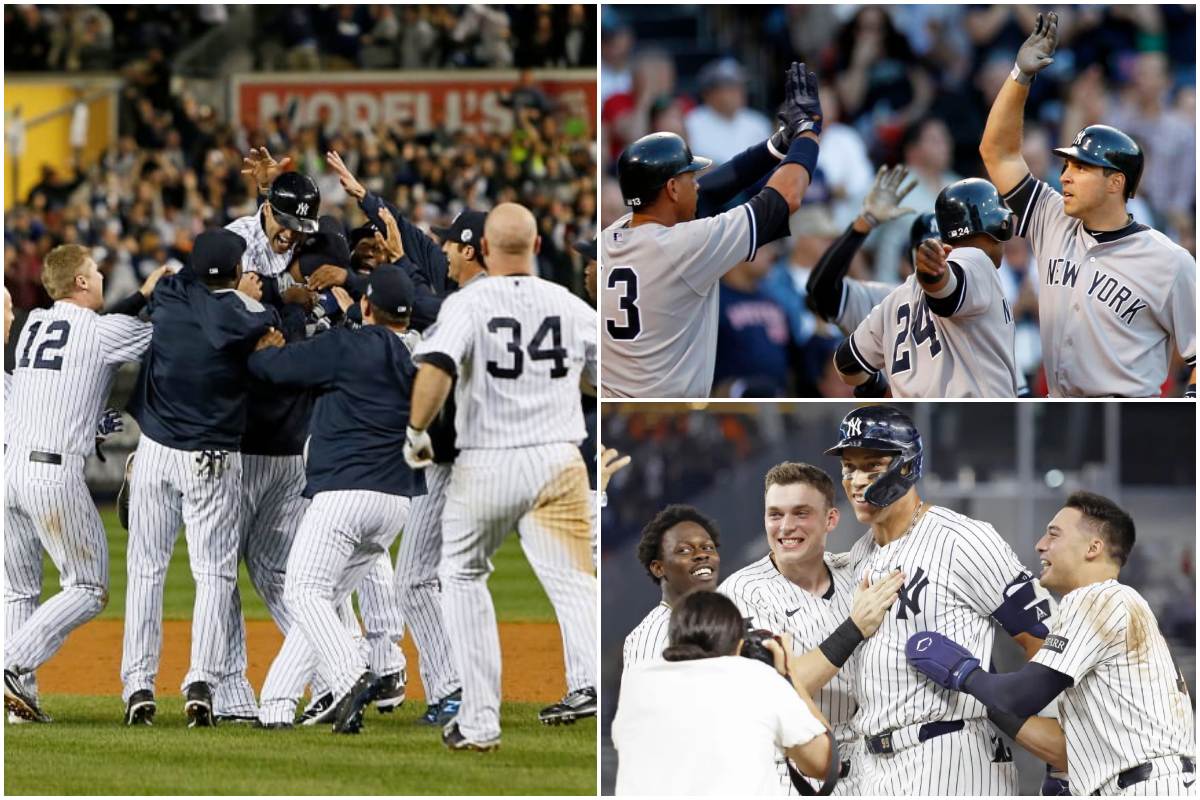
NEW YORK — No franchise has turned hopeless into historic quite like the New York Yankees.
Over 123 years of baseball, the Bronx Bombers have erased nine-run deficits five times, delivered back-to-back World Series miracles on consecutive nights and launched full-blown dynasties from the wreckage of seemingly lost causes. The moments below represent the 10 most dramatic single-game comebacks in franchise history, ranked by a combination of the deficit overcome, the stakes involved and the sheer weight of the story.
1. Derek Jeter becomes ‘Mr. November’ in an instant (Oct. 31, 2001)
World Series Game 4 | Yankees 4, Diamondbacks 3 (10 innings) | Deficit: Down 3-1 with two outs in the bottom of the ninth
Seven weeks after Sept. 11, Yankee Stadium hosted baseball that felt larger than sport. Arizona closer Byung-Hyun Kim had retired the first two Yankees in the ninth. The stadium was one out away from silence. Then Tino Martinez crushed Kim’s first pitch over the right-center wall for a two-run, game-tying homer.
Mariano Rivera kept the Diamondbacks off the board in the 10th. Then the clock struck midnight. November arrived. And Derek Jeter sliced a walk-off solo homer just inside the right-field foul pole to become the first player in history to hit a home run in November. The emotional weight of a healing city, combined with the two-out, two-strike drama, makes this the consensus greatest comeback in franchise history.
2. Jim Leyritz shocks Atlanta and launches a dynasty (Oct. 23, 1996)
World Series Game 4 | Yankees 8, Braves 6 (10 innings) | Deficit: Down 6-0 after five innings
Trailing the defending champion Braves two games to one, the Yankees stared at a six-run hole. Kenny Rogers had been chased early. Atlanta closer Mark Wohlers entered the eighth to finish it. He never did.
Backup catcher Jim Leyritz, using Darryl Strawberry’s bat, turned on a hanging slider and drove it over the left-field wall for a three-run homer that tied the game. In the 10th, Wade Boggs drew a bases-loaded walk to push across the lead. New York won the next two games, captured its first championship since 1978 and lit the fuse on a four-titles-in-five-years dynasty.
3. Brosius strikes twice in two nights against the same closer (Nov. 1, 2001)
World Series Game 5 | Yankees 3, Diamondbacks 2 (12 innings) | Deficit: Down 2-0 with two outs in the ninth
In the first major league game ever played in November, Mike Mussina threw eight dominant innings and still trailed 2-0. Arizona again turned to Kim. With two outs and runners aboard, Scott Brosius launched a two-run homer to left to tie it.
“I just remember running the bases thinking, no way did that happen twice,” Brosius said. Alfonso Soriano’s walk-off RBI single in the 12th completed the miracle. The Yankees became the first postseason team in history to win consecutive games after trailing entering the final inning.
4. Aaron Boone ends it with one swing in Game 7 (Oct. 16, 2003)
ALCS Game 7 | Yankees 6, Red Sox 5 (11 innings) | Deficit: Trailed 4-0 early, down 5-2 entering the eighth
Pedro Martinez against Roger Clemens. Winner take all. The Red Sox led 4-0, but Jason Giambi kept the Yankees close with two solo homers off Pedro. The game turned in the eighth when Red Sox manager Grady Little left a fading Martinez on the mound. Jorge Posada blooped a two-run double to tie it, and Rivera shut down the Sox for three innings.
In the 11th, Aaron Boone, who had not started the game, turned on Tim Wakefield’s first-pitch knuckleball and drove it into the left-field seats for a pennant-clinching walk-off. Only the second player after Bill Mazeroski to end a Game 7 with a walk-off homer, Boone would later return to the Bronx as the Yankees manager.
5. Posada walks it off after the Yankees trail by nine (May 16, 2006)
vs. Texas Rangers | Yankees 14, Rangers 13 | Deficit: Down 10-1 after three innings
This remains the only game in Yankees history that combined a nine-run deficit with a walk-off home run. Shawn Chacon was hammered early and New York trailed 10-1 before beginning one of the most relentless rallies in franchise regular-season history. Derek Jeter’s three-run homer capped a six-run sixth to put the Yankees briefly ahead, but Texas punched back.
Trailing 13-12 with two outs in the ninth, Jorge Posada crushed a two-run blast off closer Akinori Otsuka. Posada finished with five RBI. The Yankees pulled it off without Jason Giambi, Gary Sheffield or Hideki Matsui in the lineup.
6. Yankees crash Fenway’s centennial party with a nine-run comeback (April 21, 2012)
at Boston Red Sox | Yankees 15, Red Sox 9 | Deficit: Down 9-0 entering the sixth
Boston was celebrating Fenway Park’s 100th anniversary. Freddy Garcia had been chased after 1 2/3 innings. The Red Sox led 9-0 through five and the party was in full swing. Then the Yankees went to work.
Nick Swisher crushed a grand slam in the seventh. Mark Teixeira followed with a three-run homer. Between the seventh and eighth innings, the Yankees scored seven runs each time, outscoring Boston 14-0 over the final three frames. The 15-9 final stands as the most recent of the franchise’s five nine-run comeback wins.
7. Judge’s foul-pole shot saves the season in 2025 (Oct. 7, 2025)
ALDS Game 3 | Yankees 9, Blue Jays 6 | Deficit: Down 6-1 in the third inning
Facing a sweep and the end of their season, the Yankees were sinking fast. Vladimir Guerrero Jr. had homered early and Toronto’s lineup was doing damage in the third. Then, on an 0-2 count with three runners aboard, Aaron Judge turned on a 99.7 mph fastball nearly six inches inside and drove it off the left-field foul pole for a game-tying three-run blast.
“I guess a couple of ghosts out there in Monument Park helped keep that fair,” Judge said. Jazz Chisholm Jr. added a go-ahead solo homer the next inning, and five relievers combined for 6 2/3 scoreless innings to finish it. The largest comeback in a Yankees elimination game ever, and the first time any team overcame a five-run deficit while facing a multi-game series sweep.
8. Baby Bombers erase eight runs and walk off in extras (April 28, 2017)
vs. Baltimore Orioles | Yankees 14, Orioles 11 (10 innings) | Deficit: Down 9-1 entering the sixth
A young Yankees roster gave a preview of its October potential in a slugfest that featured eight home runs. Aaron Judge homered twice, including one clocked at 119.4 mph, which was the hardest-hit ball in the Statcast era at the time. Jacoby Ellsbury’s grand slam slashed the deficit to 11-8.
Starlin Castro’s two-run homer in the ninth off closer Brad Brach forced extras, and Matt Holliday capped the night with a walk-off three-run blast in the 10th. The game foreshadowed that fall’s Baby Bombers run all the way to Game 7 of the ALCS.
9. A 13-run inning buries Tampa Bay (June 21, 2005)
vs. Tampa Bay Devil Rays | Yankees 20, Devil Rays 11 | Deficit: Down 10-2 in the fifth
Randy Johnson’s rough start handed Tampa Bay a 10-2 lead. What followed was a historic explosion. Sixteen batters came to the plate in the eighth inning alone. Gary Sheffield hit his second three-run homer of the game. Bernie Williams cleared the bases with a go-ahead triple. The 13-run inning matched a franchise record.
Derek Jeter collected five hits and scored five runs, both career highs. The combined 31-run total remains the most lopsided scoreline of any Yankees comeback victory.
10. Billy Martin’s debut makes Opening Day history (April 18, 1950)
at Boston Red Sox | Yankees 15, Red Sox 10 | Deficit: Down 9-0 entering the sixth
Mel Parnell and the Red Sox, still raw from losing the 1949 pennant on the final day of the season, built a nine-run cushion fueled by Ted Williams’ power. The Yankees worked back four in the sixth. Then in the eighth, 21-year-old rookie Billy Martin entered for his first career at-bat and doubled off the Green Monster to drive in a run.
When the lineup batted around, Martin singled with the bases loaded for two more RBI, becoming the first player in major league history to record two hits in the same inning of his debut game. Joe Page closed it out with two perfect innings. The comeback still stands as the largest in Opening Day history.
What makes the Yankees different in the late innings
The common thread across 75 years of impossible rallies is timing. Four of these 10 games are postseason contests, and each one altered the direction of an entire series. The regular-season entries share a different but equally revealing pattern: the Yankees have overcome a nine-run deficit five times, and Boston was the victim in three of them.
The franchise has never erased a 10-run deficit, making nine the number opponents must survive. From Billy Martin’s wartime debut to Aaron Judge’s foul-pole prayer in 2025, the lesson is one opposing dugouts have had to relearn generation after generation: no lead is safe against the pinstripes.
Which do you think is the best? Did you watch anyone of these comebacks live?