HOUSTON — The New York Yankees’ late-season concerns came into full view Tuesday night. Aaron Judge remains without a clear timetable to return to right field, and Giancarlo Stanton’s latest outfield shuffle only deepened worries about the state of the roster.
Judge’s stalled throwing program and Stanton’s sudden move to left field against the Astros signaled what many feared — the Yankees are searching for answers while their cornerstone player’s health remains uncertain.
Boone’s rapid reversal raises questions
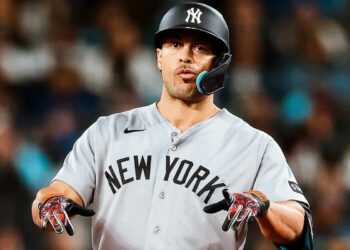
Just three days after insisting he had “no plans” to put Stanton in left field, manager Aaron Boone reversed himself. The 35-year-old slugger started in left for the first time since Sept. 14, 2023, at Daikin Park.
The abrupt change underscored organizational anxiety. Stanton has played exclusively in right field since early August, but his willingness to shift suggests the Yankees know Judge’s return to the outfield is far from imminent.
Judge’s throwing program stalls progress

Judge has stretched his throwing program to about 150 feet. But progress has slowed, raising doubts about when or if he can return to right field this season. Since coming off the injured list on Aug. 5 following a right flexor strain, the reigning AL MVP has been limited to designated hitter duty.
“The bottom line is we want to do this the right way,” Boone said. “And as much as he wants to be out there and we want him out there, we’ve got to make sure we want to do everything possible to put ourselves in the best position to not reinjure this.”
Behind the scenes, the Yankees have been less optimistic. Industry sources suggest the organization has deeper concerns about Judge’s arm strength and his ability to throw at full capacity.
Stanton’s defensive gamble exposes desperation
With Judge sidelined from outfield play, Stanton has been pushed into defensive roles he hasn’t handled regularly in years. Since Aug. 9, he has filled in at right field. On Tuesday, he shifted to left to take advantage of Houston’s shorter 315-foot Crawford Boxes.
The move reflects both strategy and desperation. Stanton has not been a regular outfielder since 2023, and years of lower-body injuries have limited his range. While left field at Minute Maid Park offers less ground to cover, it still demands positioning instincts Stanton has not used in game action for nearly two years.
Hidden concerns about Judge’s future
The Yankees have avoided specifics when discussing Judge’s recovery. His throwing program has progressed slower than hoped, and his long-term defensive capabilities are now being questioned inside the organization.
Sources close to the team suggest Judge may not regain his pre-injury arm strength. That could limit his effectiveness in right field for the rest of his career.
Judge was activated on July 30 after missing 10 days with the flexor strain, but his defensive return has not followed the expected timeline. The team’s cautious approach and repeated emphasis on avoiding setbacks point to worries about permanent limitations.
Did injury affect Judge’s bat?
The stark contrast in Judge’s offensive production before and after his flexor strain tells a concerning story. Prior to his July 26 injury, Judge was having a historic season, leading Major League Baseball with a .342 batting average, .449 on-base percentage, .711 slugging percentage, and 1.160 OPS through 103 games.
Since returning from the injured list on August 5, Judge has managed just a .218 batting average with three home runs and an .804 OPS across 16 games. His power numbers have dropped dramatically from his pre-injury pace, raising questions about whether the elbow injury has affected his swing mechanics or approach at the plate.
Despite Judge’s insistence that “the elbow has not affected his hitting,” the statistical evidence suggests otherwise. His home run production has slowed considerably, managing only five homers in 23 games since his return compared to his torrid pre-injury pace that had him on track for another record-breaking season.

September desperation mode activated
The Yankees’ choice to move Stanton to left in Houston was partly about dimensions. The Crawford Boxes are shallow, making left field less demanding than right. Boone has previously hinted that similar moves could be made at Fenway Park, where the Green Monster requires unique defensive coverage.
This venue-based strategy suggests the Yankees plan to rotate Stanton depending on ballpark layouts rather than set him in a fixed defensive role.
The Yankees’ willingness to experiment in September speaks volumes. With Judge limited to DH duties, the team is determined to keep both of its power bats in the lineup. Stanton has produced since returning from his own injury, hitting .295 with a .374 on-base percentage, .624 slugging, and 17 home runs. His offensive value is too high to ignore.
But playing him in unfamiliar outfield roles is risky. His lack of range and defensive rust could create liabilities in critical games. The decision highlights how limited the Yankees’ options are without Judge in right.
Organizational silence speaks volumes
Boone has repeatedly used words like “close” and “soon” when describing Judge’s recovery, but no concrete dates have been offered. This vagueness has become familiar to Yankees fans, who have seen similar injury updates in past seasons.
By projecting optimism publicly while avoiding specifics, the Yankees are signaling caution without admitting concern. The contrast between statements and actions suggests Judge’s recovery is not on track.
Long-term implications emerge
The Yankees’ current situation extends beyond September. Judge’s nine-year, $360 million contract assumed he would continue to play elite defense in right field. If his arm does not return to full strength, the Yankees will face difficult roster decisions in the coming years.
Stanton’s defensive limitations only complicate matters. At 35 and with his own history of injuries, his ability to cover for Judge is temporary at best.
The Yankees’ late-season defensive shuffling, paired with Judge’s uncertain timetable, has forced the organization to confront a troubling reality. What began as a strain is now casting doubt over their captain’s defensive future — and confirming the very fears they hoped to avoid.
What do you think?