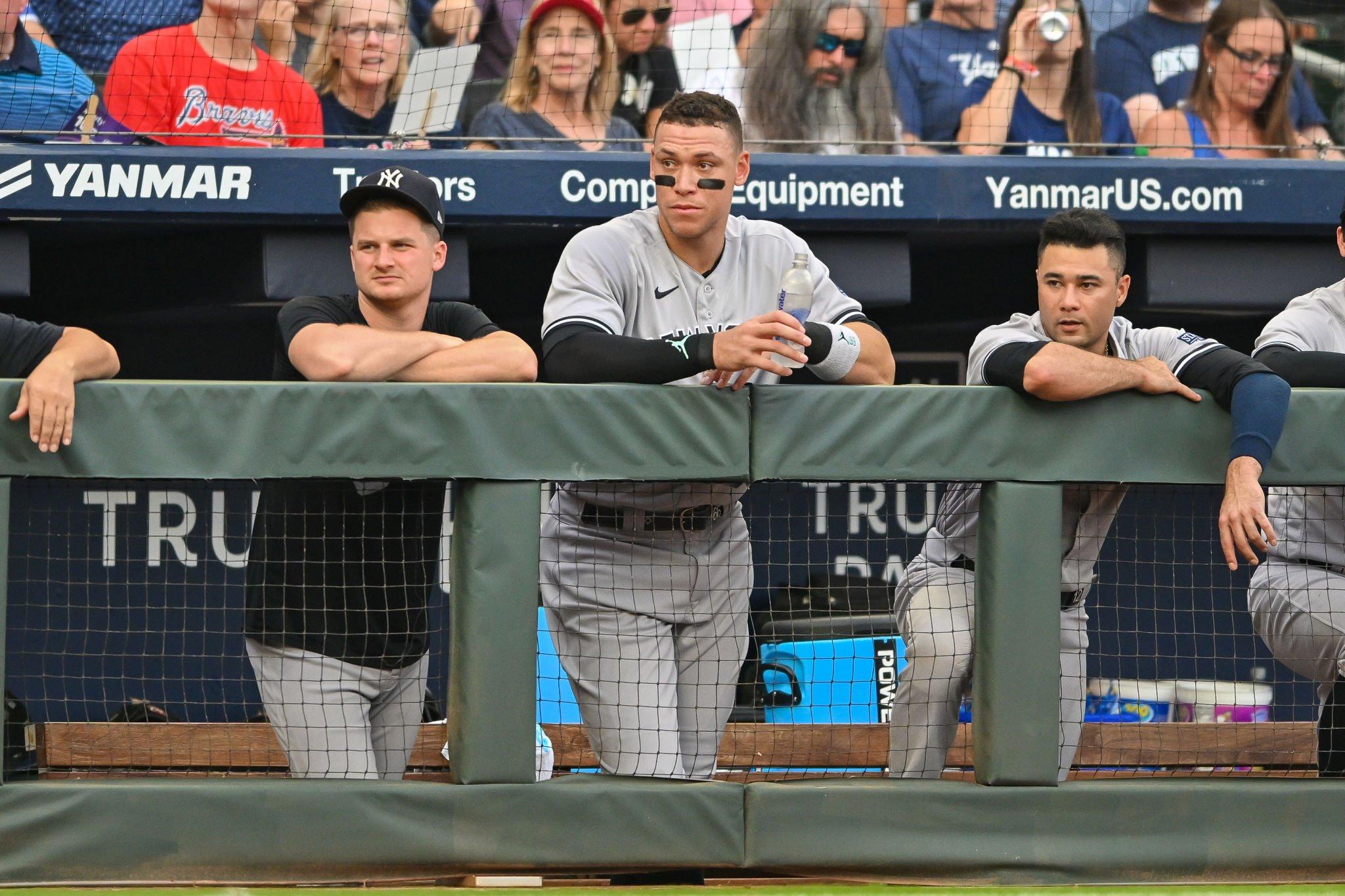
TAMPA, Fla. — Aaron Judge has spent the better part of a decade punishing pitches all over the strike zone. He has hit 210 home runs in the last four seasons alone, won three MVP awards and a batting title. The numbers are staggering by any era’s standards.
But here is what makes those numbers even more remarkable: Judge has done all of it while being penalized for standing 6-foot-7.
For years, home plate umpires have rung up the Yankees captain on pitches below his knees that their own tracking data shows were out of the zone. The bigger you are, the bigger your zone appears to be in the eyes of a human caller. Judge, the tallest regular position player in the game, has been the most frequent victim of that optical illusion.
That dynamic could shift in a meaningful way starting this season, and it has everything to do with a rule change that debuted on paper last September and arrived in practice this week in Tampa.
How the ABS challenge system works

Major League Baseball finalized the guidelines for its Automated Ball-Strike challenge system on Thursday during Cactus League media day. The system, which uses 12 Hawk-Eye cameras and a private 5G network to track every pitch, will be active at every ballpark starting Opening Day on March 25 when the Yankees visit the Giants in San Francisco.
Each team receives two challenges per game. Only the batter, pitcher or catcher can initiate a challenge by tapping their hat or helmet immediately after the call. Managers have no say. Successful challenges are retained, meaning a team only loses a challenge when it is wrong.
The ABS zone is a two-dimensional rectangle set over the middle of the plate, 17 inches wide. The top is defined at 53.5 percent of a player’s certified standing height and the bottom at 27 percent. Every player will be independently measured during spring training to ensure accuracy.
For Judge, that means the bottom of his automated zone sits at roughly 21.7 inches off the ground, based on his listed height of 6-foot-7. If a pitch falls below that line and is called a strike, Judge can tap his helmet and let the cameras sort it out.
Why this matters most for Judge
Judge has been one of the best hitters in baseball at controlling the strike zone. He consistently ranks among the league leaders in walk rate and has elite pitch recognition. The problem is that his eye has sometimes worked against him. When he correctly lays off a pitch that is low and out of the zone, umpires have too often called it a strike anyway.
Consider what Judge has produced despite that disadvantage. In 2022, he hit 62 home runs to break Roger Maris’ American League record. In 2024, he belted 58 with 144 RBIs. Last season, he hit .331 to claim a batting title while also slugging 53 home runs and driving in 114.
Yankees manager Aaron Boone was asked this week whether the ABS system could specifically benefit Judge on low pitches.
“I don’t know if I look at it so much as the low (strike),” Boone said. “I look at it as our guys that are really good at controlling the zone, it should benefit. Aaron is certainly one of those guys that controls it really well, knows it real well. So I would say hopefully he is one of those guys that benefits from it.”
Boone added: “But I think there’s a number of guys on our team that will.”
Yankees already deep into ABS strategy
The Yankees are not waiting until Opening Day to figure this out. Day one of pitchers and catchers workouts Thursday included a 75-minute ABS education and strategy meeting before the team stretch. Boone and his coaching staff laid out their spring training game plan, which will include testing approaches during Grapefruit League play.
“We’ll set that more in place when we get ready to break camp and then probably continue to evolve with it throughout the year,” Boone said. “We’ve done a lot of work on it behind the scenes, a lot of meetings and stuff this winter, just kind of going through it and trying to tighten.”
Some clubs have already announced they will not allow pitchers to challenge. Data from the 2025 spring training trial backs up that caution: catchers posted the highest overturn rate at 56 percent, followed by batters at 50 percent and pitchers at just 41 percent.
Boone is not going that far. Not yet.
“I’m not at the point of not allowing pitchers,” Boone said. “I am less comfortable. Definitely, I think catcher probably number one with who I’m the most comfortable with challenging, then hitter, then pitcher, probably in that order.”
Fried eager to test his own strike-zone knowledge
Yankees All-Star left-hander Max Fried, who finished fourth in the AL Cy Young voting last season with a 2.86 ERA and a 19-5 record, wants to find out how good his own eyes are before committing to using his challenges in regular season games.
“There’s a couple times in a game where I think a pitch is there and I’d really like the opportunity to see if it was,” Fried said. “There are also times that I know that I threw a pitch that probably wasn’t a strike, and you get it.”
Fried plans to challenge pitches during Grapefruit League games to calibrate his perception before the stakes are real.
“I guess I’m going to have to really pay attention here in spring training and see if my eyes are as good as I think they are,” Fried said. “If I’m really good in spring, then I might have a little bit more liberty of doing it in the game. But if I’m not, I might just refer to the catcher.”
A new weapon for a team chasing October
The Yankees won 94 games last season without Gerrit Cole and lost to the Blue Jays in the ALDS. Judge hit .600 in that series with a majestic home run off the foul pole, but it was not enough. The club has not won a World Series since 2009.
Judge enters his age-34 season with 62, 37, 58 and 53 home runs in the last four years. If the ABS system corrects even a handful of wrongly called low strikes per month, the ripple effects on Judge’s walk rate, count leverage and overall production could be significant.
For a Yankees team that needs its captain to keep performing at a historic level, the new rule is not just an interesting wrinkle. It could be a genuine competitive edge.
What do you think? Leave your comment below.