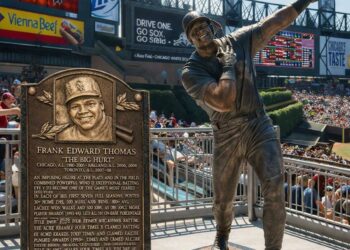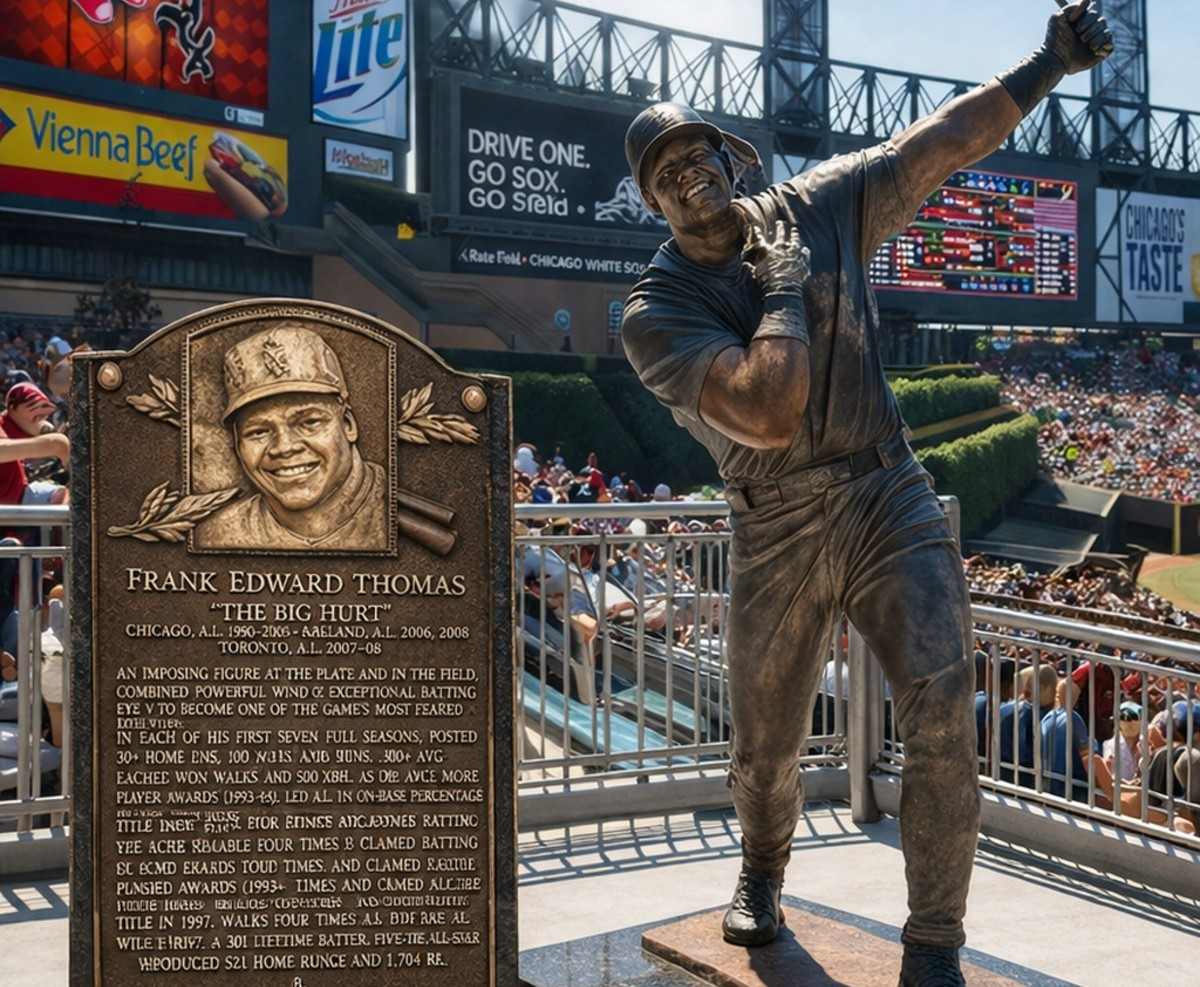
Chicago, Il — A Baseball Hall of Famer has taken his former MLB club to court, and the lawsuit targeting the Chicago White Sox is drawing attention across the sport.
Frank Thomas, one of the most feared hitters in baseball history, has filed a civil lawsuit against the White Sox, Nike, and Fanatics. The complaint, lodged March 19, 2026, in Cook County Circuit Court, claims his name and jersey number were placed on merchandise sold to the public without his knowledge, consent, or any financial compensation.
The case number is 2026L003200, Thomas v. Chicago White Sox.
A decorated career and a protected identity
Thomas spent 16 of his 19 MLB seasons on the South Side of Chicago. A two-time American League MVP and five-time All-Star, he was inducted into the National Baseball Hall of Fame in 2014. His No. 35 was retired by the White Sox in 2010, and he formally signed a one-day contract with the organization on Feb. 12, 2010, to announce his retirement as a member of the team.
He has long trademarked his “Big Hurt” nickname and kept firm control over how his commercial identity is used. That control, he argues, was ignored entirely by the MLB franchise.
The jersey at the center of the dispute
The complaint centers on the White Sox “City Connect 2.0” jerseys, which went on sale around April 28, 2025. The red-and-black uniforms were designed with a colorway paying homage to owner Jerry Reinsdorf’s other Chicago franchise, the Bulls. They quickly became one of the more popular alternate uniforms in the league.
Thomas’ No. 35 appeared on the front of the jerseys, while his last name and number were printed on the back, alongside White Sox trademarks, logos, and Nike branding.
Thomas says the MLB franchise and the retailers involved likely generated significant profits while he received “no compensation” for the use of his name and iconic number 35. The suit claims he has “suffered economic detriment,” including lost licensing revenue and diminished control over his commercial identity.
The legal argument
The suit alleges the White Sox and partner companies “were unjustly enriched through substantial commercial benefits” and that Thomas “has received no compensation or other consideration,” which “violates fundamental principles of justice, equity, good conscience, and fair play.”
The legal team at Corboy & Demetrio filed the complaint on Thomas’ behalf. Attorney William T. Gibbs issued a direct statement on the matter.
“The complaint we filed alleges violations of the Illinois Right to Publicity Act,” Gibbs said. “Companies may not profit from anyone’s identity without their permission. We believe our filing speaks for itself.”
The suit seeks payment in excess of $50,000 and demands a jury trial. It also seeks attorney fees and punitive damages.
A strained relationship with the White Sox
The lawsuit arrives against the backdrop of a rocky stretch between Thomas and the organization. On Feb. 1, 2026, the first day of Black History Month, the White Sox posted a graphic on X highlighting “momentous firsts” for the franchise. Thomas, widely regarded as the greatest player in White Sox history, was notably absent from the spotlight.
Thomas responded publicly on X: “I guess the Black player who made you rich over there and holds all your records is forgettable! Don’t worry, I’m taking receipts!”
The post sparked national attention and brought renewed scrutiny to how the organization has handled its relationship with its all-time franchise pillar.
Retailers and organizations named in discovery
The complaint identifies several major retailers as parties that may hold relevant information. Nike, Fanatics, the Chicago White Sox, the Chicago Bulls, and major retailers were named, including Dick’s Sporting Goods, Kohl’s, Nordstrom, Macy’s, Lids Sports Group, and Academy Sports + Outdoors. The National Baseball Hall of Fame and Museum is also listed in discovery.
The jersey bearing Thomas’ name and number remains available for purchase on Nike’s and Fanatics’ websites as of this writing.
The White Sox said they do not comment on active litigation. Nike and Fanatics declined to comment. The MLB Players Association could not be reached.
What this means for player rights in baseball
The Thomas case puts a spotlight on an area of ongoing tension in professional sports: the rights of retired players over how their identities are used in merchandise sold years after their careers end.
Thomas’ commercial likeness is described in the complaint as remaining “extremely valuable,” a point underscored by the popularity of the City Connect 2.0 line. With the jerseys still on sale and the lawsuit now public, the White Sox, Nike, and Fanatics face mounting pressure to address the allegations.
Thomas built a Hall of Fame career in Chicago. His fight to protect what that career is worth, commercially, is now in the hands of a Cook County jury.
What do you think about such a legal tussle in MLB? Any implications for the New York Yankees?