ST. PETERSBURG, Fla. — The New York Yankees were three outs from extending their losing streak to three games and had one real chance to change that. Runners on second and third. Two runs down. The tying runs 90 feet away from scoring. A clutch at-bat to decide whether the game lived or died.
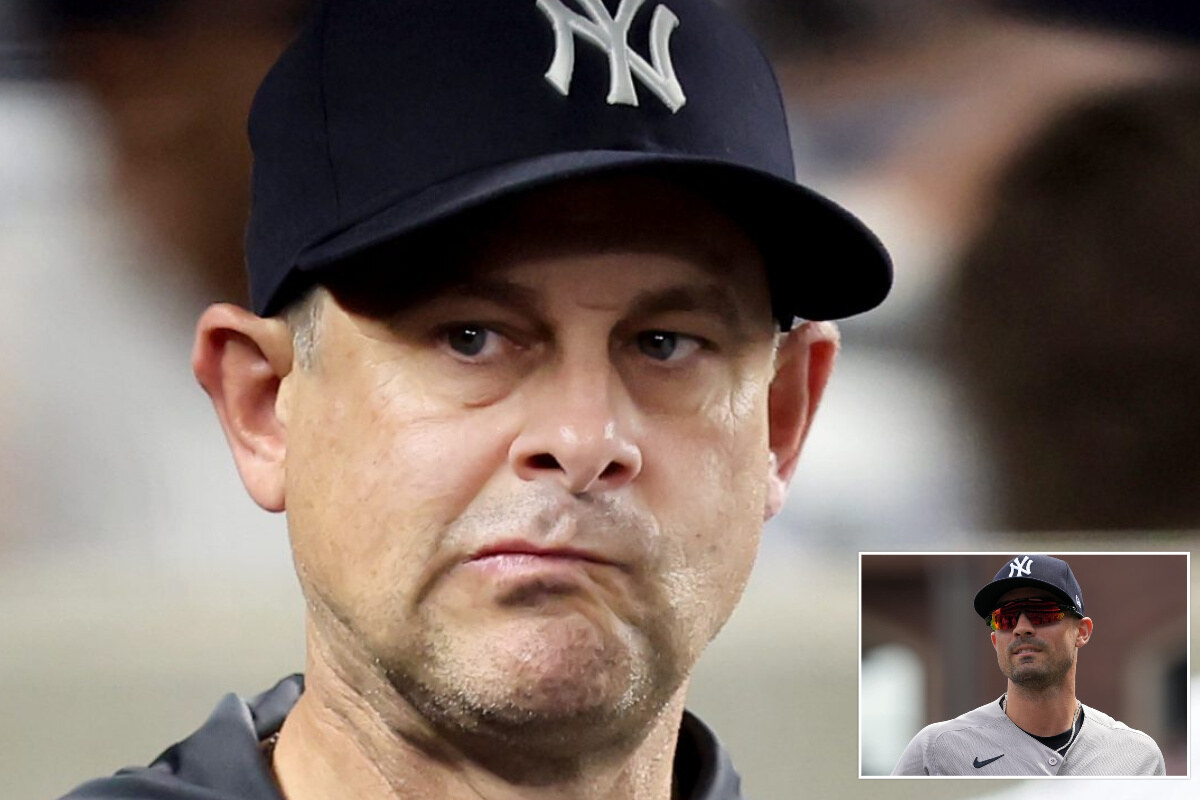
Yankees manager Aaron Boone made his call. It did not work. And the decision itself raised more questions than the result alone.
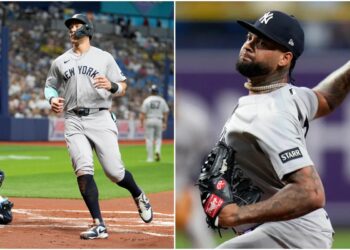
Boone kept Randal Grichuk in the lineup to bat in the ninth inning of Friday’s 5-3 loss to the Tampa Bay Rays at Tropicana Field. Grichuk struck out. Trent Grisham, who was available on the bench, batted for the next hitter and popped out. The comeback attempt died there. The Yankees fell to 8-5, their third straight loss.
How the ninth inning unfolded
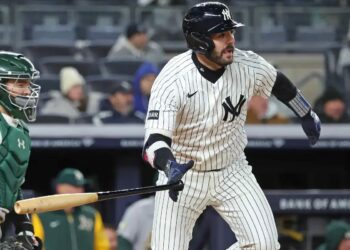
The stage was set by a Giancarlo Stanton single and an Amed Rosario single that opened the ninth against Tampa Bay right-hander Bryan Baker. The Yankees had two on with no outs. Then Jazz Chisholm Jr. hit what appeared to be an inning-ending double play, but a replay challenge reversed the call at first base, showing Chisholm had beaten the relay by a hair. Runners on first and second, no outs. The game was alive.
Chisholm then stole second, putting runners on second and third. The Yankees needed two runs to tie. The next two scheduled batters were Randal Grichuk and Jose Caballero.
Grichuk had gone 0-for-8 to that point in the 2026 Yankees season, though he had been penciled into the starting lineup that night against left-hander Steven Matz. Caballero was sitting at .125 for the year, 5-for-40. Neither was inspiring a great deal of Yankees confidence.
On the Yankees bench, Boone had Grisham, Ryan McMahon, and JC Escarra, who was 0-for-9 on the young season. Ben Rice had already been used as a pinch hitter in the eighth inning, when he launched a solo homer to cut the Rays’ lead from 5-2 to 5-3.
Boone did not pinch-hit for Grichuk. Grichuk struck out with the tying runs in scoring position. Then Trent Grisham, pinch-hitting for Caballero, popped out to end the game.
What Boone said, and what the numbers say
After the game, Boone explained his thinking. The Yankees skipper pointed to Baker’s career splits as the reason he preferred the right-handed Grichuk against the right-handed reliever.
Baker carries a .617 OPS against left-handed hitters over his career and a .695 OPS against right-handed hitters. By that measure, a right-handed hitter such as Grichuk is actually a slightly less favorable matchup for Baker. In 2026, Baker had also retired all six left-handed batters he had faced while striking out three of them.
Boone also acknowledged the sequencing logic behind his decision. With Grisham as the only legitimate pinch-hit option left for the Yankees, using him to bat for Grichuk would have left Caballero, who entered the game hitting .125, as the next batter in the most critical moment of the inning.
“Had there been two out, I might’ve gone Grisham,” the Yankees manager said.
With one out, Boone’s plan was to let Grichuk hit against the righty Baker and save Grisham for Caballero. The logic was sequential: Grichuk against a righty who is harder on righties than lefties, then Grisham for Caballero. It did not work out, but the framework had an internal logic.
What was left unsaid, as the brief’s source notes plainly, is that McMahon and Escarra were not genuine game-on-the-line Yankees options. That reality effectively limited Boone to a two-batter bench in the ninth. Grichuk or Grisham for batter one, and then only Grisham for batter two. Boone chose to hold Grisham in reserve.
The broader problem the decision exposed
Strip away the game-theory calculus and a harder truth sits underneath it. The Yankees went into the ninth inning of a winnable game with a bench that could not absorb consecutive late-inning at-bats without quickly exhausting its options.
Grichuk, who entered the game in a 0-for-8 slump, was the Yankees’ most trusted right-handed bat off the bench in that moment. Caballero, who has struggled to a .125 average, was the next option. McMahon and Escarra were, in Boone’s own implied assessment, not viable choices with a game on the line.
The Yankees’ offense has now gone through a stretch of extraordinary futility. They scored zero runs over 17 consecutive innings to close their Athletics homestand, then scored twice in the first inning Friday before going cold for six more innings. Rice’s eighth-inning homer was the only evidence that this offense still exists beyond the third out of the first.
Through 13 games the Yankees are batting .201 as a team, a mark that ranks ahead of only Seattle and Chicago’s White Sox across the entire league. The conversation around Aaron Boone’s lineup decisions will only intensify if the bats do not wake up soon.
On Friday night, everything that could go wrong in a ninth inning did. The first Yankees batter struck out. The second popped out. Two men were left on base. And a manager who made a defensible call found himself answering for it anyway, because in baseball, the decisions that do not work always demand an explanation.
What do you think? Leave your comment below.