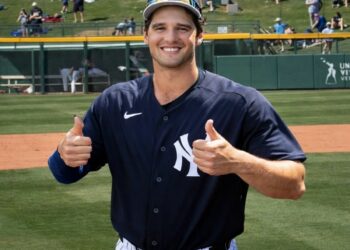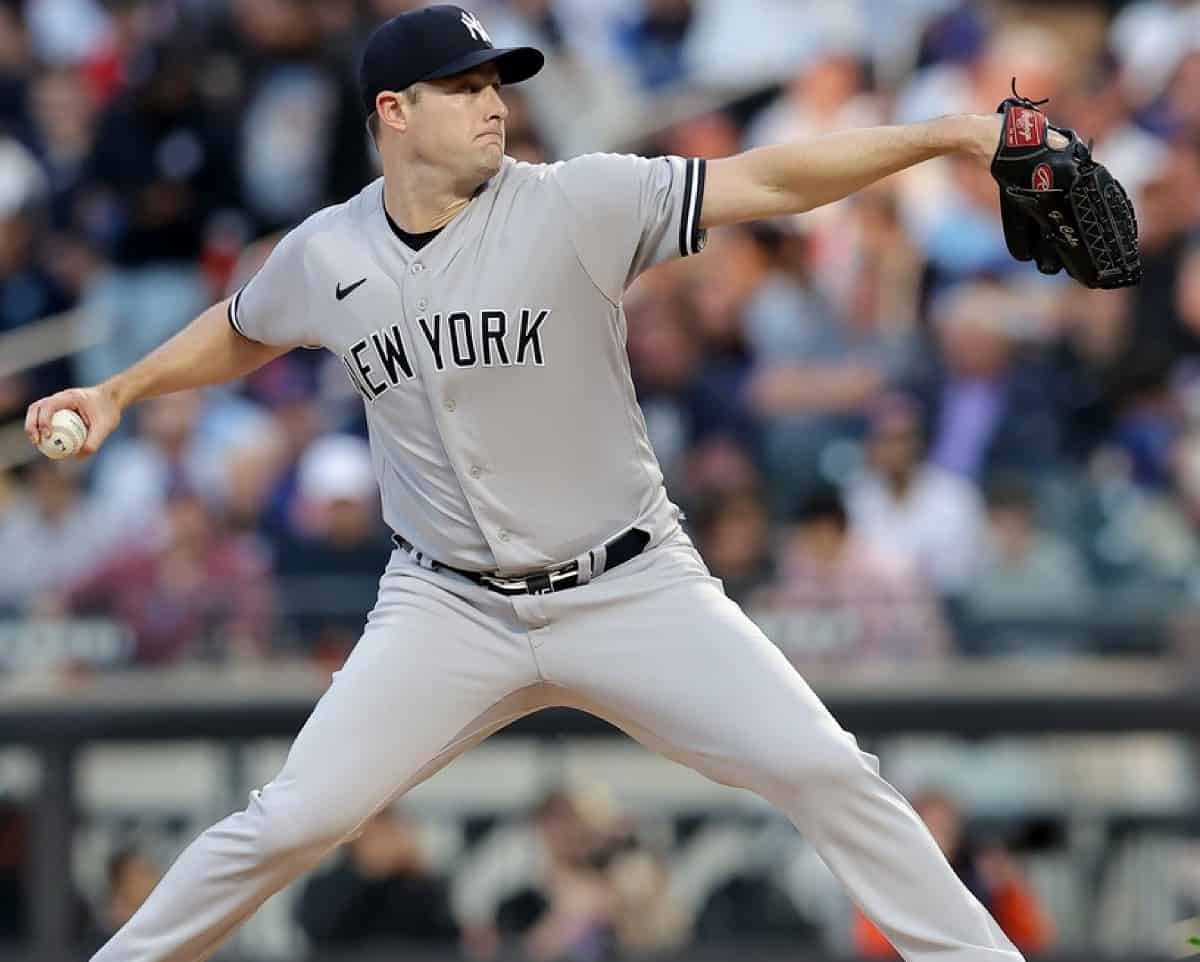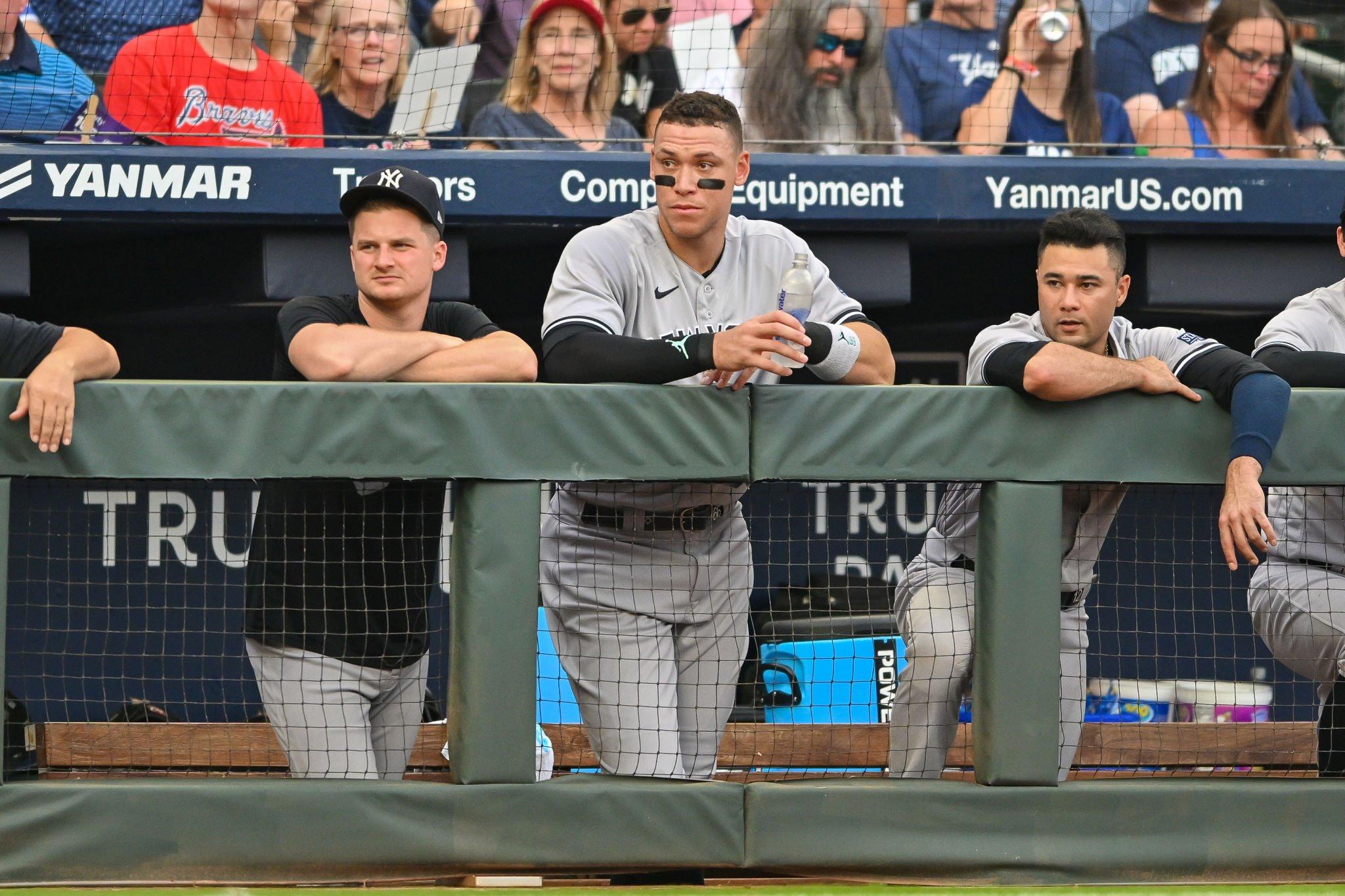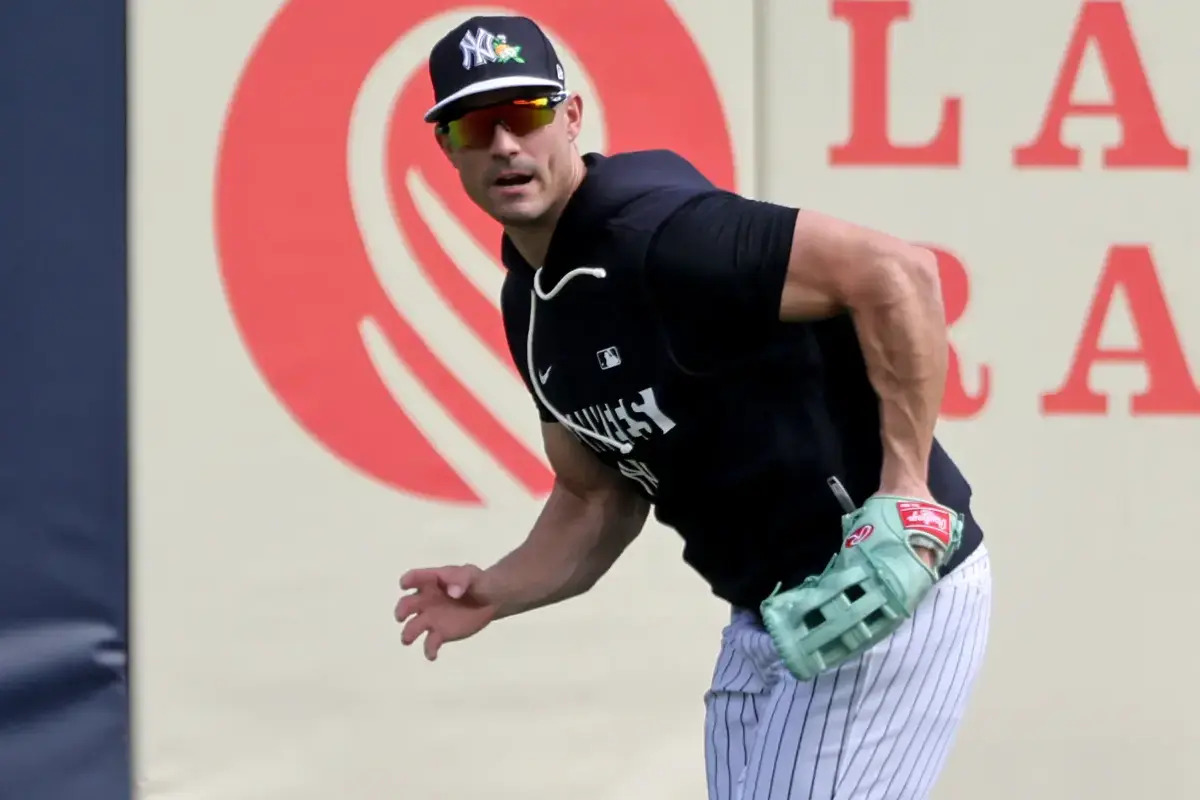
TAMPA, Fla. — Randal Grichuk did not rush into a decision this winter. The veteran outfielder waited. He weighed his options. He searched for the right fit.
When the call came from the Yankees, the wait felt worth it.
Randal Grichuk admitted he waited longer than expected in free agency. The market did not move as quickly as he hoped. When the Yankees engaged, he saw opportunity.
He said the chance to join a club with World Series expectations mattered most.
The Yankees have made the postseason in five of the past six full seasons. They continue to operate with one of the highest payrolls in MLB. For a veteran seeking October baseball, the Yankees offer a clear path.
Grichuk emphasized that point when discussing his decision. He said there is “no better place” to compete for a championship.
The Yankees saw more than just a platoon bat. They saw experience. Grichuk has logged postseason at bats and handled big market pressure before. That background carries weight in a clubhouse built to contend.
Grichuk said he believed there was “no better place” to chase a championship than the Bronx. The Yankees, in turn, believe they found the exact right handed bat they needed to sharpen one specific edge in their lineup.
The pairing was not flashy. It was precise.
Yankees outfield strength creates narrow opening
When the Yankees re signed Cody Bellinger in January, they effectively committed to bringing back the same primary outfield trio that carried them through 2025. Bellinger, Trent Grisham, and Aaron Judge combined for a major league best 16.6 WAR last season.
That production left little room for everyday additions.
But roster construction is not just about starters. It is about edges.
With Jasson Domínguez and Spencer Jones both holding minor league options, general manager Brian Cashman made it clear the Yankees would prioritize development over rushed promotion.
“I would concede it’s in his best interest to be getting everyday reps,” Cashman said in mid February about Domínguez.
That statement opened the door.
The stat that explains everything
Grichuk’s career split against left handed pitching is the reason the Yankees moved.
For his career, Grichuk owns a .268/.318/.500 slash line against lefties across 1,672 plate appearances. That translates to a 118 career wRC+. Against right handed pitching, that number drops to 92.
From 2022 through 2024, his dominance against southpaws was elite:
- 2022 vs LHP: .308/.333/.593, 143 wRC+
- 2023 vs LHP: .328/.388/.607, 157 wRC+
- 2024 vs LHP: .319/.386/.528, 152 wRC+
Last season marked a dip. In 2025, split between Arizona and Kansas City, he hit .227/.273/.430 with an 89 wRC+ against lefties.
Yet the underlying metrics suggest bad luck played a role.
His expected batting average against left handed four seam fastballs remained .268, with a .533 expected slugging percentage. His actual results were far lower.
Contact quality tells a different story
Statcast data paints a clearer picture of Grichuk’s 2025 profile:
- 92.4 mph average exit velocity
- 11.7 percent barrel rate
- 49.5 percent hard hit rate
- .259 expected average versus .228 actual
- .457 expected slugging versus .401 actual
If he had qualified for leaderboards, his exit velocity would have ranked in the 92nd percentile. His hard hit rate would have been in the 85th percentile.
The Yankees saw those gaps. His 56 point shortfall between actual and expected slugging suggests regression potential.
That is the niche they are betting on.
Grisham split makes platoon case stronger
The move also complements Trent Grisham’s profile.
Grisham delivered a career season in 2025 with 34 home runs, a 129 wRC+, and 3.2 WAR. But against left handed pitching, he struggled. He hit .182/.303/.348 with an 88 wRC+ in 153 plate appearances.
That marked his third sub 100 wRC+ season against lefties in four years.
Grichuk provides a right handed counter. Boone can deploy a Grichuk in left, Bellinger in center alignment when facing tough southpaws.
The Yankees improve their matchup flexibility without weakening defense.
Domínguez and Jones reflect developmental patience
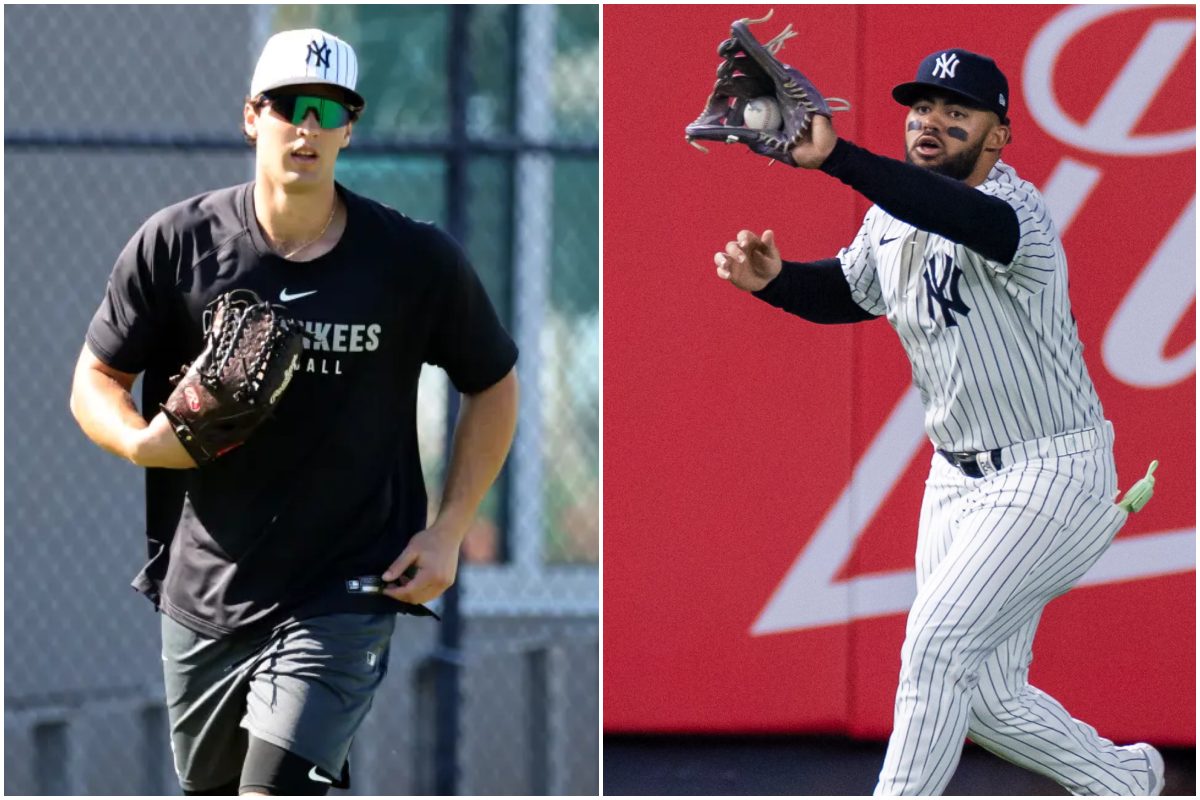
Grichuk’s signing also reflects the Yankees’ stance on prospect readiness.
Domínguez posted a 63 wRC+ against left handed pitching in 2025. He struck out 32.7 percent of the time in those matchups. His average exit velocity against lefties was just 86.7 mph with a 1.7 percent barrel rate.
Against righties, he was far stronger with a 116 wRC+.
Spencer Jones brings elite raw power but struck out 35.4 percent of the time in Triple A. His 35.5 percent chase rate and 72 percent zone contact rate signal refinement is needed.
Cashman acknowledged the long term vision.
“He’s an exciting young talent that’s, again, unproven at the Major League level,” Cashman said of Jones. “We’re going to find out at some point — or somebody else would find out at some point, if they pry him away from me.”
The Yankees prefer those players develop without the pressure of platoon exposure against elite lefties.
Stanton variable shapes roster math
Giancarlo Stanton remains central to lineup construction. In 2025 he hit .273/.350/.594 with a 158 wRC+ and 24 home runs in just 281 plate appearances. His average exit velocity of 94.4 mph ranked fourth among qualified hitters.
But health remains a factor. Stanton has averaged 101 games over the past four seasons. He continues managing bilateral elbow issues.
On days Stanton rests, Judge can slide to designated hitter, opening outfield space. Grichuk becomes even more valuable in that alignment.
Defensive value adds roster flexibility
While the bat headlines the move, Grichuk’s defensive profile supports the Yankees’ structure.
Defensive metrics project him as roughly average in the corners and playable in center field in short bursts. That flexibility allows Boone to rotate rest days without sacrificing range.
The Yankees prioritize run prevention. In 2025, their team ERA ranked in the upper half of the league. Supporting that with competent outfield defense matters as much as adding power.
Grichuk’s arm strength remains solid. His routes are efficient. He does not need to be elite. He needs to be steady.
Yankees sharpen their margin with calculated addition
The Yankees won 90 games in 2025. They reached October. They again fell short of the final prize.
When margins are that thin, small roster upgrades matter.
Grichuk is not a headline superstar. He is a targeted answer. His career numbers against left handed pitching are not anecdotal. They are sustained across multiple seasons.
The Yankees did not sign Grichuk to be an everyday fixture. They signed him to attack a specific weakness.
A 121 wRC+ against LHP is not random. A slugging percentage near .500 is not accidental. An OPS north of .800 against southpaws in 2025 is not cosmetic.
The Yankees identified a weakness and addressed it with statistical clarity.
For Grichuk, the bitter offseason wait ends in a clubhouse built to contend. For the Yankees, the addition adds a measurable edge in the matchups that often decide playoff games.
The American League East features left handed depth across rotations and bullpens. Marginal gains in those matchups matter in October.
Grichuk’s career 118 wRC+ against lefties, combined with elite contact metrics in 2025 despite suppressed results, presents a low cost upside play.
For Grichuk, the long offseason wait ends with a contender.
For the Yankees, the move strengthens a narrow but meaningful edge.
What do you think? Leave your comment below.