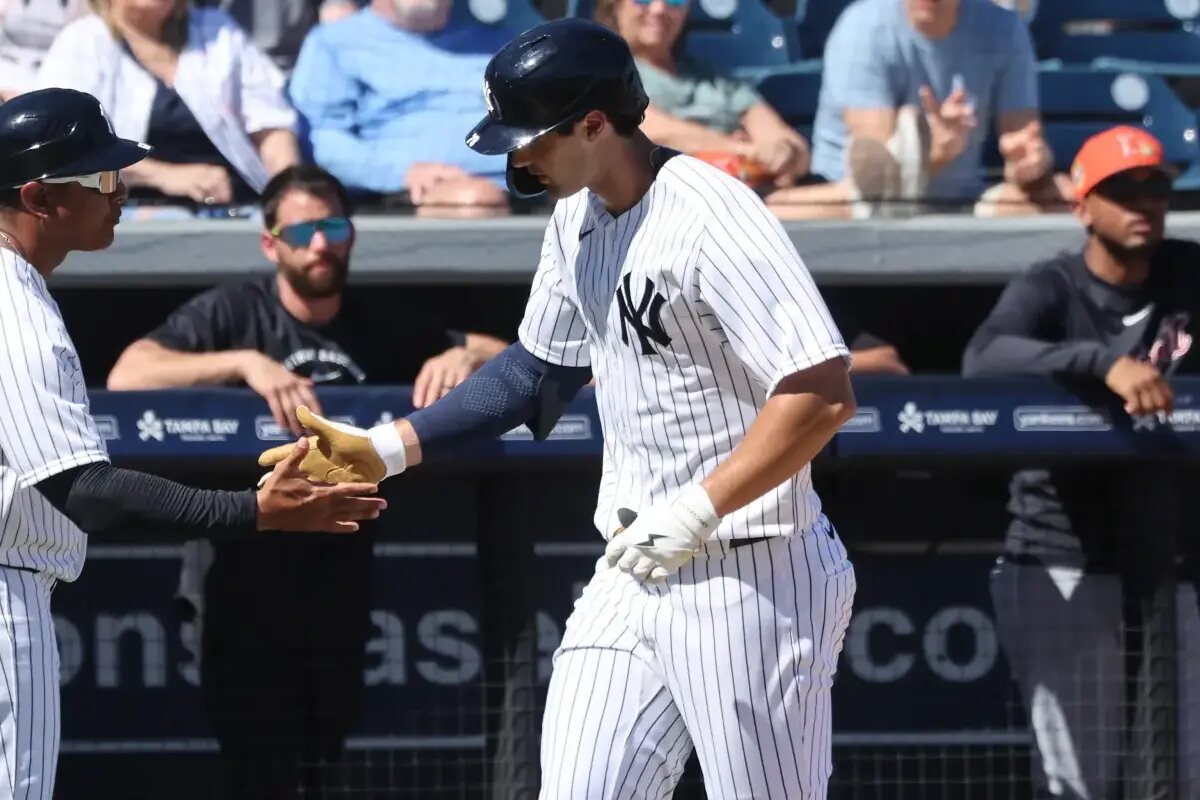
TAMPA, Fla. — For years, the scouting reports on Spencer Jones began and ended the same way. Big. Left-handed. Raw power. Next Aaron Judge. That script got rewritten on Saturday morning, and nobody in the Yankees organization saw it coming quite like this.
Jones walked into George M. Steinbrenner Field for his first Grapefruit League plate appearance of the 2026 season, and within seconds, the conversation around one of baseball’s most watched prospects shifted in a direction that surprised even the people who watch him every day.
It was not just what he did. It was how he did it. And it got people thinking about somebody who plays 2,500 miles away in a Dodgers uniform.
A swing that stopped everyone cold
Jones stepped in against Detroit Tigers right-hander Keider Montero. The pitch was mid-90s, belt-high, top of the zone. Jones did not flinch. He made one clean, compact move and sent the baseball 408 feet over the right-field pavilion. It left his bat at 111.7 mph and kept traveling until it cleared the stadium entirely.
The Yankees beat Detroit 20-3 that afternoon. Aaron Judge went deep twice in three at-bats. Yet it was the 24-year-old prospect’s single swing that dominated the post-game conversation, on the YES Network broadcast, in the dugout, and across Yankees social media.
YES analyst David Cone put it plainly during the broadcast. He described what he saw as “almost Ohtani-like,” pointing specifically to the toe-tap Jones was using as his load trigger. That one observation cracked open a comparison nobody had made publicly before.
Jones has been studying Shohei Ohtani all winter
This is the part that makes the comparison more than a broadcast moment. Jones confirmed after the game that he has been actively studying Shohei Ohtani‘s mechanics. The offseason work was deliberate and specific.
“He’s a great reference of a really good mover with a great swing,” Jones said, per MLB.com. “He’s one of those guys that I look at with some of the stuff he does, and I try to apply it in whichever way I can.”
Jones described the goal as getting “some good feels with the hands” and using that as his trigger into the hitting zone. That single detail explains everything Cone saw on the broadcast. Ohtani’s brilliance at the plate is built on the same principle: one fluid, connected move with no wasted motion and no timing gap created by a large leg kick.
Yankees manager Aaron Boone picked up on the physical parallel immediately. Ohtani is 6-foot-4. Jones is 6-foot-7. Both are long-bodied left-handed hitters who can generate enormous bat speed without relying on a big stride.
“The way they move, he’s trying to have one complete move with it,” Boone said. “Obviously, the size is very similar. So hopefully he can copy that well.”
Boone did not oversell it. He called the homer “a no-doubter” and described the swing as “a really clean move.” But he also noted Jones has been “searching for it a little bit mechanically” early in camp. Saturday was a sign of what the ceiling can look like when everything connects.
Judge delivers specific, pointed praise
Aaron Judge does not speak in generalities about hitting mechanics. He has been working with Jones in big league camp since last spring, and he watched Saturday’s at-bat with a trained eye.
“The minute he puts that foot down with that little toe-tap, he’s ready to hit,” Judge said. “They might have gotten him with a lot of high heaters in the past, or even last season. I think that’s just going to help him.”
"…We've got a lot of unfinished business from last season…"
Judge continued: “He doesn’t have a big leg kick and doesn’t have to worry about trying to get that down. I liked the results I saw in that first at-bat. That quickness, that readiness, it’s really going to be a game-changer for him.”
Judge’s endorsement matters for reasons beyond reputation. He is the reigning back-to-back AL MVP. He has also faced the same challenge Jones is working through: harnessing enormous raw power without letting swing length create exploitable vulnerabilities at the top of the zone.
The prospect resume that backs the hype
The Yankees selected Jones 25th overall in the 2022 MLB Draft out of Vanderbilt. He has done nothing but hit for power since. In 2025, he combined for 35 home runs, 120 hits, and 250 total bases across 116 games split between Double-A Somerset and Triple-A Scranton/Wilkes-Barre.
At Triple-A, he posted a .897 OPS and went deep 19 times in 67 games. His career OPS across all minor league levels sits at .839. He finished 2025 ranked as the Yankees’ No. 4 prospect per MLB Pipeline and landed among baseball’s Top 100 overall prospects before the 2026 season.
The one number that complicates the picture is strikeouts. Jones fanned 179 times in 506 plate appearances last year. That rate is the primary reason the Yankees are not rushing him to the majors. The new swing mechanics are directly aimed at fixing it.
For context on how high the Ohtani bar sits: Shohei Ohtani batted .282/.392/.622 with 55 home runs, 102 RBIs, and 20 stolen bases in 2025. He led the Dodgers to back-to-back World Series titles and claimed his fourth career NL MVP award. Nobody expects Jones to replicate those totals. The argument is that the mechanical foundation Jones is building mirrors what makes Ohtani so hard to beat.
A loaded outfield and a prospect stuck waiting
There is a genuine problem for the Yankees here, and it has nothing to do with Jones’s talent. The major league outfield is blocked. Judge holds down right field. Cody Bellinger is in center. Trent Grisham, re-signed this offseason for two years and $22 million, fills the remaining spot. Jasson Dominguez, who appeared in 123 games in 2025, also occupies a roster role.
Grisham’s contract extension was widely read as a signal that Jones would open 2026 back at Triple-A. The Yankees have reportedly declined to include Jones in trade discussions even when proven major league talent was offered in return. That tells you what the front office thinks of his ceiling.
One home run in February does not change roster math. But it does apply pressure. If Jones spends the next six weeks of spring training hitting the ball the way he did on Saturday, the Yankees will face a harder conversation about how to get him on the field.
Why this spring moment carries real weight
Jones has made mechanical changes before. What is different this time is the specificity of the model he is studying and the visible results appearing as early as the first at-bat of camp. That combination is drawing attention from people paid to evaluate baseball talent.
Boone’s language was cautious but honest. Jones is still working things out. But when the pieces line up, the output is a 408-foot shot off a mid-90s fastball at 111.7 mph in February.
Spencer Jones arrived in Tampa carrying the weight of being the next big thing in the Yankees system. He is leaving this week’s headlines with a different kind of weight entirely. The Ohtani comparison is not a pressure label anymore. It is starting to look like a mechanical argument. And in baseball, those are the comparisons that tend to age well.