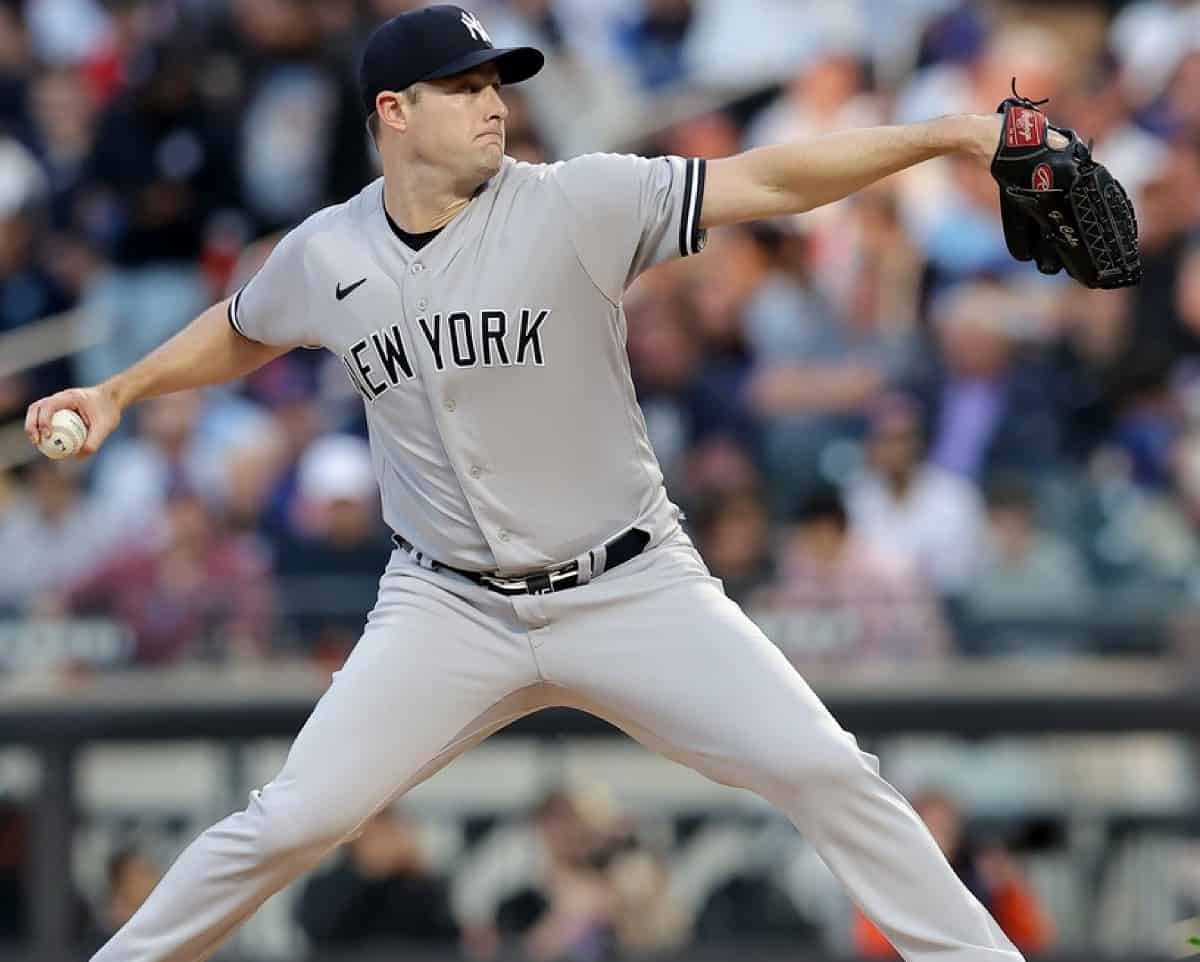
TAMPA, Fla. — Clarke Schmidt was pitching the best baseball of his life. Through 14 starts in 2025, the Yankees right-hander carried a 3.32 ERA with 73 strikeouts in 78.2 innings. He looked like a Yankees pitcher who had finally figured it out. The stuff was sharper. The results were real. And the reason for both was a new pitch that the Yankees pitching lab had helped him develop during the season.
Then his elbow gave out. On July 3, Schmidt exited a start against the Blue Jays after just three innings with forearm soreness. A week later, he was on the operating table for his second Tommy John surgery. The 2025 season was over. Most of 2026 would be gone, too.
Now, eight months into his recovery, Schmidt has offered a blunt explanation for what went wrong. And it points directly at the pitch that was supposed to make him a star.
A grip change that came with a cost
Schmidt told Gary Phillips of the New York Daily News this week that a mid-season grip change was the primary factor behind his Yankees career-altering elbow injury. The Yankees pitching staff had worked with him to develop a new sweeper with more horizontal break. To generate that movement, Schmidt used a choked-out grip that required significantly more torque on his forearm.
The pitch worked. It was effective against right-handed hitters and gave Schmidt a weapon he had never had before. But it came at a price.
“I think the No. 1 thing that played a factor was mid-season grip changes,” Schmidt said. “You make grip changes, and you start to really put different stress on different areas of your forearm and stuff like that.”
The Yankees had essentially split Schmidt’s breaking ball into two distinct pitches. One was the traditional slider. The other was the new sweeper designed for maximum horizontal movement. Getting that frisbee-like action required a grip and arm path that put the elbow under stress it was not built to handle on a start-by-start basis.
Schmidt acknowledged that the results made it hard to stop throwing the pitch, even as his arm began to break down.
“I was getting a lot of really good results with it, so it’s hard to be like, ‘Oh, let’s stop throwing it,'” Schmidt said. “It was like a double-edged sword.”
The timeline for Schmidt’s Yankees return

Dr. Keith Meister performed the surgery on July 11 in Dallas. The procedure was described as the “best case” version of Tommy John. The ligament had torn away from the bone but did not need to be fully replaced. Meister reattached it and inserted an internal brace. Schmidt was told recovery would take approximately 11 to 13 months.
That puts his earliest possible return around late August or September. Schmidt began playing catch on flat ground during spring training in Tampa earlier this month. A video posted by Chris Kirschner of The Athletic on Feb. 13 showed him throwing with ease and without visible discomfort.
Schmidt will remain in Tampa after the Yankees break camp, continuing his rehab at the Yankees spring training complex. He is not on a throwing program off the mound yet. But his goals are clear.
“Obviously, I have goals and check marks that I want to hit, as far as when I want to come back and stuff like that. But it’s not written in stone,” Schmidt said. He added that he plans to stay focused and not get caught up in what-ifs.
“You have to have goals and things that push you, but you can’t look too far ahead or reflect on the past, like, ‘Dang, I wish this didn’t happen’ or ‘Why me?’ It’s not like that at all,” Schmidt said. “I’m very hungry. I’m very driven, maybe more driven than I’ve ever been.”
What it means for the Yankees pitching philosophy
Schmidt’s admission raises serious questions about the Yankees approach to pitch design. The Yankees organization has invested heavily in its pitching lab at Steinbrenner Field, using data and biomechanics to redesign arsenals. The results across the system have been impressive. But Schmidt’s case is a cautionary example of what can go wrong when a new grip is introduced during the demands of a Yankees major league season.
Making grip changes while pitching every five days at maximum intensity is inherently risky. The forearm does not have time to adapt to new stress patterns. Schmidt said the soreness started picking up around a June road start in Anaheim and worsened through his next start in Cleveland before the injury in Toronto ended his season.
Schmidt said he plans to ditch the pitch entirely when he returns. He will go back to a more traditional arsenal, one that does not require the extreme torque that broke his elbow. The Yankees need him healthy more than they need him throwing a pitch that lands him on the injured list.
A Yankees rotation that needs all hands on deck
The Yankees are already thin on the mound. Yankees ace Gerrit Cole is working back from his own Tommy John surgery and is expected to return around May or June. Carlos Rodon had offseason elbow surgery to remove bone spurs and loose bodies. He is progressing but was not ready for Opening Day. The projected rotation for March 25 in San Francisco is Max Fried, Cam Schlittler, Ryan Weathers, Luis Gil, and Will Warren.
Schmidt signed a $4.5 million deal with the Yankees in November to avoid arbitration. If he can return healthy by August or September, he would give the Yankees a significant boost for the stretch run and a potential Yankees postseason push. The 29-year-old has spent his entire six-year career in the Bronx. This is his second Tommy John surgery, the first coming in 2017 before the Yankees drafted him 16th overall.
His revelation about the grip change is a reminder that innovation has limits. The Yankees got the best version of Clarke Schmidt for 14 starts. Then they lost him for over a year. The question now is whether the version that comes back to the Yankees can stay on the mound long enough to matter.
What do you think? Leave your comment below.