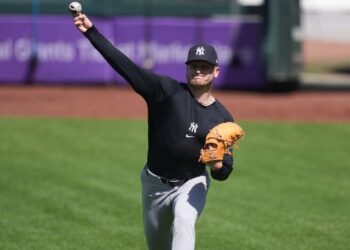
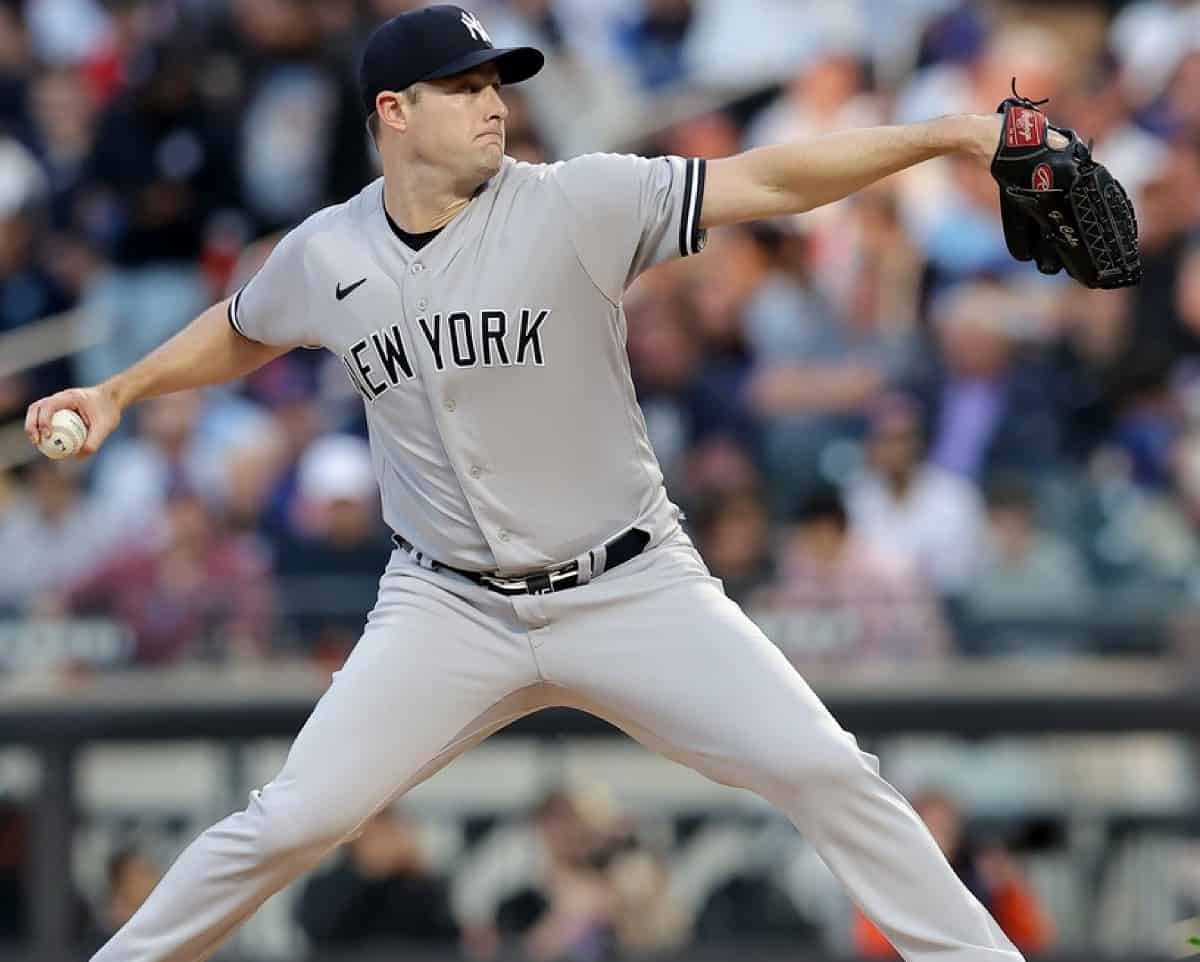
Nicknamed the “Airbender,” Devin Williams ranks among the MLB’s most standout closers. He is known for his elite pitching skills and signature changeup, which seems to defy physics with its sharp, unpredictable movement.
Devin Williams quickly claimed both NL Rookie of the Year and Reliever of the Year honors in 2020 soon after starting his MLB journey with Milwaukee in 2019. After earning All-Star selections in 2022 and 2023, the dominant reliever’s Brewers tenure ended. He was traded to the Yankees on on Dec. 13, 2024, for LHP Nestor Cortes, INF Caleb Durbin and cash,
Devin Williams’ moniker and talent have drawn comparisons to the type of closer every team dreams of having. His “Airbender” pitch, paired with his ability to perform under pressure brings game-changing dominance to the bullpen, embodying the precision and power the franchise thrives on.
Early life and career of Devin Williams
The Brewers acquired Devin Williams in the 2013 MLB draft, selecting him 54th overall in the second round. Faced with a choice between professional baseball and college baseball at Missouri, he opted for the pros, signing with Milwaukee for a $1.35 million bonus.

Devin Williams’ path to the majors hit a significant roadblock during 2017’s spring training when he suffered a devastating elbow injury. A torn ulnar collateral ligament required Tommy John surgery, forcing him to sit out the entire season. However, his’ resilience and talent shone through in his recovery, culminating in his selection as the Brewers’ representative at the prestigious 2019 All-Star Futures Game.
From debut to dominance (2019-2020)
His breakthrough came during the shortened 2020 MLB season. Making his major league entrance on August 7, 2019, at Pittsburgh’s PNC Park, Devin Williams showed promise in his first 13 Brewers appearances, posting a 3.95 ERA.
But it was 2020 when he truly exploded onto the scene, culminating in a historic September where he allowed zero runs and just four hits while striking out 24 batters. In 22 appearances, Devin Williams posted an astonishing 0.33 ERA – the lowest for any pitcher throwing at least 21 innings since ERA became official in 1913 – allowing just one earned run over 27 innings while striking out 53 batters. This historic performance earned him the National League Rookie of the Year Award, as well as the NL Reliever of the Year Award. Devin Williams’ dominance that year wasn’t just impressive—it was virtually unparalleled in MLB history.
Devin Williams’ excellence continued in 2021, earning NL Reliever of the Month honors in August. However, his season ended abruptly when he fractured his pitching hand punching a wall during the team’s NL Central title celebration. In 2022, following Josh Hader’s trade, Devin Williams stepped into the closer role.
After avoiding arbitration with a $3.35 million deal for 2023, Devin Williams dominated with a 1.53 ERA and 36 saves, securing his second NL Reliever of the Year award. His 2024 season, despite starting late due to back stress fractures, showcased his resilience with a 1.25 ERA across 22 appearances and 14 saves. However, his Brewers tenure ended on a difficult note, surrendering four runs in a crucial Wild Card Series loss to the Mets, after which Milwaukee declined his $10.5 million option.

On December 13, 2024, the Yankees announced a trade for Devin Williams. He landed in the Bronx as starter Nestor Cortes and prospect Caleb Durbin headed for Milwaukee.
The making of an ‘Airbender’
Devin Williams isn’t just another arm in the bullpen; he’s a craftsman of one of the most elusive pitches in baseball: the changeup. This isn’t just any changeup either—it’s a pitch so unique in its movement that it earned him the nickname “Airbender.” The pitch seemingly defies the laws of physics, darting unpredictably as if it’s bending the very air around it.
While many closers rely on blistering fastballs to overpower hitters, Devin Williams takes a different approach. His fastball is formidable, regularly clocking in the mid-to-upper 90s, but it’s his changeup—the “Airbender”— is one of the most effective and unique in modern baseball, often leaving hitters flailing at thin air.
Statcast data reveals that Devin Williams’ changeup has an average horizontal break of over 18 inches, which is among the best in the league. Coupled with a vertical drop that confounds hitters, it’s no wonder this pitch has a whiff rate of nearly 50%. Opponents often swing and miss entirely, even when they know the changeup is coming.
Tom Verducci of Sports Illustrated once referred to the Airbender as “a pitch that belongs in its own category.” It’s a testament to how rare and impactful this offering is. Devin Williams’ ability to pair it with a strong fastball and slider gives him an arsenal that’s as unpredictable as it is deadly.
What makes Devin Williams even more fascinating is his mental approach to the game. Pitching at the highest level requires not just physical skill but also mental toughness, and Williams has both in spades. He’s spoken openly about the focus required to stay ahead of hitters, as well as the importance of confidence on the mound.
“You have to trust your stuff,” Devin Williams said in an interview. “If you go out there and second-guess yourself, hitters will pick up on that. Confidence is everything in this game.”
Turbulent ‘Airbender’ in the Bronx
Williams’ tenure with the Yankees lasted just a single season, the 2025 campaign, but it attracted outsized attention because of expectations built on his dominant Brewers track record.

The 2025 season proved to be a career-worst statistical campaign for Williams. In 67 appearances and 62 innings pitched for the Yankees, he finished with a 4-6 record, 4.79 ERA, 90 strikeouts and 18 saves. His 1.13 WHIP reflected that he still limited baserunners, but his traditional ERA ballooned compared with his historic numbers.
Williams began 2025 as the designated closer, but inconsistency early in the year led the Yankees to remove him from that role by late April. He was later reinstated in early June after some improvement, only to lose the role again when the Yankees acquired David Bednar at the trade deadline to stabilize late-inning duties. The shift in roles suggested New York’s discomfort with relying on Williams in high-leverage moments.
Despite his struggles, Williams was effective in parts of the season. He struck out 90 batters, a strong total for a reliever, and finished with 18 saves in 22 opportunities. Advanced analytics hinted that bad luck and the vagaries of Yankee Stadium’s hitter-friendly environment contributed to his inflated ERA, with metrics like FIP suggesting stronger underlying performance.
Williams also appeared in the Yankees’ 2025 postseason run. He pitched in multiple playoff games and delivered four scoreless innings across his outings, frequently taking pressure innings when the game was tight. He posted a 0.00 ERA in those postseason appearances, though setup man Bednar recorded the team’s playoff saves. His postseason work demonstrated the veteran’s ability to rebound under playoff pressure even after a difficult regular season.
Free agency and signing with the Mets
After the 2025 season, the Yankees chose not to re-sign Williams. He entered free agency and quickly reached agreement with the New York Mets on a three-year, $51 million deal. The Mets signing positions him as a key piece of their bullpen overhaul after the offseason departure of closer Edwin Díaz and other roster shifts. The reported contract included a $6 million signing bonus and annual base salaries of about $15 million, underscoring that teams still valued his overall résumé despite a down year.
Williams’ departure to the Mets — New York’s National League city rival — provides a compelling crosstown narrative. Fans and media highlighted the irony of the move, especially after his tumultuous 2025 season in the Bronx and a social-media comment in which he seemingly addressed fans’ reactions to his performance and eventual exit.
What do you think? Leave your comment below.