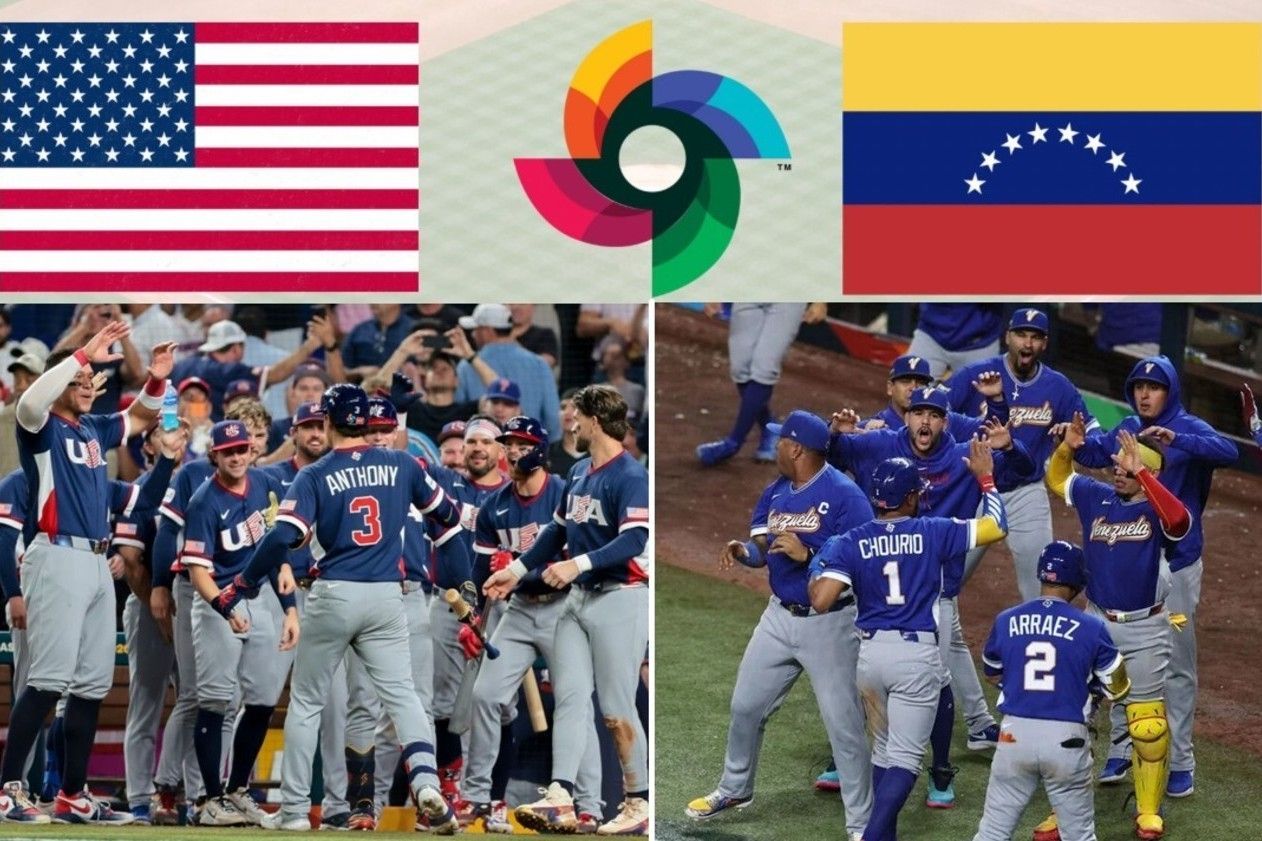
MIAMI — The 2026 World Baseball Classic comes down to one game. Team USA faces Venezuela in the WBC championship Tuesday night at loanDepot Park. First pitch is set for 8 p.m. ET on FOX.
Both squads finished their WBC campaigns with identical 5-1 records. Both posted matching 3.00 ERAs through 54 innings of tournament play. On paper, this is as tight as a WBC final gets. But a deeper look at the numbers and the circumstances reveals that one team carries a real, if narrow, edge heading into the title game.
So which side holds the advantage? The answer comes down to three areas that could decide the WBC championship.
Team USA’s on-base machine vs. Venezuela’s power lineup
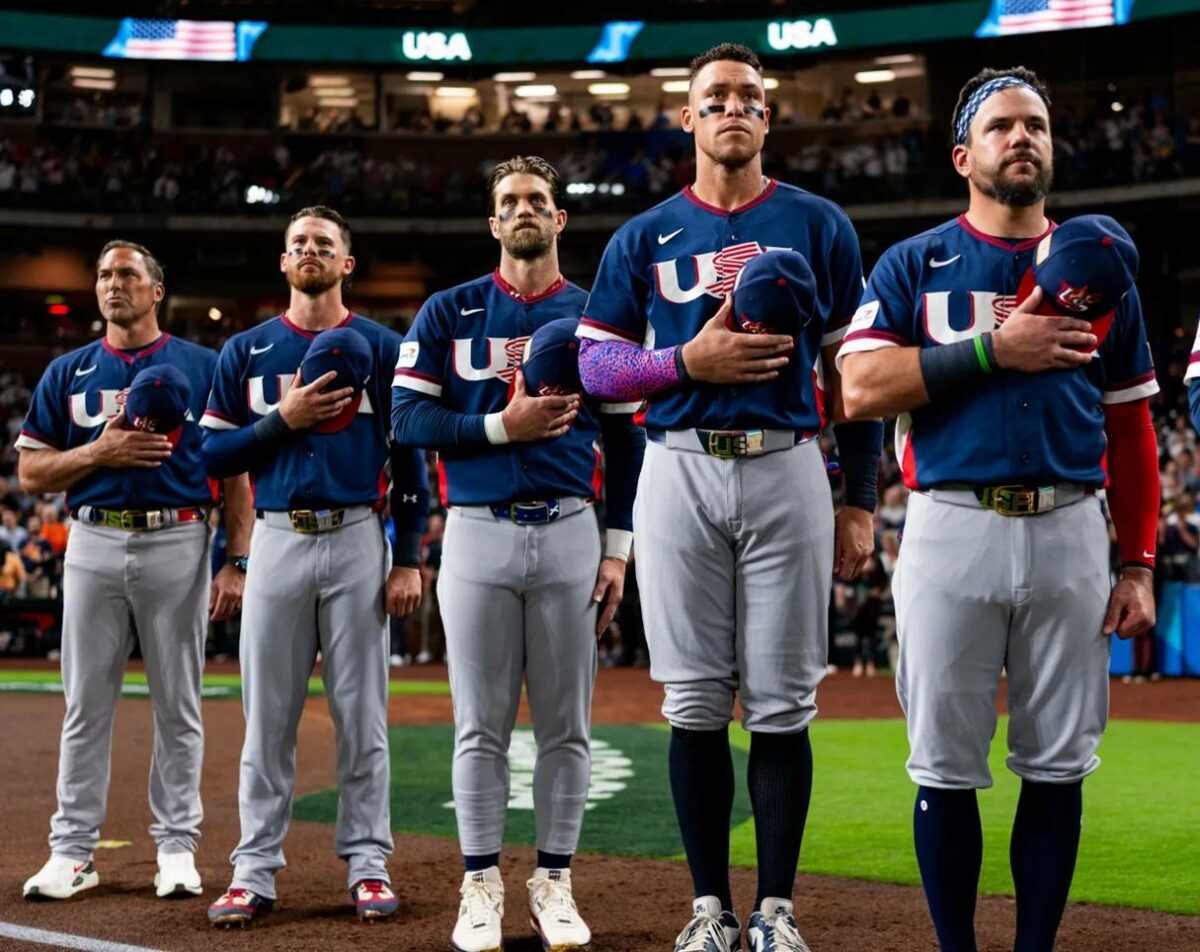
The offensive profiles of these two WBC finalists look similar at first glance. Both have launched nine home runs. Team USA is hitting .272 and Venezuela .271. The gap widens when you factor in plate discipline.
Team USA has drawn 38 walks through six WBC games. Venezuela has drawn 24. That difference is reflected in on-base percentage, where the Americans hold a .393 mark compared to Venezuela’s .346. The overall OPS tilts in the same direction, with Team USA at .854 and Venezuela at .804.
That matters because walks create traffic. Traffic forces pitchers into the stretch and extends innings. Against a Venezuelan pitching staff that has issued 18 walks (double Team USA’s nine), the American lineup could find plenty of opportunities to put crooked numbers on the board.
Venezuela counters with arguably the most dangerous collection of bats in the WBC. Ronald Acuna Jr. has been electric all tournament. Maikel Garcia has been the team’s best hitter, going 10-for-23 (.435) with a 1.110 OPS. Luis Arraez (.348 average, two homers, 10 RBIs) has been a machine at the plate. Eugenio Suarez adds cleanup thump.
Simple bar chart: the two biggest “process” differences
(Scale is relative; higher OBP is better, lower WHIP is better.)
OBP
USA | ████████████████████ 0.393
Venezuela| █████████████████ 0.346
WHIP (lower is better)
USA | ████████ 0.87
Venezuela| ███████████ 1.09
Comparative tables
The final is at in (8 p.m. ET, March 17). carries the broadcast.
Offense (team totals and core rates)
All official team hitting stats from MLB WBC team leaderboards.
| Category | Team USA | Venezuela | Edge (why it matters) |
| Games played | 6 | 6 | Even sample size context |
| Runs | 42 | 38 | USA +4 (more total production) |
| Runs per game | 7.00 | 6.33 | Slight USA edge in scoring rate |
| AVG / OBP / SLG | .272 / .393 / .461 | .271 / .346 / .458 | USA OBP gap is the separator |
| OPS | .854 | .804 | USA higher overall |
| HR | 9 | 9 | Power output essentially equal |
| 2B | 12 | 11 | Slight USA edge in XBH volume |
| Walks / Strikeouts | 38 / 48 | 24 / 41 | USA draws 14 more walks (pressure) |
| SB / CS | 6 / 0 | 8 / 2 | Venezuela more aggressive; USA more efficient |
Quick read: This isn’t “USA has more power.” It’s USA gets on base far more often (OBP .393 vs .346), forcing longer innings and more traffic for opposing pitchers.
Pitching (team-level run prevention and dominance indicators)
All official team pitching stats from MLB WBC team leaderboards.
| Category | Team USA | Venezuela | Edge (why it matters) |
| Record | 5–1 | 5–1 | Even |
| ERA | 3.00 | 3.00 | Even on ERA alone |
| WHIP | 0.87 | 1.09 | USA: fewer baserunners allowed |
| Opp AVG | .194 | .209 | USA suppresses hits better |
| IP | 54.0 | 54.0 | Even workload |
| K / BB | 76 / 9 | 57 / 18 | USA strike-throwing + swing-and-miss edge |
| K/9 | 12.67 | 9.50 | USA misses more bats (important vs elite lineups) |
| BB/9 | 1.50 | 3.00 | Venezuela issues more free passes |
| HR allowed | 11 | 8 | Venezuela has allowed fewer HR (real counterpoint) |
FIP-style comparison (not official WBC output): “FIP minus constant”
Using the standard FIP equation, FIP = ((13×HR)+(3×(BB+HBP))−(2×K))/IP + constant.
| Metric (computed from official HR/BB/HBP/K/IP) | Team USA | Venezuela | Interpretation |
| FIP (minus constant) | 0.61 | 1.04 | Lower is better; USA ahead due to K/BB dominance |
Key implication: Both teams show the same ERA, but the process (WHIP + K/BB + FIP-core) tilts to USA.
Bullpen depth and leverage readiness (usage + constraints)
This table combines official context about bullpen usage patterns and WBC rest rules.
| Category | Team USA | Venezuela | Edge |
| Primary late-inning script (recent high leverage) | (7th), (8th), (9th) used as planned in key wins | Venezuela needed a multi-arm bridge in the semifinal after exited early; closer finished | USA has a clearer “A” lane and, crucially, more rest |
| Rest/schedule factor entering final | USA had an off-day and avoided back-to-backs in this tournament | Venezuela played the semifinal the night before and used a large bullpen share | USA advantage in availability and leverage stamina |
| Pitch-count/rest constraints | WBC rules restrict pitchers after 30+ pitches (1 day) and 50+ pitches (4 days) | Venezuela managed pitch counts in the semifinal specifically to keep relievers available; only hit the 30-pitch “no next-day” mark | Venezuela did good damage control—but still enters with less rest |
| MLB club “input” uncertainty | Reuters reported availability questions around key relievers (club workload gatekeeping) | Not highlighted as strongly on Venezuela’s side in reporting, but always a WBC factor | Slight volatility to USA late inning certainty depending on approvals |
Injuries and availability snapshot (known/confirmed vs variable)
| Team | Item | What’s known now | Why it matters |
| Venezuela | Losses impacting roster construction | Venezuela advanced despite not being able to roster and due to injury | Removes a premier bat/infielder and a frontline starter option depth |
| Venezuela | Rotation depth concern | Official preview framing identifies rotation depth beyond and other top arms as a question mark | Increases odds of bullpen-heavy game scripts |
| Team USA | Starter workload | is the announced starter; Reuters reported he’s expected to be on a limited pitch count due to recent health issues (not detailed in MLB’s preview writeups) | If true, this increases early bullpen innings and magnifies reliever availability risk |
| Team USA | Late-inning relief workload | MLB notes the top leverage trio would be working for the third time in five days; Reuters notes similar workload context and club input | Affects whether the clean “7-8-9” plan is fully usable |
Matchups (starting pitchers + recent WBC results + meaningful batter/pitcher notes)
Final matchup details are from MLB’s official final preview and related MLB reporting.
| Matchup angle | Team USA | Venezuela | Why it matters |
| Announced starter | (RHP) | (LHP) | Both starters have shown volatility in this tournament |
| Starter’s key recent WBC outing | McLean: 3 ER in 3 IP vs Italy (pool play) | Rodriguez: 3 R in 2⅔ IP vs Dominican Republic (pool play), with 2 HR allowed | Both lineups have seen the starter type struggle quickly |
| Tactical lineup depth lever | USA has multiple viable starters at key spots (catcher/3B/CF), allowing matchups vs the LHP | Venezuela has many lineup combinations, but also may need to manage fatigue from bullpen-heavy semifinal | USA’s “choice set” is a subtle edge in a one-game final |
| Example split that could influence USA’s right-handed stacking vs LHP | is described as 9-for-27 with 3 HR and 1.160 OPS vs Rodriguez | Not applicable (same data point) | Suggests USA can materially optimize the lineup for this pitcher profile |
| Home designation | USA is designated home after a coin flip (same 5–1 records entering) | Visiting designation | Marginal—last at-bat can matter, especially with WBC extra-innings rules |
| Recent WBC head-to-head | USA leads WBC meetings 3–2; last meeting was USA 9–7 in the 2023 quarterfinal decided by grand slam | Same | Historical edge is modest; the bigger value is psychological/memory of ’23 |
Pitching process tilts toward the Americans
The matching 3.00 ERAs are where the pitching similarities end. Team USA’s WHIP of 0.87 is significantly better than Venezuela’s 1.09. The Americans have held opposing hitters to a .194 average. Venezuela has allowed a .209 mark. The strikeout-to-walk ratio is where the gap becomes a chasm. Team USA has struck out 76 batters and walked just nine through six WBC games. Venezuela has fanned 57 and issued 18 free passes.
In terms of a FIP-style comparison using official WBC tournament data, the process numbers favor Team USA across the board. The Americans miss more bats (12.67 K/9 vs. 9.50) and give up fewer free passes (1.50 BB/9 vs. 3.00). Venezuela’s pitchers have allowed fewer home runs (eight vs. 11), which is a legitimate counterpoint. But the overall pitching profile gives Team USA the edge in run prevention.
The bullpen battle and the rest factor
This is where the WBC final could be won or lost. Both starters carry question marks. Team USA will hand the ball to Mets right-hander Nolan McLean. The rookie, just eight MLB starts into his career, struggled against Italy in pool play. He gave up three earned runs in three innings in that WBC start. But he owns some of the nastiest stuff in baseball and called the opportunity a dream.
“I would think I’m probably around 65 or 70 [pitches] just with the ramp-up,” McLean said Monday. “But just until Mark comes and gets me.”
Venezuela will counter with Diamondbacks left-hander Eduardo Rodriguez. His lone WBC start was rough. He allowed three runs in 2 2/3 innings against the Dominican Republic in pool play, including two home runs.
With both starters on short leashes, the bullpens will likely decide the WBC championship. And this is where scheduling gives Team USA a tangible advantage. The Americans played their WBC semifinal on Sunday and had Monday off. Venezuela played its semifinal Monday night and will be right back on the field Tuesday with less than 24 hours of rest.
Venezuela’s bullpen was magnificent against Italy. Six relievers combined for 7 2/3 scoreless innings after Keider Montero exited early. But that workload means several of those arms logged significant innings just one night before the WBC final. Daniel Palencia, who closed out the Italy win by throwing 98- and 99-mph fastballs, will be working on short rest.
Team USA’s relief corps has been dominant all tournament. David Bednar, Garrett Whitlock and Mason Miller have formed a late-inning trio that opposing WBC lineups have struggled to solve. Miller, who topped 100 mph on 13 of 22 pitches in the semifinal against the Dominican Republic, may or may not be available Tuesday based on workload considerations and input from his MLB club, the Athletics.
Key matchup to watch in the WBC final
Team USA manager Mark DeRosa is expected to stack right-handed bats against the left-handed Rodriguez. Alex Bregman is projected to slot in at third base in place of Gunnar Henderson. SI reported that Bregman is 9-for-27 with three homers and a 1.160 OPS against Rodriguez in his career. That is the kind of matchup data that could influence the entire WBC championship game.
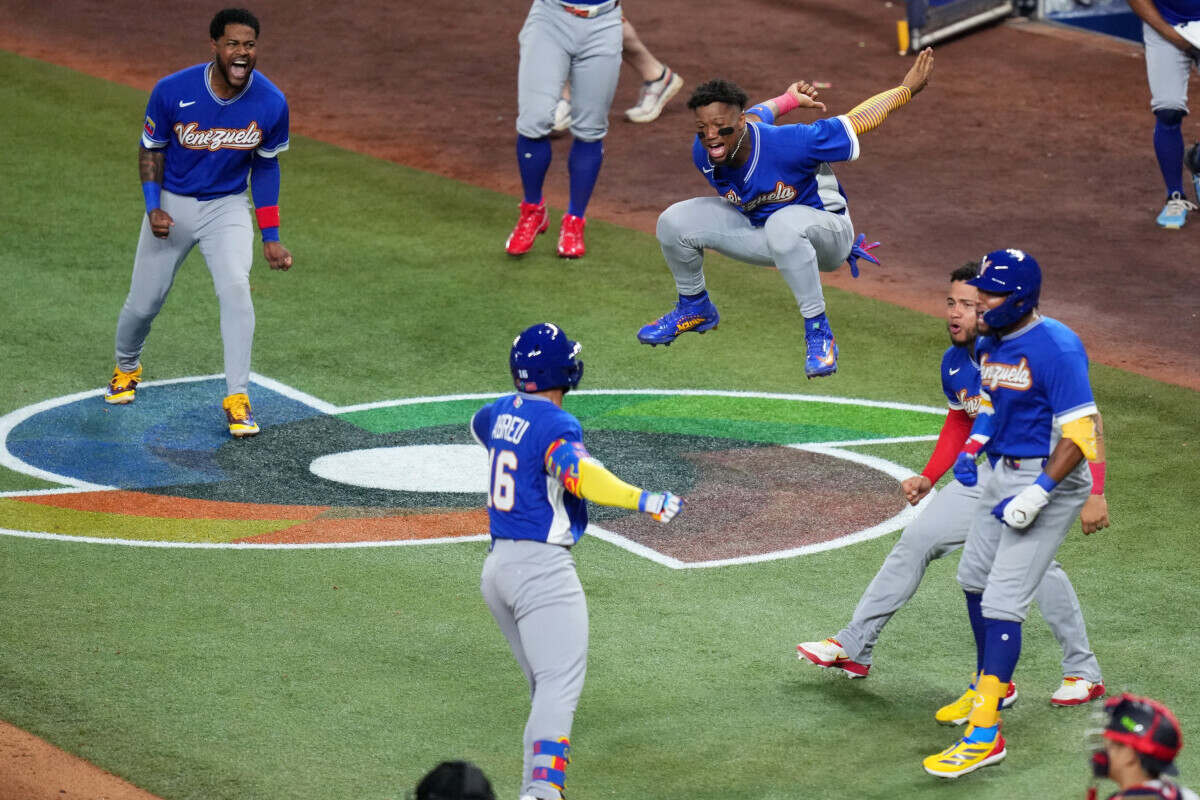
Venezuela also has a familiarity card. Five starters from the 2023 WBC quarterfinal between these teams are expected in the lineup Tuesday: Acuna, Arraez, Suarez, Gleyber Torres and William Contreras. Former Yankee Torres had a strong semifinal, drawing a key seventh-inning walk that sparked the comeback against Italy.
Team USA won that 2023 WBC quarterfinal 9-7, a slugfest decided by a grand slam. Both managers, DeRosa and Venezuela’s Omar Lopez, return from that game. The Americans lead the all-time WBC series 3-2.
The verdict on the WBC final
Team USA holds a narrow but real advantage. The on-base pressure, the pitching process numbers (WHIP, K/BB) and the extra day of rest all tilt toward the Americans. BetMGM has the U.S. listed as a -300 favorite vs. +240 for Venezuela. The estimated win probability sits around 56-44 in favor of Team USA.
But Venezuela’s WBC path has been paved with comebacks. They trailed Japan in the quarterfinals and Italy in the semifinals before rallying to win both games. Acuna, Garcia and Arraez give them bats capable of flipping any WBC game in a single inning.
“We have to come tomorrow and play the same way we played against Japan, against Italy,” Acuna said after Monday’s WBC semifinal win. “And we have to show the world who Venezuela is.”
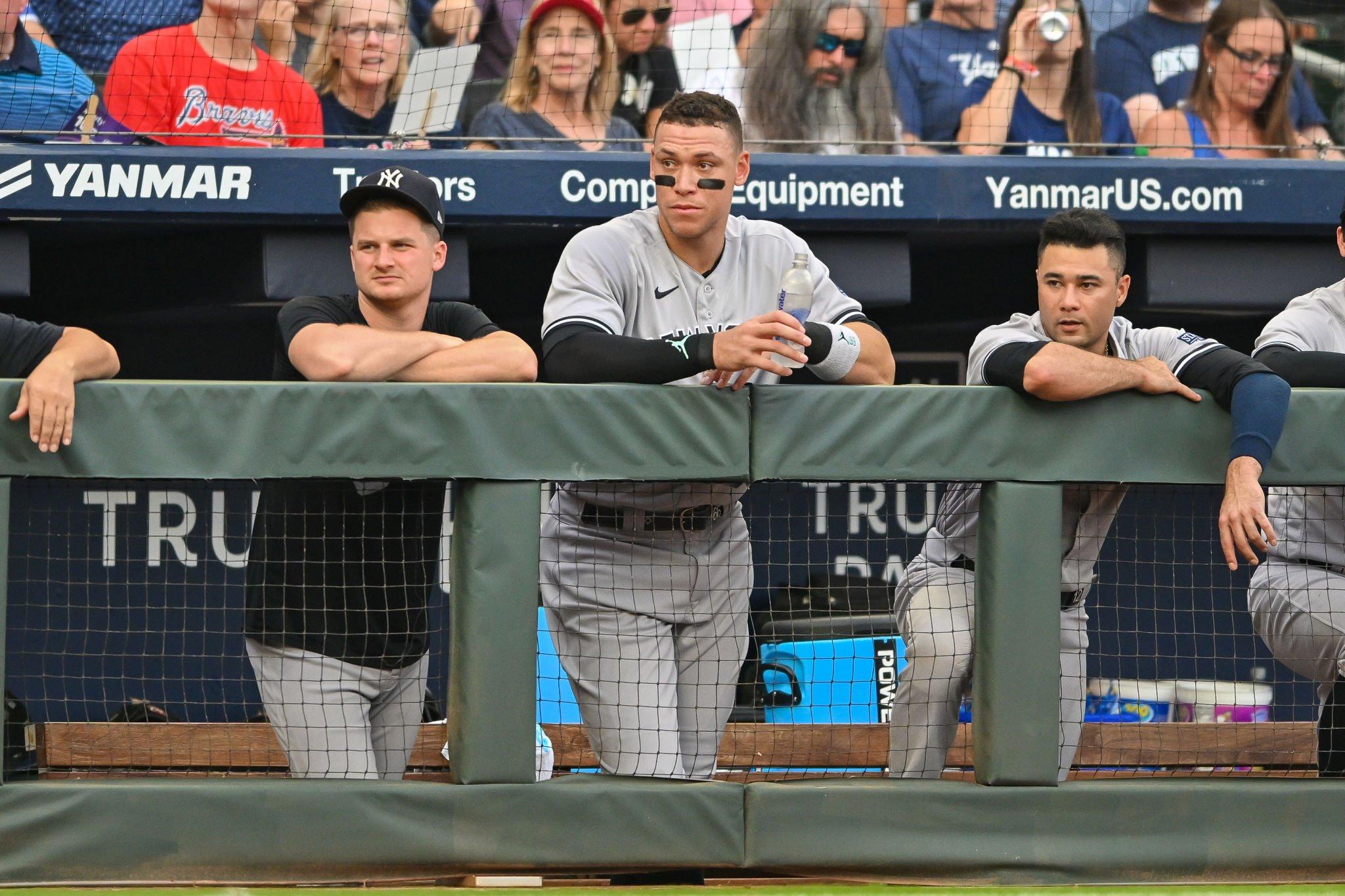
Yankees captain Aaron Judge and Team USA stand in the way. The WBC title has eluded the Americans since 2017. For Judge, it is a chance to lift his first international trophy. For Venezuela, it is a chance to make history in the franchise’s first WBC final.
One game. Tuesday night. The biggest stage the World Baseball Classic has ever produced.
What do you think? Comment your pick below.