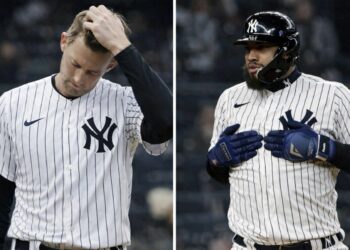
NEW YORK — When Anthony Volpe went on the injured list with a shoulder problem, the Yankees found themselves searching for a shortstop. The search has not gone well. Wednesday night it went worse than anyone expected, and it did so while carrying a $32 million price tag.
Aaron Boone made a bold call for the second game of the Oakland Athletics series. He started Ryan McMahon at shortstop, a position McMahon had almost no major league experience at, in order to keep Amed Rosario in the lineup at third base after Rosario’s two-home run night on Tuesday. Jose Caballero, the Yankees’ usual fill-in shortstop while Volpe recovers, was benched.
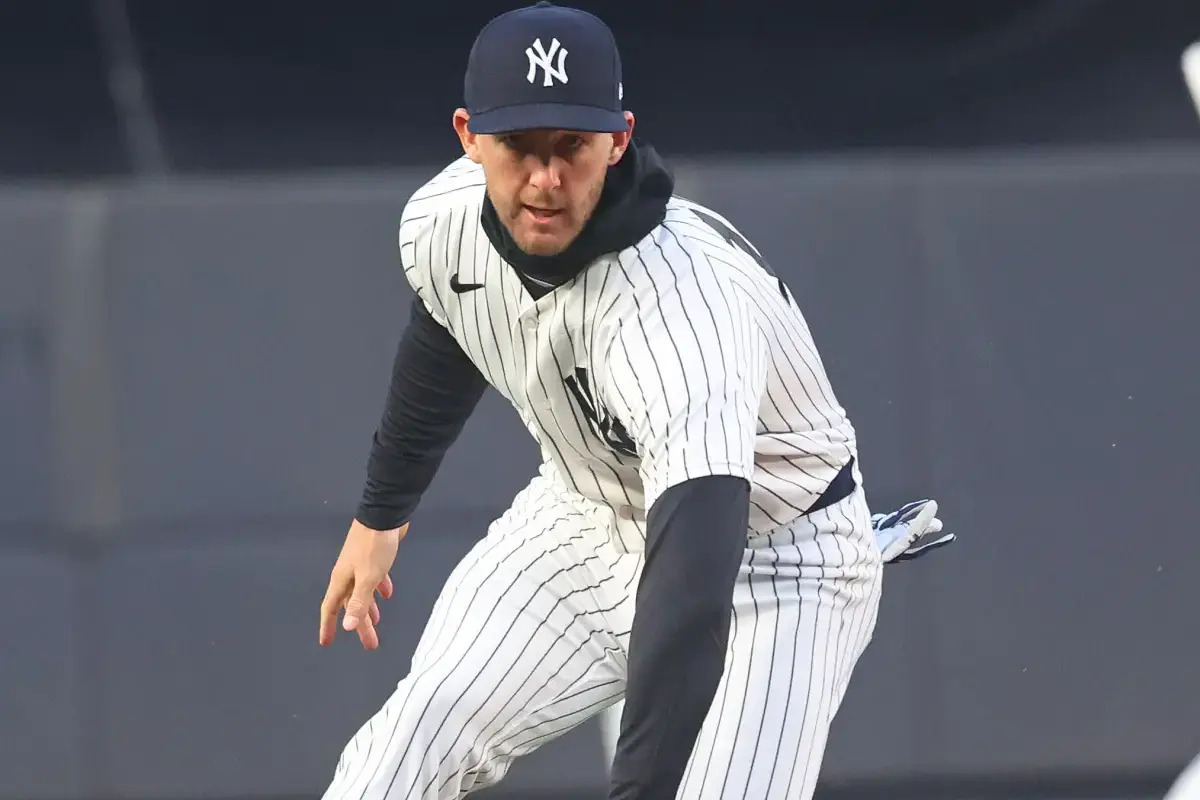
The result was a 3-2 loss. McMahon went 0-for-3 with two strikeouts, a walk, and a fourth-inning double play that drew audible boos from the Yankee Stadium crowd. He handled five assists defensively without an error. But the defensive contribution could not offset what happened, or didn’t happen, at the plate.
The Yankees drop to 8-3 and will need Thursday’s rubber game to take a fourth consecutive series.
The decision to play McMahon at shortstop
Boone’s reasoning was understandable from a lineup construction standpoint. Rosario hit two home runs and drove in four on Tuesday. Caballero was batting just .129 with a 16 wRC+ through the first week and a half of the season. With right-hander Luis Severino on the mound for Oakland, the matchups suggested playing the left-handed Rosario. Keeping both Rosario and McMahon in the lineup meant one of them had to play short.
The Yankees had given McMahon reps at shortstop during spring training specifically so he could serve as a backup option at the position if needed. He made two brief late-inning appearances at short for Colorado in 2020, totaling three innings across the entire season. Wednesday was his first full regular-season start at shortstop in his career. He has played more than 700 games at third base, 244 at second base, and 70 at first base. Shortstop is unfamiliar territory.
The fielding test came immediately. In the first inning, McMahon ranged to his backhand and bounced his throw to first base. Ben Rice saved him with a pick to complete the out. It was not clean, but it held. McMahon finished with five assists and no errors on the night. Defensively, the experiment survived. Offensively, the same problems followed him from third base to short.
Part of Boone’s thinking was that a change of position might shake something loose for McMahon mentally. A new spot, new responsibilities, a different view of the field. Maybe that shift in routine would help him find his stride at the plate.
It did not. McMahon finished Wednesday at 2-for-26 on the season with a .077 batting average and a .350 OPS. He has struck out 13 times in 26 at-bats. Half his plate appearances have ended in a punchout. His career wRC+ entering the game was 88, meaning he was already slightly below average over his career. His 2026 numbers are far worse than that baseline.
The Volpe parallel Boone cannot afford to repeat
The concern among Yankees fans is not just that McMahon is struggling. It is that Boone may handle it the way he handled Anthony Volpe last season, backing a struggling player with public confidence long past the point where adjustments were warranted.
Boone’s full defense of McMahon, delivered to the New York Daily News, captured the mindset.
“I mean, Mac’s a good major league hitter. It’s 10 games in, okay? He’s scuffling right now, but the reality is, the last 3 games, he’s been on base 4 times too with walks and hits and big at-bats,” Boone said. “We want him to improve even who he’s been obviously in his career, and he’s off to a slow start right now, but a number of our guys are as well. He’ll get it rolling and trust that he will, especially against some of these good right-handed pitchers.”
The walk total is genuine. McMahon has drawn seven walks in 11 games, and his 27.9 percent chase rate is slightly better than league average. He is being selective. But selectivity without contact does not drive in runs. His two hits are both singles. The Yankees went 1-for-7 with runners in scoring position on Wednesday and lost by a single run for the third time this season.
Jose Caballero was always a stopgap, a speed-and-defense option whose bat was never expected to carry a lineup spot. He is hitting .129 through 11 games. What the Yankees did not plan for was McMahon, their intended left-handed power source at third, also failing to contribute. Boone’s decision to move McMahon to shortstop was an attempt to solve both deficiencies at once. Rosario stays in the lineup at third. McMahon gets at-bats. The batting order gets a proven left-handed presence against right-handers. The logic was sound. The execution was not.
A $32 million problem the Yankees cannot hide
Talkin’ Yanks@X
The financial structure of McMahon’s contract makes this situation more than just an April slump. The Yankees assumed full responsibility for McMahon’s deal when Brian Cashman traded for him from Colorado last July. The organization gave up minor league pitchers Josh Grosz and Griffin Herring to acquire him.
McMahon is owed $16 million for the 2026 season and another $16 million in 2027. The total remaining commitment is $32 million. The Yankees are not a team that panics on the basis of 26 at-bats in April. But they are also not a team that can afford to carry a $16 million player who is hitting .077 deep into a pennant race.
McMahon’s career history offers some cause for patience. He hit 20 or more home runs in six of his first nine major league seasons. He made the All-Star Game in 2024. He has a proven track record as a run-producer when his swing is functioning. His hard-hit rate this season still sits near 91 percent of his career level, suggesting the contact quality is present even when contact frequency is not.
Aaron Boone on Ryan McMahon:
"I mean, Mac's a good major league hitter. It's 10 games in, okay? He's scuffling right now, but the reality is, the last 3 games, he's been on base 4 times too with walks and hits and big at-bats.
The problem is frequency. A 37.9 percent strikeout rate from a player running at the 11th percentile in sprint speed leaves no margin. He cannot beat out weak contact. He cannot manufacture hits. He has to barrel the ball, and he is not doing it consistently enough.
But his performance away from Coors Field in Colorado was a documented concern before the trade. He hit .216/.302/.362 away from the altitude-boosted environment in Denver. Since arriving in New York, his combined numbers over 61 games and 214 plate appearances are .192/.304/.302. The sample is large enough to raise questions.
The patience argument and its limits
Inside the Yankees clubhouse, the early slump is being treated as a normal part of a long season. Boone and the organization have not wavered publicly. McMahon made the All-Star Game in 2024 and hit 20 or more home runs in six of his first nine major league seasons. A career 88 wRC+ before this season shows he was already a slightly below-average hitter over his full body of work, but he was good enough in the right circumstances to be a viable starting third baseman.
The Yankees are 8-3 and hold a 3.5-game lead in the AL East. There is time for McMahon to turn this around. Volpe is expected back around May 1, which resolves the shortstop situation regardless of what happens with McMahon. The third base question, however, has no defined end date.
If McMahon’s numbers do not improve meaningfully before the trade deadline, the conversation will extend beyond starting pitching for the first time in years. There are no obvious internal solutions at third base. An outside upgrade would require real capital or mid-season spending the organization may resist. The Yankees have $32 million invested in a player who is hitting .077 with a .350 OPS after 11 games, and the Volpe parallel is sitting right there for anyone who watched this manager’s pattern last season. Boone’s confidence may be genuine. The results, so far, are not backing it up.