


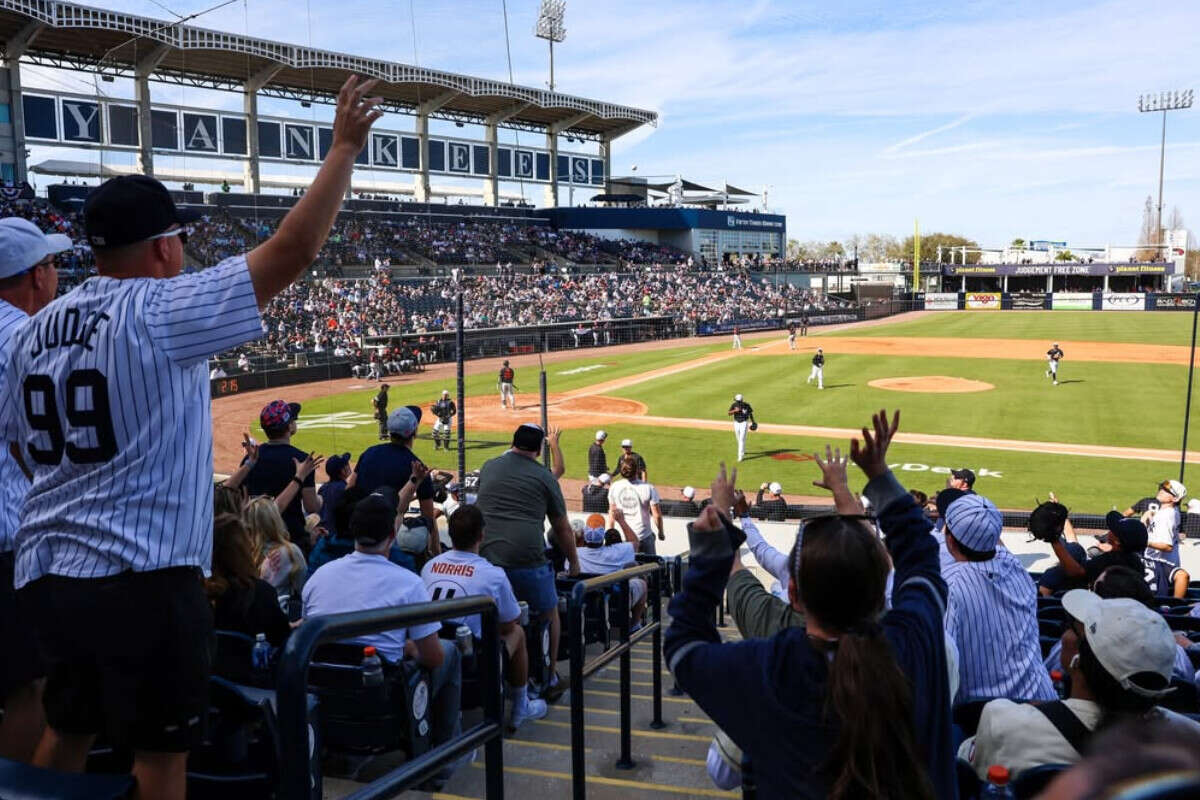
NORTH PORT, Fla. — The biggest rule change in a generation arrives in less than two weeks. The automated ball-strike challenge system will debut across every Major League ballpark this season, and the New York Yankees will be under the spotlight from pitch one. Their March 25 opener against the Giants in San Francisco is Netflix’s first-ever MLB broadcast.
Yankees manager Aaron Boone has been watching the system all spring. He is not a fan.
“I don’t like it,” Boone said before the Yankees’ 7-6 loss to the Braves on Friday. “I don’t want it. I think the umpires are trained really well now and graded really fairly. I’ve seen the zone get more consistent umpire-to-umpire.”
Boone’s real concern about the Yankees and ABS
The Yankees manager is not objecting to the technology. His issue is the impact the challenge system will have on the flow of the game.
“It’s a whole new component,” Boone said. “A guy strikes out a guy to end the sixth inning in a big spot and he’s going off the field and it’s overturned. Now he’s back in the fire. Hopefully that serves us well, but that’s now part of the game. Is that a great thing? I don’t know.”
He also raised the scenario every team will face when its challenges run out. “There’s a human element of ‘This team is out of challenges and the umpire got one wrong,'” Boone said.
Boone would prefer MLB go fully automated rather than use a hybrid system.
“I’m kind of one way or the other,” he said. “Then there’s no consternation. You want it or you don’t.”
How the system works for the Yankees and every MLB team

Each team gets two challenges per game. Only the batter, pitcher or catcher can initiate a challenge by tapping their helmet or cap immediately after a call. No help from the dugout is allowed. Twelve Hawk-Eye cameras in every ballpark track each pitch. A graphic showing the ball’s location appears on the scoreboard within about 15 seconds. If the challenge succeeds, the team keeps it.
During spring training testing, teams averaged about four challenges per game and succeeded 52.2 percent of the time. Catchers led all challengers at a 56 percent overturn rate, followed by hitters at 50 percent and pitchers at 41 percent.
Aaron Judge stands to gain but Austin Wells could lose an edge
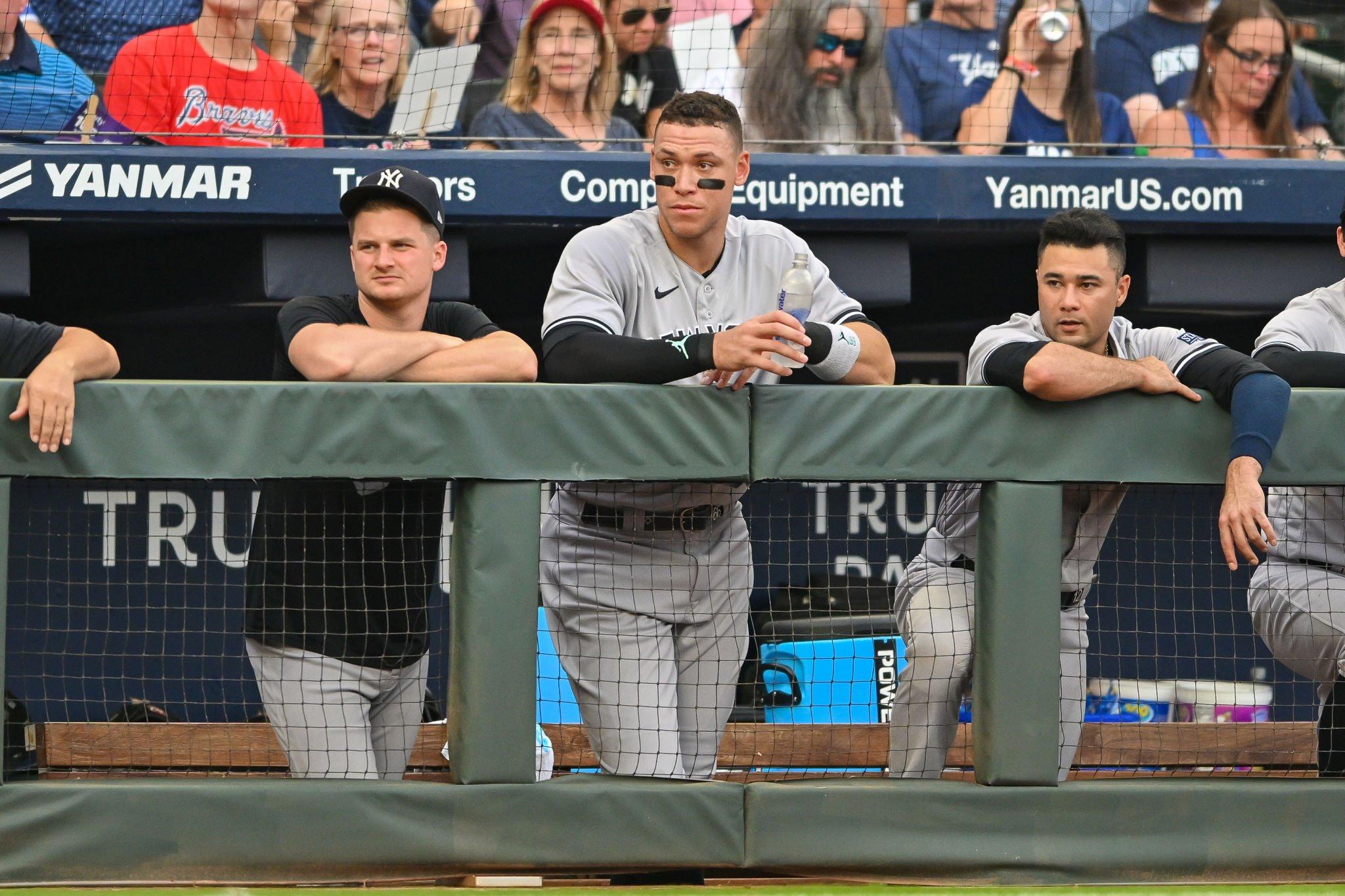
The ABS system is a double-edged sword for the Yankees. On offense, it could be a major boost for the Yankees lineup. Aaron Judge, the Yankees captain and three-time AL MVP, has long been victimized by strikes called on pitches below the zone. At 6-foot-7, umpires have consistently struggled to adjust to his strike zone. A challenge system that corrects those calls could make an already terrifying hitter even more dangerous.
But on defense, the Yankees stand to lose one of their most valuable hidden weapons. Yankees catcher Austin Wells ranked third in all of baseball last season in catcher framing runs, posting a total of 13. His shadow strike percentage, which measures how often he steals calls on pitches at the fringe of the zone, sat at 44.6 percent. Wells was especially skilled at getting strike calls on pitches below the zone, which is ironic given Judge’s struggles with the same calls as a hitter.
All of those stolen strikes helped Yankees pitchers get into favorable counts and generate outs more efficiently. The ABS system puts that advantage at risk. Opposing hitters can now challenge the borderline calls that Wells has been turning into free strikes for the Yankees staff.
The saving grace for the Yankees is that the system is not always on. Challenges are limited. But opposing teams will likely save their challenges for the biggest moments, which could have an outsized impact on late-inning situations when the Yankees need outs the most.
Boone still expects the Yankees to thrive
Despite his reservations, Boone expressed confidence in the Yankees’ ability to work the new system.
“I think we’re going to be good at it. I expect us to be good at it,” Boone said. “I think our guys, offensively speaking, kind of our identity and DNA, is controlling the strike zone. Hopefully that serves us well in this environment.”
The Yankees have reason for optimism on the challenge front. Since the replay system was overhauled in 2015, Boone has been the fifth-most successful manager in overturning calls, winning just over 60 percent of his challenges, per Pinstripe Alley. The Yankees expect that preparation to carry over.
Boone also left the door open for a change of heart. “I might grow to like it,” he said. “I was skeptical about some of the rule changes a couple years ago. And I’m not dead-set that I hate it. It’s fine. I don’t think I love it.”
Ready or not, the challenge era starts with the Yankees on the field on Opening Night. Whether Judge benefits more than Wells loses will be one of the most fascinating subplots of the 2026 season.
What do you think?











Alternatives:
The painful truth is that umps can’t truly see these pitches over, say, 85 mph, and with catchers playing “hide the ball” with umps, the task becomes impossible.
Perhaps a “framer tracker” rather than balls and strikes. Every framed pitch gets called a ball. End of an error.